


Hong Kong and Chinese health authorities each reported nine deaths from the pneumonia-like SARS yesterday, but the former British colony reported only 10 new cases -- the lowest number since the outbreak of the disease here in mid-March.
The new figures brought the total number of deaths in Hong Kong to 179 and infections to 1,621, with the low number of new cases further boosting hopes that the SARS epidemic here has stabilized.
But despite China reporting only nine deaths yesterday, the country has now suffered a death toll of 190. Another 181 new cases brought the total number of infections in China so far to 3,971.
Five of the new deaths occurred in the capital Beijing, as did 114 of the new cases, bringing the death toll in the capital to 96 from 1,741 infections.
Nine cases that had previously been announced as SARS had been misdiagnosed, the health ministry said.
Police in Singapore meanwhile filed criminal charges against a man who defied a home quarantine order, signalling the government's determination to enforce an all-out campaign against SARS.
Chua Hock-seng, a jobless and single 50-year-old, was charged in court while being held in isolation at the central police station after being arrested late Friday at a coffee shop where his presence had caused alarm.
Some 3,000 people are currently under home quarantine for a minimum of 10 days in Singapore for observation after having been potentially exposed to the severe acute respiratory syndrome (SARS) virus, for which there is no cure or vaccine.
The arrest of Chua, who is not classified as a suspected SARS case, followed the passage of tougher quarantine laws, including hefty fines and up to a year in jail for violators, under the Infectious Diseases Act.
SARS has claimed 25 lives and infected at least 203 people in Singapore, a densely populated city-state whose economy has been badly shaken by SARS.
Prime Minister Goh Chok Tong on Friday lashed out at "selfish" people hampering the campaign against SARS, and described Chua's acts as "madness."
"One selfish act can bring an organization to a halt for a few days and if this goes on in a big way, it can bring the whole economy to a [grinding halt]," he said.
Hong Kong's government meanwhile announced it will discuss with the World Health Organization (WHO) the possibility of lifting its month-long travel advisory against the city because of the SARS outbreak, an official said.
Speaking to reporters after a radio program, Secretary for Health Dr Yeoh Eng-kiong said he would discuss the matter with David Heyman, the head of the WHO's communicable diseases section, in a video-conference session at the end of next week.
"I will be discussing with Dr Heyman at the end of next week through video-conference ... to see how we can move forward and for us to continue discussions on the criteria for lifting the travel ban," he said.
The WHO warning has devastated Hong Kong's travel and tourism industry with around 40 percent of flights at the Hong Kong International Airport canceled in April while passenger numbers plummeted 60 percent.
In Canada -- the worst effected nation outside of Asia with more than 20 SARS deaths -- the Montreal-based International Civil Aviation Organization (ICAO) urged its 188 member states to screen all airline passengers arriving from, or transiting through, SARS-infected areas in a bid to halt the virus.
Meanwhile, Malaysia expressed concern Saturday over screening measures for SARS at its land border with Singapore as it reported another suspected case of the disease apparently contracted in the island-state.
Health ministry deputy director general Ismail Merican said screening at the causeway and a second link in southern Johor state bordering Singapore was a major "headache" as some 100,000 people travel through the areas daily.
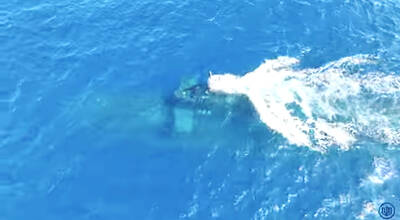
CSBC Corp, Taiwan (台灣國際造船) yesterday released the first video documenting the submerged sea trials of Taiwan’s indigenous defense submarine prototype, the Hai Kun (海鯤), or Narwhal, showing underwater navigation and the launch of countermeasures. The footage shows the vessel’s first dive, steering and control system tests, and the raising and lowering of the periscope and antenna masts. It offered a rare look at the progress in the submarine’s sea acceptance tests. The Hai Kun carried out its first shallow-water diving trial late last month and has since completed four submerged tests, CSBC said. The newly released video compiles images recorded from Jan. 29 to
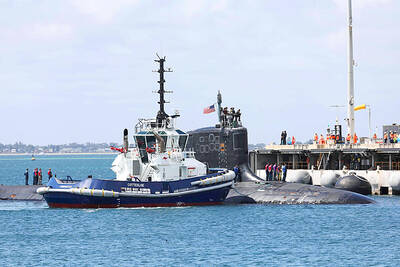
DETERRENCE EFFORTS: Washington and partners hope demonstrations of force would convince Beijing that military action against Taiwan would carry high costs The US is considering using HMAS Stirling in Western Australia as a forward base to strengthen its naval posture in a potential conflict with China, particularly over Taiwan, the Wall Street Journal reported on Saturday. As part of its Indo-Pacific strategy, Washington plans to deploy up to four nuclear-powered submarines at Stirling starting in 2027, providing a base near potential hot spots such as Taiwan and the South China Sea. The move also aims to enhance military integration with Pacific allies under the Australia-UK-US trilateral security partnership, the report said. Currently, US submarines operate from Guam, but the island could
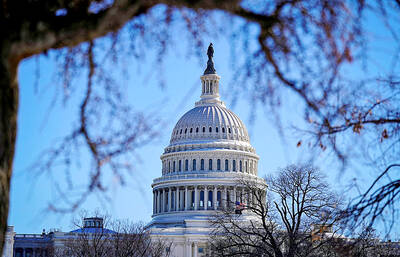
RESTRAINTS: Should China’s actions pose any threat to Taiwan’s security, economic or social systems, China would be excluded from major financial institutions, the bill says The US House of Representatives on Monday passed the PROTECT Taiwan Act, which states that Washington would exclude China from participating in major global financial organizations if its actions directly threaten Taiwan’s security. The bill, proposed by Republican Representative Frank Lucas, passed with 395 votes in favor and two against. It stipulates that if China’s actions pose any threat to Taiwan’s security, economic or social systems, the US would, “to the maximum extent practicable,” exclude Beijing from international financial institutions, including the G20, the Bank for International Settlements and the Financial Stability Board. The bill makes it clear that China must be prepared

Taiwanese trade negotiators told Washington that Taipei would not relocate 40 percent of its semiconductor production to the US, and that its most advanced technologies would remain in the nation, Vice Premier Cheng Li-chiun (鄭麗君) said on Sunday. “I told the US side very clearly — that’s impossible,” Cheng, who led the negotiation team, said in an interview that aired on Sunday night on Chinese Television System. Cheng was referring to remarks last month by US Secretary of Commerce Howard Lutnick, in which he said his goal was to bring 40 percent of Taiwan’s chip supply chain to the US Taiwan’s almost


 RSS
RSS