


A general from Iraqi President Saddam Hussein's army has been captured in southern Iraq and is being pressed to provide strategic information, British officers said yesterday. An Iraqi official said 4,000 Arab volunteers have arrived in Iraq, eager to carry out suicide attacks against US and British forces.
Group Captain Al Lockwood, a British spokesman, said the general -- the highest-ranking Iraqi prisoner of war thus far -- was captured in the southern city of Basra
"We'll be asking him quite politely if he's willing to assist us to continue our operations against the paramilitary forces in Basra," Lockwood said.
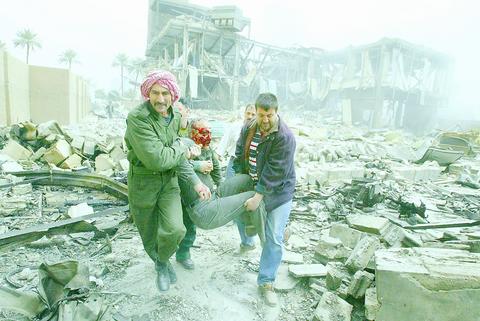
PHOTO: AFP
Lockwood also said Royal Marine Commandos killed a Republican Guard colonel who apparently was sent to Basra to strengthen the resolve of the defense forces, who are encircled by British troops.
Four American infantrymen were killed in a suicide bomb attack in Iraq on Saturday, and yesterday a man in civilian clothes rammed a white pickup truck into a group of US soldiers standing by a store at their base in Kuwait.
Between 10 and 15 people were injured, said Lieutenant Colonel Larry Cox, public affairs officer at Camp Udairi. He had no immediate information on the fate of the driver.
General Tommy Franks, commander of the allied coalition, said he was unsure whether the two incidents were linked. He called the suicide attack "pure terrorism" and said his troops would henceforth exercise more caution in dealing with Iraqis.
Along the approach routes to Baghdad, some US units have paused while supply lines are shored up, but others were engaged in battles to clear the way for an all-out assault. US and British warplanes have focused three-quarters of their strikes in recent days on Republican Guard positions defending the capital.
The US Central Command said the latest targets hit by allied aircraft included military facilities at the Abu Garayb Presidential Palace, the Karada military intelligence complex and the barracks of a major paramilitary training center, all in different sectors of Baghdad.
Several telephone exchanges in the city also were hit yesterday, as well as a train loaded with Republican Guard tanks.
Although allied commanders have been unflaggingly upbeat about the progress of the war, US soldiers in the field were jolted by news of Saturday's car bombing in which an Iraqi soldier posing as a taxi driver gestured for help at a checkpoint near the city of Najaf, then blew up his car as soldiers approached.
"It's a shame they are doing that, because now we're going to have to treat every civilian vehicle like it is hostile," said Staff Sergeant Bryce Ivings, a member of 3rd Battalion, 7th Infantry Regiment.
"If we accidentally kill a civilian because they took a wrong turn and came at us, it will be on their [the Iraqi leadership's] head," he said.
Captain Chris Carter, Ivings' commander, told his men not to take chances.
"I'm not going to trust any civilian vehicle," said Carter. "If you see any hostile intent, take it out."
Iraqi Information Minister Mohammed Saeed al-Sahhaf contended at a briefing yesterday that several Iraqi civilians had been shot dead in their cars by allied soldiers in a mood for vengeance after the suicide attack.
Lieutenant General Hazem al-Rawi, a senior Iraqi defense official, said the suicide attack marked "the beginning of a long path of jihad for Iraqis and Arabs against the invaders." More than 4,000 volunteers have come from numerous Arab countries to participate in suicide attacks, he said.
Iraq's state television reported that the Najaf bomber -- identified as Ali Jaafar al-Noamani, a noncommissioned officer with several children -- was posthumously promoted to colonel and awarded two medals by Saddam. His family reportedly was awarded 100 million dinars -- about US$34,000.
Iraqi Vice President Taha Yassin Ramadan indicated the attack was part of a coordinated effort to thwart the invasion and he raised the specter of terrorism on US or British soil. "The day will come when a single martyrdom operation will kill 5,000 enemies," Ramadan said.
"We will use any means to kill our enemy in our land and we will follow the enemy into its land. This is just the beginning," he said.
Joint Chiefs of Staff Chairman General Richard Myers, in an interview yesterday with the BBC, said the attack was "a reminder that there are some very desperate people out there."
"I would think the toughest fighting is ahead of us," Myers said.
Fighting continued in several areas, notably around the southern cities of Nasiriyah and Basra.
Al-Sahhaf said Iraqi tribesman had shot down an Apache helicopter near Basra.
"They buried the two pilots there," al-Sahhaf said. US Central Command said it had no information of such an incident.
In central Iraq, thousands of US Marines pushed north yesterday in "seek and destroy" missions, trying to clear the route toward Baghdad that they have nicknamed "Ambush Alley."
* US destroys "terrorist facility" in northern Iraq; no operational pause in Iraq, says US General Tommy Franks
* Attacker drives truck into soldiers at US base in Kuwait, says a US military source
* Some US troops say land advance may pause for several weeks; military "reshaping" for next stage, says a UK minister
* Iraq says more than 4,000 Arabs go to Iraq as willing "martyrs" against US-led invasion
* US denies Iraqi claim that its forces bombed the Basra headquarters of Iraq's South Oil Company
* UK forces say they have captured an Iraqi general during clashes with Iraqi units south of Basra
Source: Reuters
Taiwan Semiconductor Manufacturing Co (TSMC, 台積電), the world’s largest foundry service provider, yesterday said that global semiconductor revenue is projected to hit US$1.5 trillion in 2030, after the figure exceeds US$1 trillion this year, as artificial intelligence (AI) demand boosts consumption of token and compute power. “We are still at the beginning of the AI revolution, but we already see a significant impact across the whole semiconductor ecosystem,” TSMC deputy cochief operating officer Kevin Zhang (張曉強) said at the company’s annual technology symposium in Hsinchu City. “It is fair to say that in the past decade, smartphones and other mobile devices were
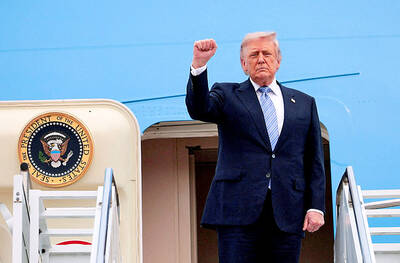
US-CHINA SUMMIT: MOFA welcomed US reassurance of no change in its Taiwan policy; Trump said he did not comment when Xi talked of opposing independence US President Donald Trump yesterday said he has not made a decision on whether to move forward with a major arms package for Taiwan after hearing concerns about it from Chinese President Xi Jinping (習近平). Trump’s comments on Taiwan came as he flew back to Washington after wrapping up critical talks in which both leaders said important progress was made in stabilizing US-China relations even as deep differences persist between the world’s two biggest powers on Iran and Taiwan. “I will make a determination,” Trump said, adding: “I’ll be making decisions. But, you know, I think the last thing we need right
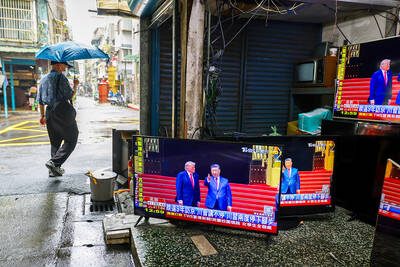
TAIWAN ISSUE: US treasury secretary Scott Bessent said on the first day of meetings that ‘it wouldn’t be a US-China summit without the Taiwan issue coming up’ There were no surprises on the first day of the summit between US President Donald Trump and Chinese President Xi Jinping (習近平), the Mainland Affairs Council (MAC) said yesterday, as the government reiterated that cross-strait stability is crucial to the Asia-Pacific region, as well as the world. As the two presidents met for a highly anticipated summit yesterday, Chinese state media reported that Xi warned Trump that missteps regarding Taiwan could push their two countries into “conflict.” Trump arrived in China with accolades for his host, calling Xi a “great leader” and “friend,” and extending an invitation to visit the White House
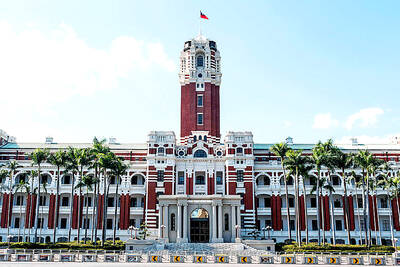
SECURITY: Taipei presses the US for arms supplies, saying the arms sales are not only a reflection of the US security commitment to Taiwan but also serve as a mutual deterrent against regional threats Taiwan is committed to preserving the cross-strait “status quo” and contributing to regional peace and stability, the Presidential Office said yesterday. “It is an undeniable fact that the Republic of China is a sovereign and independent democratic nation,” Presidential Office spokeswoman Karen Kuo (郭雅慧) reiterated, adding that Beijing has no right to claim sovereignty over Taiwan. The statements came after US President Donald Trump warned against Taiwanese independence. Trump wrapped up a state visit to Beijing on Friday, during which Chinese President Xi Jinping (習近平) had pressed him not to support Taiwan. Taiwan depends heavily on US security backing to deter China from carrying


 RSS
RSS