


The US and Britain intended to introduce a new UN Security Council resolution yesterday that would set the stage for war in Iraq by declaring Baghdad in violation of UN demands, council diplomats said.
Britain's UN ambassador, Sir Jeremy Greenstock, was to make the formal introduction, which a spokesman for British Prime Minister Tony Blair has said he hoped would be voted on by mid-March, a signal there would be no invasion of Iraq before that time.
Getting approval will be difficult in face of opposition from France, Russia and China, who have veto power on the 15-member council.
So far only Spain and Bulgaria support the US and Britain while the other nations have spoken in favor of France's position for continuing arms inspections or are uncomfortable in having to make a decision.
To counter the US, French President Jacques Chirac's spokeswoman, Catherine Colona, said France would put forward proposals immediately for more intrusive inspections.
"There is no reason today to interrupt the inspections and go over to another logic that would lead to war," she said.
France earlier this month circulated proposals to Security Council members calling for a tripling of inspectors and UN guards to "freeze" suspected weapons sites, and more spy plane overflights. These proposals are expected to be refined, probably in the form of an informal draft resolution.
The US has been sending senior officials to lobby council nations. Two have already visited Mexico and another went to Africa to talk to officials in Angola, Cameroon and Guinea.
At the same time US President George W. Bush has been making telephone calls to his counterparts in various nations, including Chilean President Ricardo Lagos, whose government has publicly leaned toward the French position but is still undecided.
"It is true that President Bush called President Lagos, another thing is how you interpret that," a Chilean government spokesman said.
"Chile couldn't accept pressures because it has a sovereign and autonomous foreign policy," the spokesman added in Santiago.
He said Chile would have to study the resolution.
On the other side, Chirac and German Chancellor Gerhard Schroeder were scheduled to meet yesterday evening in Berlin to discuss their strategy.
Before the resolution is adopted or rejected Iraqi President Saddam Hussein faces a test on whether or not he will destroy dozens of missiles by this Saturday as ordered last Friday by chief UN inspector Hans Blix.
Destruction of the al-Samoud 2 missiles, which have a range that exceeds UN limits, would be a blow to Iraq as it prepares for a possible invasion by US forces.
If it does not destroy them, the US and Britain could use this as proof Iraq is not cooperating with the UN and that war is justified.
Blix said Iraq's al-Samoud 2 missiles exceeded by 33km the 150km range set by the Security Council in a 1991 resolution.
He ordered Iraq to destroy not only the missiles, but their SA-2 engines, auto-pilots, guidance and control systems, launchers, fuel, oxidizer, casting chambers, equipment and components designed for production and testing as well as software and research used to construct the missiles.
Blix was scheduled to deliver yesterday and today a list of more than 30 unresolved questions about Iraqi disarmament to his advisory board -- called a College of Commissioners -- and composed of some 16 government officials and technical experts from around the world.
After meeting the commissioners, Blix will submit a report to the Security Council in writing by Saturday. That will be followed by an oral presentation to the council, tentatively scheduled for March 7.
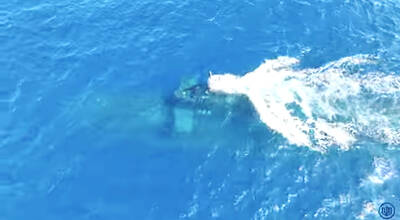
CSBC Corp, Taiwan (台灣國際造船) yesterday released the first video documenting the submerged sea trials of Taiwan’s indigenous defense submarine prototype, the Hai Kun (海鯤), or Narwhal, showing underwater navigation and the launch of countermeasures. The footage shows the vessel’s first dive, steering and control system tests, and the raising and lowering of the periscope and antenna masts. It offered a rare look at the progress in the submarine’s sea acceptance tests. The Hai Kun carried out its first shallow-water diving trial late last month and has since completed four submerged tests, CSBC said. The newly released video compiles images recorded from Jan. 29 to
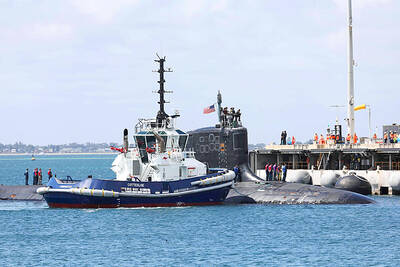
DETERRENCE EFFORTS: Washington and partners hope demonstrations of force would convince Beijing that military action against Taiwan would carry high costs The US is considering using HMAS Stirling in Western Australia as a forward base to strengthen its naval posture in a potential conflict with China, particularly over Taiwan, the Wall Street Journal reported on Saturday. As part of its Indo-Pacific strategy, Washington plans to deploy up to four nuclear-powered submarines at Stirling starting in 2027, providing a base near potential hot spots such as Taiwan and the South China Sea. The move also aims to enhance military integration with Pacific allies under the Australia-UK-US trilateral security partnership, the report said. Currently, US submarines operate from Guam, but the island could
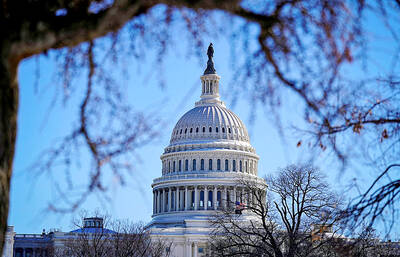
RESTRAINTS: Should China’s actions pose any threat to Taiwan’s security, economic or social systems, China would be excluded from major financial institutions, the bill says The US House of Representatives on Monday passed the PROTECT Taiwan Act, which states that Washington would exclude China from participating in major global financial organizations if its actions directly threaten Taiwan’s security. The bill, proposed by Republican Representative Frank Lucas, passed with 395 votes in favor and two against. It stipulates that if China’s actions pose any threat to Taiwan’s security, economic or social systems, the US would, “to the maximum extent practicable,” exclude Beijing from international financial institutions, including the G20, the Bank for International Settlements and the Financial Stability Board. The bill makes it clear that China must be prepared

Taiwanese trade negotiators told Washington that Taipei would not relocate 40 percent of its semiconductor production to the US, and that its most advanced technologies would remain in the nation, Vice Premier Cheng Li-chiun (鄭麗君) said on Sunday. “I told the US side very clearly — that’s impossible,” Cheng, who led the negotiation team, said in an interview that aired on Sunday night on Chinese Television System. Cheng was referring to remarks last month by US Secretary of Commerce Howard Lutnick, in which he said his goal was to bring 40 percent of Taiwan’s chip supply chain to the US Taiwan’s almost


 RSS
RSS