


DPP Legislator Tsai Chi-fang (
Tsai told a press conference that attempts to register the Taiwan Beer and Kinmen Kaoliang brands in China have reportedly been blocked by Beijing on the grounds that geographical names may not be part of trademark registrations.
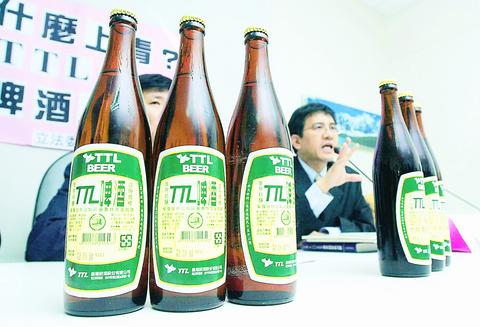
PHOTO: CHIANG YING-YING, TAIPEI TIMES
"It is outrageous that unfair trade practices still exists in the alcohol trade across the Taiwan Strait now that both sides have been admitted to the WTO and Taiwan businessmen have made huge investments on the mainland," Tsai said.
He said the entry of Tsing Tao and Yanjing beer to the local market resulted in an 8-percent decrease in beer sales for the state-owned Taiwan Tobacco and Liquor Co's (TTL) last year.
Tsai said both the US and the EU have approved TTL's applications to market its beer under the "Taiwan Beer" label in those markets.
"It's unreasonable that China still does not allow us to sell Taiwan beer in its market," Tsai said.
A TTL executive told reporters that the company first tried to register its "Taiwan Beer" trademark with Chinese authorities in 1998 and then again in 2000, but both applications were rejected.
He said the company was later given approval to market the beer under the name "TTL Beer. "
The official said the company filed another application for a "Taiwan Beer" trademark last year following China and Taiwan's accession to the WTO.The Kinmen Liquor Co has reportedly encountered similar problems in trying to sell its Kinmen Kaoliang on the Chinese market because it cannot get its trademark registered.
Media reports say that TTL and Kinmen Liquor will ask the government to start negotiations with China over the trademark restrictions under the WTO framework.
Kinmen Liquor is reportedly resisting the opening of Taiwan's market to Chinese liquor products until the problem is resolved.
Media reports also note that TTL's Long Life cigarette brand was registered in China by Xunyang Tobacco and Liquor Group a few years ago, which would mean the company cannot market its cigarettes under that name in China.
Xunyang is reportedly asking for NT$30 million to release the rights to the "Long Life" name.
However, TTL markets China's Zhonghua brand cigarettes locally.
Taiwan Tobacco is reportedly negotiating with the Chinese representatives of Zhonghua cigarettes and Xunyang Tobacco to try to arrange an exchange of trademark registrations.


RESILIENCE: Taiwan plays a key role in semiconductors, energy, information infrastructure and advanced manufacturing, AIT Director Raymond Greene said Taiwan’s continued investment in deterrence and resilience remains vital, especially in uncrewed systems and other emerging technologies, American Institute in Taiwan (AIT) Director Raymond Greene said yesterday. Greene made the remarks at the annual National Strategic Summit on Supply Chain Resilience held by the Research Institute for Democracy, Society and Emerging Technology (DSET), a government-backed think tank. As Taiwan last year became the US’ fourth-largest trading partner and supply chain security is becoming more important, cooperation in emerging technologies continues to deepen between the two countries, he said. The US is committed to accelerating innovation, building key infrastructure, strengthening cooperation

The National Chungshan Institute of Science and Technology yesterday showcased its locally developed variants of the Vision 60 robotic patrol dog, which it plans to deploy on the nation’s outlying territories in the South China Sea. The variants were produced under the Joint Lab project — created by the institute and domestic companies — and assembled with domestically produced motors, lenses and artificial intelligence (AI) systems alongside licensed tech from the US, Missile and Rocket Systems Research Division deputy director Jen Kuo-kang (任國光) told the media event at a military base in Taipei’s Dazhi (大直) area. Taiwan has built up its strengths

RIGHT DIRECTION: Taiwan’s efforts to prevent forced labor include a proposal to ‘fully prohibit’ employers from withholding workers’ documents, an official said Taiwan is to establish a mechanism to restrict imports of goods linked to forced labor, the Executive Yuan said yesterday, after the US proposed imposing additional tariffs on Taiwanese goods over labor concerns. “The Ministry of Labor and the Ministry of Economic Affairs are to establish an interministerial review procedure,” Executive Yuan spokesperson Michelle Lee (李慧芝) said at a news briefing in Taipei. “The government is to use the Foreign Trade Act [貿易法] as the legal basis to restrict imports of goods produced with forced labor” and bring its supply chain governance more in line with international standards on human rights, resilience

NOT IMMEDIATE: Taiwan has a chance to appeal the proposed 10 percent tariff before it starts, while other countries face a 12.5 percent tariff from the trade office Taiwan is among 60 economies determined by the US to have failed to impose or enforce a ban on the importation of goods produced with forced labor, according to a notice released on Tuesday by the Office of the US Trade Representative (USTR), which proposed imposing an additional 10 percent or more tariff on them. The USTR in a statement said that following an investigation, it had determined under Section 301 of the Trade Act of 1974 that the failure of the 60 economies to impose and effectively enforce a prohibition on the importation of goods produced with forced labor is


 RSS
RSS