


Large parts of the British government's latest dossier on Iraq -- which allegedly draws on "intelligence material" -- were plagiarized from published academic articles, it emerged Thursday. The dossier, entitled "Iraq -- its infrastructure of concealment, deception and intimidation," won high praise from the US Secretary of State Colin Powell, in his speech to the UN Security Council on Wednesday.
"I would call my colleagues' attention to the fine paper that the United Kingdom distributed ... which describes in exquisite detail Iraqi deception activities," Powell said.
The first sentence of the document -- issued by the British government -- states, somewhat cryptically, that it "draws upon a number of sources, including intelligence material."
But Glen Rangwala, a lecturer in politics at Cambridge University, England, was not impressed. "I found it quite startling when I realized that I'd read most of it before," he said yesterday.
Four of the report's 19 pages appear to have been copied, with only minor editing and a few insertions, from the Internet version of an article by Ibrahim al-Marashi that appeared in the Middle East Review of International Affairs last September.
The content of six more pages relies heavily on articles by Sean Boyne and Ken Gause that appeared in Jane's Intelligence Review in 1997 and last November. None of these sources is acknowledged.
The document, as posted on the government's Web site at the end of January, also accidentally named four government officials who had worked on it: P Hamill, J Pratt, A Blackshaw and M Khan. It was reposted on Feb. 3 with the first three names deleted.
"Apart from passing this off as the work of its intelligence services," Rangwala said, "it indicates that the UK really does not have any independent sources of information on Iraq's internal policies. It just draws upon publicly available data."
Evidence of an electronic cut-and-paste operation by government officials can be found in the way the dossier preserves quirks from its original sources. One sentence in Marashi's article includes a misplaced comma in referring to Iraq's head of military intelligence during the 1991 Gulf war. The same sentence in the British government's report contains the same misplaced comma.
A government spokesman declined to say why the report's public sources had not been acknowledged. "We said that it draws on a number of sources, including intelligence. It speaks for itself."
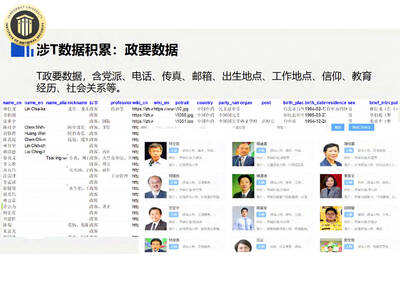
NETWORK-MAPPING PROJECT: The database contains 170 detailed files of Taiwanese politicians and about 23 million records of household registration data in Taiwan China has developed a network-mapping project targeting political figures and parties in Taiwan to monitor public opinion during elections and to craft tailored influence campaigns aimed at dividing Taiwanese society, according to documents leaked by Chinese technology firm GoLaxy (中科天璣). The documents, collected by Taipei-based Doublethink Lab, showed a database was specifically created to gather detailed information on Taiwanese political figures, including their political affiliations, job histories, birthplaces, residences, education, religion and a brief biography about them. Several notable Taiwanese politicians are in the database, including President William Lai (賴清德), former president Tsai Ing-wen (蔡英文), Minister of Foreign Affairs Lin Chia-lung (林佳龍),
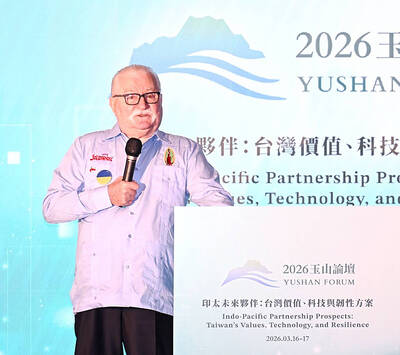
RECOGNITION: Former Fijian prime minister Mahendra Chaudhry said that Taiwan’s New Southbound Policy serves as a stabilizing force in the Indo-Pacific region Taiwan can lead the unification of the Chinese people, Nobel Peace Prize laureate and former Polish president Lech Walesa said in Taipei yesterday, adding that as the world order is changing, peaceful discussion would find good solutions, and that the use of force and coercion would always fail. Walesa made the remarks during his keynote address at a luncheon of the Yushan Forum in Taipei, titled “Indo-Pacific Partnership Prospects: Taiwan’s Values, Technology and Resilience,” organized by the Taiwan-Asia Exchange Foundation with the Ministry of Foreign Affairs. Walesa said that he had been at the forefront of a big peaceful revolution and “if
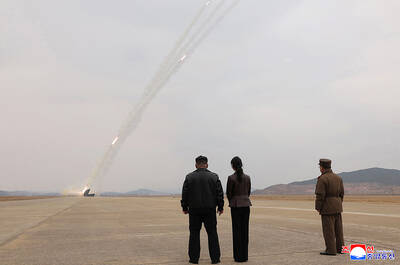
North Korea tested nuclear-capable rocket launchers, state media reported yesterday, a day after Seoul detected the launch of about 10 ballistic missiles. The test comes after South Korean and US forces launched their springtime military drills, due to run until Thursday. North Korean leader Kim Jong-un on Saturday oversaw the testing of the multiple rocket launcher system (MRLS), the Korean Central News Agency (KCNA) said. The test involved 12 600mm-caliber ultra-precision multiple rocket launchers and two artillery companies, it said. Kim said the drill gave Pyongyang’s enemies, within the 420km striking range, a sense of “uneasiness” and “a deep understanding
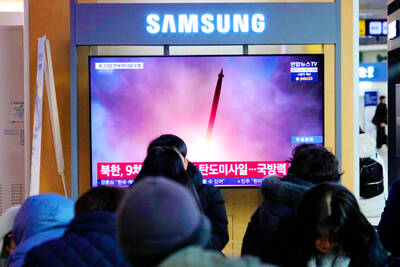
North Korea yesterday fired about 10 ballistic missiles to the sea toward Japan, the South Korean Joint Chiefs of Staff (JCS) said, days after Pyongyang warned of “terrible consequences” over ongoing South Korea-US military drills. Pyongyang recently dashed hopes of a diplomatic thaw with Seoul, Washington’s security ally, describing its latest peace efforts as a “clumsy, deceptive farce.” Seoul’s military detected “around 10 ballistic missiles launched from the Sunan area in North Korea toward the East Sea [Sea of Japan] at around 1:20pm,” JCS said in a statement, referring to South Korea’s name for the body of water. The missiles


 RSS
RSS