


A China Airlines charter flight made a historic landing at Shanghai's Pudong Airport yesterday and returned to Taipei, marking the first time a Taiwanese carrier has touched down in China in 54 years.
Taiwan banned direct air and sea links to China after the two sides split in 1949.
Departing from Pudong Airport at 11am after picking up Taiwanese businessmen, the flight stopped in Hong Kong for 50 minutes and then arrived at the CKS International Airport at about 3:40pm.
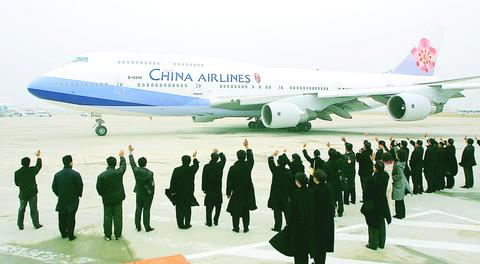
PHOTO: AP
The 243 passengers on the trip were given VIP treatment as China Airlines Chairman Lee Yun-ling (李雲寧) and high-ranking government officials including Minister of Transportation and Communications Lin Ling-san (林陵三) and MAC Vice Chairman Chen Ming-tong (陳明通) extended a warm welcome to the arrivals at the CKS Airport.
Both Lin and Chen praised the historic flight.
"Coming home for the Chinese New Year is what we traditionally do to celebrate this important holiday," Lin said at a welcoming ceremony at the airport.
"[This flight is the result] of the government's effort to enable Taiwanese businessmen and families a more convenient way to come home for such an occasion," Lin said.
"Seeing the happy faces on the passengers who have just come home, I think [the flight] has demonstrated positive interaction between the two sides of the Strait," he said.
In his speech, Chen Ming-tong pointed to President Chen Shui-bian's (
"Charter flights during the Chinese New Year are just the first step," Chen Ming-tong said. "I hope both sides of the Strait can soon negotiate on the issue of direct links in an attempt to better meet the needs of China-based Taiwanese businessmen."
Yeh Huei-te (
"It is such a good feeling to be able to travel to Taiwan from China, via Hong Kong, on the same plane," Yeh said at the airport. Yeh expressed his gratitude to those who made the trip possible.
Six Taiwanese carriers have permission to operate a total of 16 round-trip flights through Feb. 9. They are required to stop briefly in Hong Kong or Macau.
In Shanghai, a traditional Chinese lion dance was performed on the airport runway and champagne toasts were made at a ceremony to mark the flight. Chinese and Taiwanese officials waved as the plane taxied down the Pudong Airport runway.
Taiwanese officials on hand for the ceremony included KMT Legislator John Chang (章孝嚴), along with fellow KMT lawmakers Lee Chuan-chia (李全教) and Tsai Chia-fu (蔡家福), and DPP Legislator Hsu Jung-hsu (許榮淑), who arrived in Shanghai a day before to witness the historic event.
Jan Jyh-horng (詹志宏), director of the Mainland Affairs Council's Department of Planning and Research, was on the flight to Shanghai, but was unable to attend ceremonies in the city because he was engaged in talks with civil aviation officials about flight procedures. Jan, also deputy secretary-general of the Straits Exchange Foundation (SEF), expressed his gratitude to Chinese officials for their cooperation on the historic trip.
A TransAsia Airways charter flight also took off from CKS Airport yesterday and made a stop-over in Macau before arriving at Pudong Airport at 2pm. With 233 passengers on board, the plane arrived at Kaohsiung International Airport at 6:15pm and was greeted by TransAsia Airways chairman Fan Shih-chan (范自強) and airport staff.

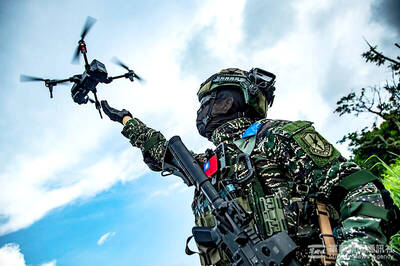
RESILIENCE: Taiwan plays a key role in semiconductors, energy, information infrastructure and advanced manufacturing, AIT Director Raymond Greene said Taiwan’s continued investment in deterrence and resilience remains vital, especially in uncrewed systems and other emerging technologies, American Institute in Taiwan (AIT) Director Raymond Greene said yesterday. Greene made the remarks at the annual National Strategic Summit on Supply Chain Resilience held by the Research Institute for Democracy, Society and Emerging Technology (DSET), a government-backed think tank. As Taiwan last year became the US’ fourth-largest trading partner and supply chain security is becoming more important, cooperation in emerging technologies continues to deepen between the two countries, he said. The US is committed to accelerating innovation, building key infrastructure, strengthening cooperation

The National Chungshan Institute of Science and Technology yesterday showcased its locally developed variants of the Vision 60 robotic patrol dog, which it plans to deploy on the nation’s outlying territories in the South China Sea. The variants were produced under the Joint Lab project — created by the institute and domestic companies — and assembled with domestically produced motors, lenses and artificial intelligence (AI) systems alongside licensed tech from the US, Missile and Rocket Systems Research Division deputy director Jen Kuo-kang (任國光) told the media event at a military base in Taipei’s Dazhi (大直) area. Taiwan has built up its strengths

RIGHT DIRECTION: Taiwan’s efforts to prevent forced labor include a proposal to ‘fully prohibit’ employers from withholding workers’ documents, an official said Taiwan is to establish a mechanism to restrict imports of goods linked to forced labor, the Executive Yuan said yesterday, after the US proposed imposing additional tariffs on Taiwanese goods over labor concerns. “The Ministry of Labor and the Ministry of Economic Affairs are to establish an interministerial review procedure,” Executive Yuan spokesperson Michelle Lee (李慧芝) said at a news briefing in Taipei. “The government is to use the Foreign Trade Act [貿易法] as the legal basis to restrict imports of goods produced with forced labor” and bring its supply chain governance more in line with international standards on human rights, resilience
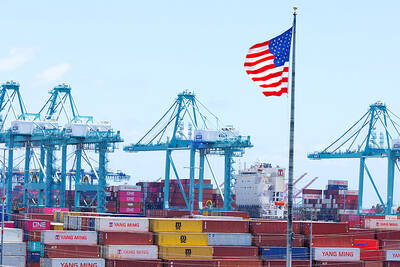
NOT IMMEDIATE: Taiwan has a chance to appeal the proposed 10 percent tariff before it starts, while other countries face a 12.5 percent tariff from the trade office Taiwan is among 60 economies determined by the US to have failed to impose or enforce a ban on the importation of goods produced with forced labor, according to a notice released on Tuesday by the Office of the US Trade Representative (USTR), which proposed imposing an additional 10 percent or more tariff on them. The USTR in a statement said that following an investigation, it had determined under Section 301 of the Trade Act of 1974 that the failure of the 60 economies to impose and effectively enforce a prohibition on the importation of goods produced with forced labor is


 RSS
RSS