


The Kaohsiung District Court yesterday granted a prosecutors' application to detain newly-elected Kaohsiung City Council Speaker Chu An-hsiung (朱安雄) and his wife, Wu Te-mei (吳德美), on charges of bribery.
According to Judge Lin Shui-cheng (林水城), who is also the spokesman of the Kaohsiung District Court, the application was approved at 12:50pm yesterday.
During a raid to search at Chu's Kaohsiung residence on Friday night for evidence of vote-buying in the Kaohsiung City Council speakership election, a team of investigators, including prosecutors and special agents from the Ministry of Justice Investigation Bureau (MJIB), discovered NT$3.5 million in cash, which prosecutors believe was set aside as bribe money.
Chu reported to the MJIB's Kaohsiung City Branch Office around 1pm on Saturday and his wife arrived around 6pm. After a nearly 20-hour interrogation, prosecutors decided to file the detention application, was immediately granted by the court.
"They defended themselves during the interrogation with prosecutors. However, judges did not believe their statements so they approved the prosecutors' request," Lin said.
According to Lin, the court hearing actually began at 1:30am yesterday because, in addition to Chu's and Wu's detention applications, judges also held a hearing to discuss whether to approve another request to detain PFP Kaohsiung City Councilor Wang Ling-jiao (
Prior to being released on bail, Wang had been interrogated for almost 21 hours because investigators discovered an usual NT$4 million transaction in her bank account, which she failed to clearly explain.
Earlier on Saturday night, the court also granted the prosecutors' request to detain DPP Kaohsiung City Council caucus whip Jan Yung-lung (詹永龍) on the same charge. His wife, Jan Wang Po-yun (詹王泊雲), was released on NT$200,000 bail. During the Friday night raid, investigators discovered NT$2 million in cash at Jan's home, which prosecutors believe was a bribe payment.
Following a prosecutors' summons on Friday night, Kaohsiung City Government's Bureau of Civil Affairs Director Wang Wen-cheng (王文正) finally reported to the prosecutors' office on Saturday night. He was released without any charges after a short interview.
Also on Friday night, another team of investigators, led by Chief Prosecutor Lin Ching-tsung (林慶宗), raided Wang's residence, where they discovered a heavy locked safe.
Wang was suspected of helping Chu distribute bribe money. In addition, the contents of the locked safe were suspected to be part of Chu's bribe packages.
According to Chou Chang-chin (周章欽), spokesman of the Kaohsiung District Prosecutors' Office, investigators confirmed that the safe only contained Wang's personal belongings after he let them see the contents on Saturday night.
"There was no relevant evidence of his being involved. So we decided to let him go," Chou said.
According to Article 108 of the Code of Criminal Procedure (
According to Tsai Sung-hsiung (蔡松雄), the newly elected vice speaker of the Kaohsiung City Council, he will sit in for Chu during his detention.

‘NO SECURITY RISK’: The Railway Bureau reassured the public that the technicians’ activities were limited to technical guidance and did not involve sensitive systems The Railway Bureau yesterday said it had invited eight Chinese technicians to assist with an airport MRT construction project. The bureau issued the confirmation after an Internet user said Chinese nationals had entered the construction zone of Taiwan Taoyuan International Airport’s Terminal 3 project. They asked why “individuals from an enemy state” were allowed access to such a major national infrastructure project, which raised serious concerns over Taiwan’s industrial safety, sensitive systems and information security. The bureau’s Northern Region Engineering Branch Office said subcontractor Taiwan Handle Industrial Co (台灣手把工業) of the Taoyuan airport MRT’s “Contract No. CU05 Project A14 Station Civil, MEP &

A US uncrewed surface vessel (USV) encountered multiple Chinese warships during an autonomous transit of the Taiwan Strait, US defense company Seasats said in a statement on Wednesday. Seasats announced that a Lightfish USV had completed the first autonomous transit of the Taiwan Strait. Over five days, the USV traversed the entire length of the Strait while constantly monitoring surface vessel traffic, the company said. The Lightfish encountered multiple Chinese warships, one of which was a Chinese People’s Liberation Army Navy (PLAN) Type 056 corvette, it said. The Chinese vessels were operating “well within Taiwan’s exclusive economic zone without transmitting their identity via the

Taiwan is still in the process of assessing the possibility of recruiting workers from Eswatini, the Ministry of Foreign Affairs said yesterday, adding that its goal is to help Eswatini upgrade its vocational training centers. If there are plans to recruit workers from Eswatini, safeguarding national security, protecting public health and ensuring the employment rights of Taiwanese would be prerequisites, Department of West Asian and African Affairs Director-General Yen Chia-liang (顏嘉良) told a news conference. Key considerations would also include filling labor shortages in specific industries, and fostering bilateral professional and technical exchanges, he said. Yen was asked about the progress of labor
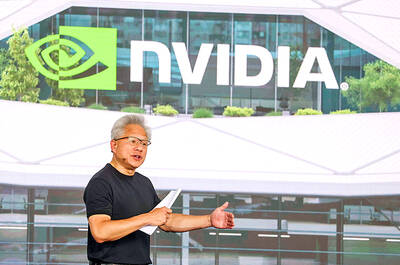
‘BOOMING’: ’ The number of partners we have here is incredible. You can see from their stock prices. They’re doing so well, they’re so happy,’ Jensen Huang said Nvidia Corp’s spending in Taiwan has ballooned to about US$150 billion a year, 10 times the US$10 billion to US$15 billion the company spent five years ago, Nvidia chief executive officer Jensen Huang (黃仁勳) said yesterday, suggesting Taiwan’s strategic importance in the global artificial intelligence (AI) supply chain. “Taiwan is the epicenter of the AI revolution. This is where the chips come, packaging comes. This is where the systems are made. This is where AI supercomputers were created,” Huang said at a meeting for the company’s employees in Beitou-Shilin Technology Park (北投士林科技園區) in Taipei, the planned site of Nvidia’s Taipei headquarters. “Taiwan


 RSS
RSS