


Afghans mourned Vice President Haji Abdul Qadir at a funeral service yesterday as investigations began into an assassination that threatens the country's fragile stability.
Qadir, one of three newly appointed vice presidents and also minister for public works, was shot dead while being driven out of his ministry compound on Saturday, the second Cabinet member to be murdered in Afghanistan this year.
A powerful regional warlord who agreed to join the central government, his death represents a serious setback to President Hamid Karzai's efforts to build an alliance to lead the country out of 23 years of war toward elections in 18 months' time.
"He was very much part of Karzai's strategy to try and bring warlords into the center and give up their fiefdoms," said Pakistani author and Afghan expert Ahmed Rashid.
"Clearly after this, warlords are going to be very reluctant to come into the center, simply because they are more vulnerable in Kabul.
"This has been a devastating blow to Karzai's strategy."
Although officials have not suggested any motive for Qadir's murder or named any suspects, police have arrested all 10 security guards at the ministry for failing to prevent the attack or apprehend the gunmen, who sped off in a waiting taxi. The men were appointed by Qadir's predecessor, Abdul Khaliq Fazal.
Karzai has set up a five-member team headed by another vice president, Karim Khalili, to investigate the murder.
The scenes that unfolded during Qadir's funeral service in Kabul will be a reminder to Afghanistan's fledgling government that the people are growing tired of the endless cycle of violence.
Thousands of mourners thronged the cortege as it made its way to the main mosque, the coffin draped in velvet and the red, black and green Afghan flag.
"If they can kill a minister guarded by strong bodyguards, what chance do I have?" said student Namin, 22. "I am a powerless member of the public. It is very frightening."
"Karzai has to do whatever is necessary to stop the violence," said Navid Bakhsh, a 43-year-old civil servant in Kabul. "Words on TV and radio don't help, there must be action. Disarmament [of the warlords] should start."
Suspicion has fallen on everyone from the remnants of the Taliban to drug lords involved in the opium trade in eastern Afghanistan or simply people with personal or business scores to settle.
Qadir was one of the few Pashtuns in the Tajik-dominated Northern Alliance which swept the Taliban from power last year, backed by US airpower.
As such, he made enemies among Pashtuns who accused him of selling out their cause for personal gain. But his assassins could just as easily have been Tajiks determined to prevent the emergence of any strong Pashtun leaders, analysts said.
"Haji Qadir had so many enemies it could be anyone," said Pakistani newspaper editor and Afghan expert Rahimullah Yusufzai.
Qadir's younger brother, mujahidin commander Abdul Haq, was executed by the Taliban shortly after the US launched its air strikes on Afghanistan.
In February, Tourism Minister Abdul Rehman was killed at Kabul airport under circumstances which have never been made clear.
Qadir's death also illustrated the problems facing Karzai as he tries to unify the country and wean it away from the gun and towards democracy.
"He was a bridge between the Northern Alliance and the Pashtuns, the most effective bridge, and he's gone," said Rashid.
"After this it will be very difficult for the Northern Alliance to find Pashtuns to be by their side."
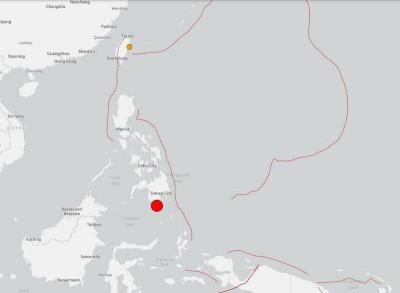
A magnitude 7.8 earthquake struck off the southern coast of Mindanao in the Philippines at 7:38am today, prompting the US Tsunami Warning System to issue an alert for neighboring countries, including Taiwan. The system issued a purple alert indicating a "tsunami threat." The potential threat zone includes Taiwan, the Philippines, Papua New Guinea, Yap and Palau. Philippine authorities were assessing the damage from the quake, with the office of civil defense seeking to verifying initial reports that 15 people had been killed and 129 injured in the region, mostly from falling debris. Arlene Hollero, disaster chief of Maasim town in the Philippines' Sarangani Province,

‘GRAY ZONE’ PRESSURE: Beijing’s activities are intended to create the deceitful impression that China has jurisdiction over the area around Taiwan, the CGA said Taiwan’s rights over its territorial waters and exclusive economic zone must not be violated by any country, the Mainland Affairs Council said yesterday, adding that it will not accept any unprovoked actions. The council issued the remarks in response to the China Coast Guard conducting maritime enforcement drills near eastern Taiwan and claiming to fully exercise China’s maritime administrative law enforcement authority. The Coast Guard Administration (CGA) has been closely monitoring the situation and is taking concrete steps to defend the nation’s sovereignty and secure its waters, the council said. China has no sovereign rights over the waters off eastern
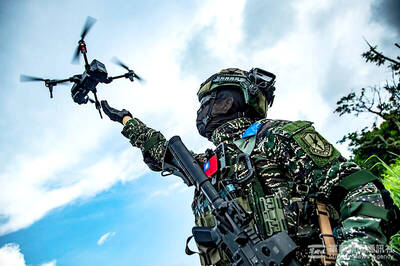
RESILIENCE: Taiwan plays a key role in semiconductors, energy, information infrastructure and advanced manufacturing, AIT Director Raymond Greene said Taiwan’s continued investment in deterrence and resilience remains vital, especially in uncrewed systems and other emerging technologies, American Institute in Taiwan (AIT) Director Raymond Greene said yesterday. Greene made the remarks at the annual National Strategic Summit on Supply Chain Resilience held by the Research Institute for Democracy, Society and Emerging Technology (DSET), a government-backed think tank. As Taiwan last year became the US’ fourth-largest trading partner and supply chain security is becoming more important, cooperation in emerging technologies continues to deepen between the two countries, he said. The US is committed to accelerating innovation, building key infrastructure, strengthening cooperation

RIGHT DIRECTION: Taiwan’s efforts to prevent forced labor include a proposal to ‘fully prohibit’ employers from withholding workers’ documents, an official said Taiwan is to establish a mechanism to restrict imports of goods linked to forced labor, the Executive Yuan said yesterday, after the US proposed imposing additional tariffs on Taiwanese goods over labor concerns. “The Ministry of Labor and the Ministry of Economic Affairs are to establish an interministerial review procedure,” Executive Yuan spokesperson Michelle Lee (李慧芝) said at a news briefing in Taipei. “The government is to use the Foreign Trade Act [貿易法] as the legal basis to restrict imports of goods produced with forced labor” and bring its supply chain governance more in line with international standards on human rights, resilience


 RSS
RSS