


China Airlines flight CI 611 with 225 people on board crashed into the sea near Penghu yesterday afternoon after taking off from Taipei en route to Hong Kong.
The search-and-rescue effort was still underway and no survivors had been discovered as of press time last night. More than 100 bodies have been spotted, according to a China Airlines spokesman.
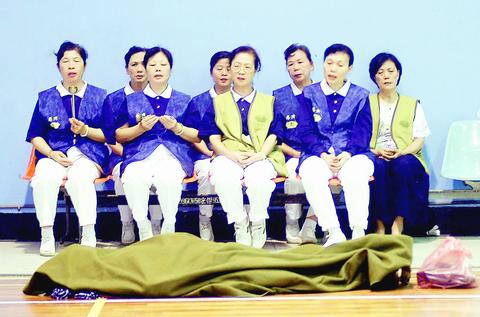
PHOTO: CHANG CHIA-MING, TAIPEI TIMES
The cause of the crash is still under investigation.
The Boeing 747-200, which took off from CKS International Airport at 3:08pm, disappeared from radar screens at around 3:30pm, when it was about 19km from Makung city, officials said.
According to China Airlines' records, the plane was carrying 206 passengers, three of whom were infants, and 19 crew members.
All 19 crew members as well as 190 passengers on board were Taiwanese, including two United Daily News reporters and a former legislator.
In addition to 14 Hong Kong, Macau and Chinese residents, foreign passengers also included one Singaporean, identified as Sim Yong-joo, and one Swiss, identified as Luigi Heer.
The air force and coast guard sent ships and helicopters to search for the plane as soon as the accident was reported, with the first body found at about 6:14pm around the port of Chihkan, located north of Penghu Island.
The Executive Yuan established an emergency command center headed by Minister of Transportation and Communications Lin Lin-san (
Showing his concern about the accident, Premier Yu Shyi-kun went to the airport in the afternoon and then rushed to the Civil Aeronautics Administration office last night to take command of the search-and-rescue efforts in person.
"This is a matter for regret," Yu said.
Yu said President Chen Shui-bian (陳水扁) had ordered the military to mobilize all possible resources to search for survivors, as long as the nation's combat readiness was not impaired.
Vice Minister of Transportation and Communications Chang Chia-juch (
Chang added that the control tower had not received any distress calls before the plane went missing.
Data indicate that the crash took place between 3:37pm and 3:40pm, when two Cathay Pacific planes in the vicinity received emergency location-indicator signals from the downed China Airlines plane, Chang said.
The Executive Yuan's Aviation Safety Council created an investigative panel last night to look into the cause of the accident.
Kay Yong (戎凱), managing director of the council, who also serves at the panel's chief investigator, said the council has contacted the US' National Transportation Safety Board and Boeing Company to help with the probe.
China Airlines officials, meanwhile, bowed and apologized to the bereaved families for the terrible air disaster.
A number of agitated relatives of the passengers rushed to the China Airlines office in Taipei to gather information related to the crash, and were upset with the company's failure to immediately provide them with details.
China Airlines Senior Vice President James Chang (
"We are regretful for such an unfortunate accident and we would like to pay our gratitude to the government for assisting with the recovery," Chang said.
With the assistance of China Airlines, around 200 relatives of the passengers flew to Makung last night to identify the bodies.
This has been the 14th air crash involving China Airlines since 1969, official statistics indicate. The company's notorious safety record once put it on the list of the world's most dangerous airlines.
The last known fatal China Airlines accident was a crash-landing in Hong Kong in 1999, killing three people.
Over 200 people were killed respectively in the 1994 crash in Nagoya and the 1998 crash in the Taoyuan in the vicinity of CKS International Airport.
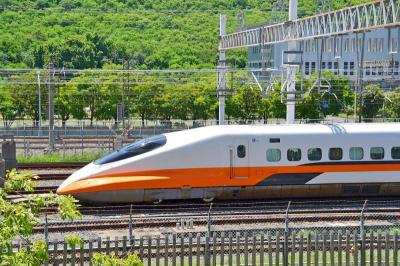
A signaling system malfunction disrupted high-speed rail (HSR) services beginning at 8am today, with trains temporarily reduced to three northbound and three southbound trains per hour as authorities conduct inspections. The malfunction occurred on a section of track in Miaoli County during pre-operation checks early this morning, forcing northbound and southbound trains to use a single track, the HSR operator said. The regular schedule has been replaced with three hourly trains offering only nonreserved seating in each direction, stopping at every station, it said, adding that business class cars would still have reserved seating. Departures from terminal stations are scheduled at the top
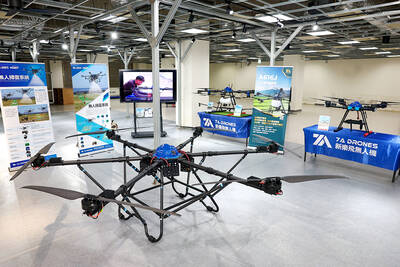
DRONE CENTRAL: Taiwan aims to become Asia’s democratic hub for drones, with most exports focused on high-quality military-grade models, an official said Taiwan’s drone industry is expected to expand significantly by 2030, producing 100,000 units per month and exporting half of them, the Ministry of Economic Affairs said yesterday. Current drone production capacity is about 15,000 units per month, but the industry can quickly scale up as demand increases, Industrial Development Administration Director-General Chiou Chyou-huey (邱求慧) told a news conference in Taipei. Taiwan’s drone output grew 2.5-fold last year to NT$12.9 billion (US$408.3 million) under a government program to develop the uncrewed vehicle sector, he said. The Executive Yuan in October last year approved plans to invest NT$44.2 billion into domestic production of uncrewed aerial
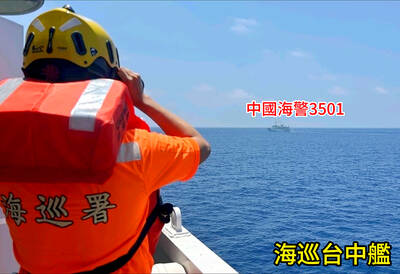
VERBOSE VESSELS: A CGA cutter and a China Coast Guard exchanged verbal barbs for more than a day in Taiwanese-controlled waters before the Chinese vessel left The Taiwanese and Chinese coast guards had a standoff near the strategically located Pratas Islands (Dongsha Islands, 東沙群島) in the north of the South China Sea, the Coast Guard Administration (CGA) said yesterday. The two sides engaged in intense radio exchanges over sovereignty claims during the 33-hour standoff. China Coast Guard vessel 3501 eventually left the restricted waters, 26.6 nautical miles (49.2km) west of the Pratas Islands, at 5pm yesterday, the CGA said. Lying approximately between southern Taiwan and Hong Kong, the Taiwan-controlled Pratas are seen by some security experts as vulnerable to Chinese attack due to their distance — more than
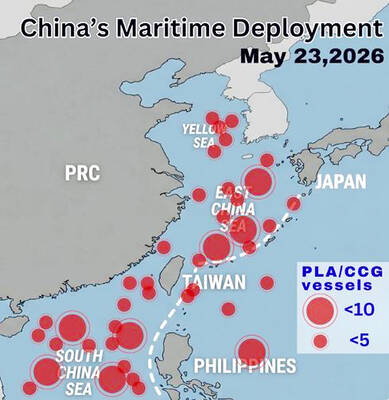
WARNING: China should stop engaging in actions that undermine regional peace and stability, as it would only build resentment among people across the Strait, the CGA said China has deployed more than 100 navy, coast guard and other vessels in waters from the Yellow Sea to the South China Sea and the western Pacific since US President Donald Trump and Chinese President Xi Jinping (習近平) met in Beijing, National Security Council Secretary-General Joseph Wu (吳釗燮) said yesterday. “In this part of the world, #China is the one & only PROBLEM wrecking the #StatusQuo & threatening regional peace & stability,” Wu wrote on X. In a separate post, he said Beijing was coercing Taiwan’s maritime domain, calling it illegal and provocative, after the Coast Guard Administration (CGA) expelled a


 RSS
RSS