


President Chen Shui-bian (陳水扁) yesterday called upon Taiwanese to stand up and to walk toward the international community because Taiwan would be safer through internationalization.
Stressing the significance of maintaining a liberal mindset, Chen said that Taiwanese should not be afraid of opening up, nor should they resist reform because as a part of the world community, "Taiwan will feel more security by being more internationalized."
"Taiwan is not an isolated island, but an island in the world. Taiwan has to walk to the world, and to allow the world to enter Taiwan. ? We should not be frightened by opening up, nor should we refuse to change," Chen said.
"Sometimes being contained and controlled are not the best policies. It might be better to communicate and to adopt effective management," the president said.
Chen gave the address at the second annual meeting of the World Taiwanese Congress (WTC,
The congress, which is composed of nearly 100 pro-Taiwan groups worldwide, was formed last March with the aim of elevating Taiwan's international standing and pushing Taiwan's entry into the international community.
Declaring the government's resolve to take a more liberal approach concerning cross-strait trade, Chen told the attending members that the former "go slow, be patient" initiative had been replaced by the "active opening and active management" policy at last August's Economic Development Advisory Council.
Besides striving for economic reforms, the president said he had placed the same emphasis on political reforms.
To that end, he had pledged to fulfill three primary tasks: reform in governmental agencies, in the legislature and within the DPP.
Chen said the governmental system had to be overhauled because the system adopted for the time being was not suitable for a nation of 23 million surrounded by water.
"Taiwan is not a continental country, it is an ocean nation. Taiwan has to be small, yet powerful," Chen said.
The president also pointed out the urgent need to carry out reform in the legislature.
He said the size of the legislature had to be reduced to bring about an efficient legislature that could oversee the government.
The last task was the reform of the DPP, because it was founded as an opposition party, whose system was not designed to rule a country, according to Chen.
He said the DPP had to be changed and the party should come up with measures on how to lead the country and how to coordinate between the party and the government.
To celebrate the second anniversary of the DPP's assuming power, hundreds of Taiwanese residing overseas returned to Taiwan to show their support to for the party.
The convener of the WTC, Kuo Cheng-kuo (郭重國), said this year the organization's main task was to push for the term "Republic of China " to be replaced by "Taiwan."
He said Taiwan was not recognized by most of the countries in the world, and only by using the name "Taiwan" could the nation enter international society with dignity.
Members of the WTC consider the most crucial undertaking for the organization to be its efforts to get Taiwan into the UN.
Dozens of members of the Chinese Unification Alliance (
Undisturbed by the protest, Chen said that while he disagrees with their statements, he respects their right to speak, which is the "fundamental value of democracy."
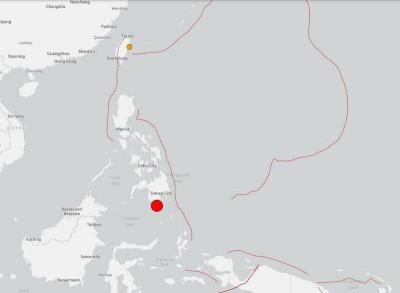
A magnitude 7.8 earthquake struck off the southern coast of Mindanao in the Philippines at 7:38am today, prompting the US Tsunami Warning System to issue an alert for neighboring countries, including Taiwan. The system issued a purple alert indicating a "tsunami threat." The potential threat zone includes Taiwan, the Philippines, Papua New Guinea, Yap and Palau. Philippine authorities were assessing the damage from the quake, with the office of civil defense seeking to verifying initial reports that 15 people had been killed and 129 injured in the region, mostly from falling debris. Arlene Hollero, disaster chief of Maasim town in the Philippines' Sarangani Province,
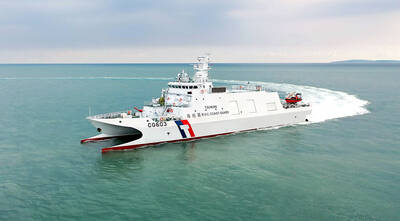
‘GRAY ZONE’ PRESSURE: Beijing’s activities are intended to create the deceitful impression that China has jurisdiction over the area around Taiwan, the CGA said Taiwan’s rights over its territorial waters and exclusive economic zone must not be violated by any country, the Mainland Affairs Council said yesterday, adding that it will not accept any unprovoked actions. The council issued the remarks in response to the China Coast Guard conducting maritime enforcement drills near eastern Taiwan and claiming to fully exercise China’s maritime administrative law enforcement authority. The Coast Guard Administration (CGA) has been closely monitoring the situation and is taking concrete steps to defend the nation’s sovereignty and secure its waters, the council said. China has no sovereign rights over the waters off eastern
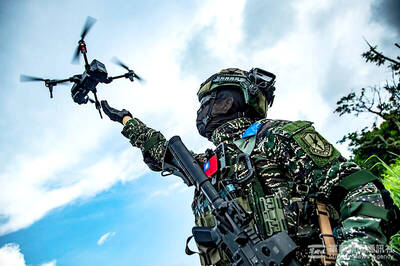
RESILIENCE: Taiwan plays a key role in semiconductors, energy, information infrastructure and advanced manufacturing, AIT Director Raymond Greene said Taiwan’s continued investment in deterrence and resilience remains vital, especially in uncrewed systems and other emerging technologies, American Institute in Taiwan (AIT) Director Raymond Greene said yesterday. Greene made the remarks at the annual National Strategic Summit on Supply Chain Resilience held by the Research Institute for Democracy, Society and Emerging Technology (DSET), a government-backed think tank. As Taiwan last year became the US’ fourth-largest trading partner and supply chain security is becoming more important, cooperation in emerging technologies continues to deepen between the two countries, he said. The US is committed to accelerating innovation, building key infrastructure, strengthening cooperation

RIGHT DIRECTION: Taiwan’s efforts to prevent forced labor include a proposal to ‘fully prohibit’ employers from withholding workers’ documents, an official said Taiwan is to establish a mechanism to restrict imports of goods linked to forced labor, the Executive Yuan said yesterday, after the US proposed imposing additional tariffs on Taiwanese goods over labor concerns. “The Ministry of Labor and the Ministry of Economic Affairs are to establish an interministerial review procedure,” Executive Yuan spokesperson Michelle Lee (李慧芝) said at a news briefing in Taipei. “The government is to use the Foreign Trade Act [貿易法] as the legal basis to restrict imports of goods produced with forced labor” and bring its supply chain governance more in line with international standards on human rights, resilience


 RSS
RSS