


Taipei motorists racked up a record-breaking NT$4.3 billion in tickets last year, thanks in part to higher fines, the city's Office of Traffic Adjudication said yesterday.
The figure is roughly NT$16 million higher than the amount of fines for 2000, the office said.
But while motorists paid more in fines last year, the number of traffic tickets issued dropped.
According to officials, traffic cops issued 3.75 million tickets last year. That compares to the 4.34 million tickets issued to motorists in 2000.
Changes to traffic laws last year are one reason why motorists paid more in fines. The changes went into effect on June 1 and raised fines for several traffic violations.
In addition, Yeh Tsu-chuan (葉梓銓), deputy chief of the traffic office, said the agency has been more aggressive in collecting outstanding fines left over from previous years.
"To close those cases, our clerks kept contacting motorists and constantly pushed them to pay their fines," Yeh said.
"Obviously, it worked last year, because many of these motorists came to the office and paid their tickets and closed their cases."
In related news, the National Police Administration said police officers will begin to strictly enforce traffic laws for motorcycle and scooter riders beginning on the first day of next month.
Specifically, the police administration plans to go after motorcycle and scooter riders who make illegal right turns at red lights.
In addition, motorcycle and scooter riders caught making left turns along with car traffic will be fined. By law, riders must make left turns by crossing an intersection twice -- a process that requires them to wait through two signal changes.
Also, Taipei Mayor Ma Ying-jeou (馬英九), who in the past year has resurfaced many of the city's sidewalks with new tiles, has vowed to get tough on motorcycle and scooter riders who drive on the sidewalks.
Ma says motorists can push their scooters to find a parking space.
According to the administration's statistics, there are more than 11 million motorcycles and scooters.
But there aren't enough parking spaces for scooters or dedicated traffic lanes, administration officials said.
"We don't have enough lanes and parking spaces for these motorcycles and scooters," said Diao Chien-sheng (
"As a result, many riders drive in lanes that are for cars exclusively, or park their motorcycles and scooters illegally on sidewalks," Diao said. "This behavior endangers other people's safety, so we must crack down."
According to the police administration's numbers, 49 percent of all traffic deaths involve motorcycles or scooters.
"We will keep working on amending the traffic law and try to create more space for motorcycles and scooters," Diao said.
"But in the meantime, police officers will begin their strict crackdown on riders who violate the traffic law beginning on March 1."
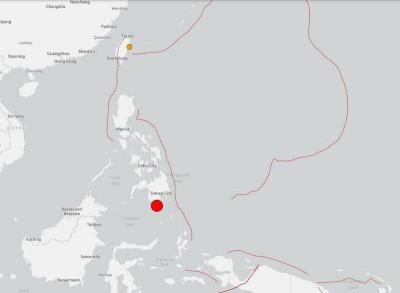
A magnitude 7.8 earthquake struck off the southern coast of Mindanao in the Philippines at 7:38am today, prompting the US Tsunami Warning System to issue an alert for neighboring countries, including Taiwan. The system issued a purple alert indicating a "tsunami threat." The potential threat zone includes Taiwan, the Philippines, Papua New Guinea, Yap and Palau. Philippine authorities were assessing the damage from the quake, with the office of civil defense seeking to verifying initial reports that 15 people had been killed and 129 injured in the region, mostly from falling debris. Arlene Hollero, disaster chief of Maasim town in the Philippines' Sarangani Province,
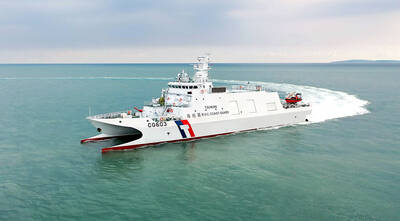
‘GRAY ZONE’ PRESSURE: Beijing’s activities are intended to create the deceitful impression that China has jurisdiction over the area around Taiwan, the CGA said Taiwan’s rights over its territorial waters and exclusive economic zone must not be violated by any country, the Mainland Affairs Council said yesterday, adding that it will not accept any unprovoked actions. The council issued the remarks in response to the China Coast Guard conducting maritime enforcement drills near eastern Taiwan and claiming to fully exercise China’s maritime administrative law enforcement authority. The Coast Guard Administration (CGA) has been closely monitoring the situation and is taking concrete steps to defend the nation’s sovereignty and secure its waters, the council said. China has no sovereign rights over the waters off eastern
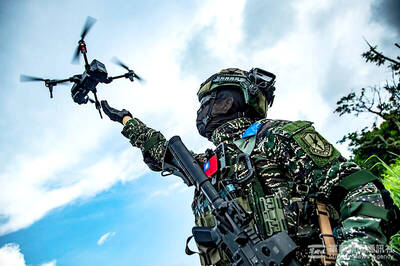
RESILIENCE: Taiwan plays a key role in semiconductors, energy, information infrastructure and advanced manufacturing, AIT Director Raymond Greene said Taiwan’s continued investment in deterrence and resilience remains vital, especially in uncrewed systems and other emerging technologies, American Institute in Taiwan (AIT) Director Raymond Greene said yesterday. Greene made the remarks at the annual National Strategic Summit on Supply Chain Resilience held by the Research Institute for Democracy, Society and Emerging Technology (DSET), a government-backed think tank. As Taiwan last year became the US’ fourth-largest trading partner and supply chain security is becoming more important, cooperation in emerging technologies continues to deepen between the two countries, he said. The US is committed to accelerating innovation, building key infrastructure, strengthening cooperation

RIGHT DIRECTION: Taiwan’s efforts to prevent forced labor include a proposal to ‘fully prohibit’ employers from withholding workers’ documents, an official said Taiwan is to establish a mechanism to restrict imports of goods linked to forced labor, the Executive Yuan said yesterday, after the US proposed imposing additional tariffs on Taiwanese goods over labor concerns. “The Ministry of Labor and the Ministry of Economic Affairs are to establish an interministerial review procedure,” Executive Yuan spokesperson Michelle Lee (李慧芝) said at a news briefing in Taipei. “The government is to use the Foreign Trade Act [貿易法] as the legal basis to restrict imports of goods produced with forced labor” and bring its supply chain governance more in line with international standards on human rights, resilience


 RSS
RSS