


Cashing in on their numerical superiority, the opposition parties last night forced through crucial legal revisions that the DPP government warned would hamper its smooth and effective functioning.
During a marathon session that started yesterday morning and will last until this morning, the opposition alliance -- despite protests from DPP legislators -- made law a proposal to allow Taiwanese people to enter China via offshore islands.
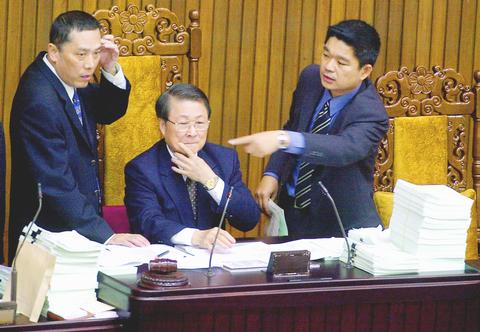
PHOTO: CHEN CHENG-CHANG, TAIPEI TIMES
Outgoing KMT lawmaker Chao Erh-chung (
DPP legislative whip Tsai Huang-liang (蔡煌瑯) sarcastically painted the reform as the last work of Chao, as he lost his seat representing the outlying island of Kinmen in the Dec. 1 elections.
Opposition lawmakers also succeeded in pushing through a disputed legal overhaul that will enable local governments to keep a greater share of tax revenues. Led by Taipei Mayor Ma Ying-jeou (
But top government statistician Lin Chuan (
Ma called a news conference at 10pm to thank the lawmaking body for adopting the legislation. Earlier in the day, chaotic wrangling virtually paralyzed the legislature, as lawmakers eager to push their pet bills up the agenda bickered over the order of business hammered out by caucus leaders.
Responding to a top mobilization order, over 130 lawmakers of all political stripes took part in the session. The high attendance rate did little to expedite the legislative process that was frequently disrupted by members whose bills risk being scrapped because they are not branded "priority."
The current session will fold before noon today, as the legislature has set aside the afternoon for outgoing legislators to deliver their farewell speeches.
As of 4:30pm, the body passed only two legal overhauls intended to halve capital gains tax on property for two years, as suggested by last year's Economic Development Advisory Conference to revive the domestic real-estate market.
The measure, lobbied for by leading industrialists, is expected to shrink local government coffers by NT$22 billion a year. The Cabinet has pledged to make up the shortfall.
Leaders from all caucuses spent the entire morning and early afternoon seeking to carve out an agenda for the remaining session.
They struck a deal to first review bills the Cabinet and all caucuses labeled as urgent, to be followed by a vote this morning on controversial items in the 2002 fiscal budget.
If time allows, the agreement said, the legislature may take up proposals to establish a financial supervisory board, look after soldiers who fought in 1958 cross-strait warfare and spare accountants already in practice the trouble of gaining certification.
The agreement drew vehement protests from members who strove to score points before their tenure expires at the end of this month.
"It makes no sense to put so-called uncontroversial bills on the backburner," said KMT legislator Chiang Yi-wen (
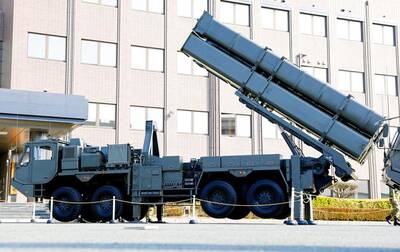
Japan has deployed long-range missiles in a southwestern region near China, the Japanese defense minister said yesterday, at a time when ties with Beijing are at their lowest in recent years. The missiles were installed in Kumamoto in the southern region of Kyushu, as Japan is attempting to shore up its military capacity as China steps up naval activity in the East China Sea. “Standoff defense capabilities enable us to counter the threat of enemy forces attempting to invade our country ... while ensuring the safety of our personnel,” Japanese Minister of Defense Shinjiro Koizumi said. “This is an extremely important initiative for
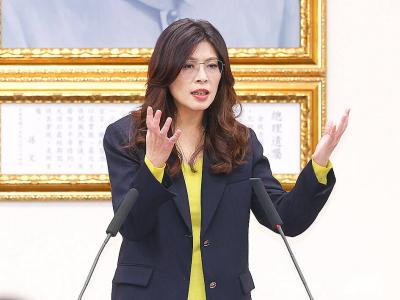
Chinese Nationalist Party (KMT) Chairwoman Cheng Li-wun (鄭麗文) today accepted an invitation from Chinese President Xi Jinping (習近平) to lead a delegation to China next month, saying she hopes to promote the peaceful development of cross-strait relations and bring stability to the Taiwan Strait. “I am grateful and happy to accept this invitation,” Cheng said in a statement from the KMT chairperson’s office. Cheng said she hopes both sides can work together to promote the peaceful development of cross-strait relations, enhance exchange and cooperation, bring stability to the Taiwan Strait and improve people’s livelihoods. At today's news conference, Cheng said any efforts to

MORE POPULAR: Taiwan Pass sales increased by 59 percent during the first quarter compared with the same period last year, the Tourism Administration said The Tourism Administration yesterday said that it has streamlined the Taiwan Pass, with two versions available for purchase beginning today. The tourism agency has made the pass available to international tourists since 2024, allowing them to access the high-speed rail, Taiwan Railway Corp services, four MRT systems and four Taiwan Tourist Shuttles. Previously, five types of Taiwan Pass were available, but some tourists have said that the offerings were too complicated. The agency said only two types of Taiwan Pass would be available, starting from a three-day pass with the high-speed rail and a three-day pass with Taiwan Railway Corp. The former costs NT$2,800

The nation’s fastest supercomputer, Nano 4 (晶創26), is scheduled to be launched in the third quarter, and would be used to train large language models in finance and national defense sectors, the National Center for High-Performance Computing (NCHC) said. The supercomputer, which would operate at about 86.05 petaflops, is being tested at a new cloud computing center in the Southern Taiwan Science Park in Tainan. The exterior of the server cabinet features chip circuitry patterns overlaid with a map of Taiwan, highlighting the nation’s central position in the semiconductor industry. The center also houses Taiwania 2, Taiwania 3, Forerunner 1 and


 RSS
RSS