


Efforts to forge a post-Taliban government progressed yesterday, as Northern Alliance commanders offered an exit to some non-Afghan fighters holed up with the Taliban in the northern city of Kunduz despite US opposition to any "negotiated surrender."
Germany said it offered to host an all-party conference on the future of Afghanistan and is awaiting a response from the UN, which is overseeing the international efforts.
Iranian state radio said the conference would take place in Berlin on Saturday.
UN envoy Francesc Vendrell "is very hopeful [about giving] a positive announcement" at a news conference later in the day, a spokesman said in Kabul.
Vendrell met late Monday with General Mohammad Qasim Fahim, the Alliance's defense minister, as well as foreign minister Abdullah Abdullah and interior minister Younis Qanooni in talks the spokesman described as "warm."
US planes pursued their raids on Kunduz and the Taliban's southern stronghold of Kandahar, the last two major pockets of Taliban resistance.
A Taliban commander said Monday that he was willing to surrender Kunduz under UN supervision, after weekend bombings killed more than 1,000 people.
The Alliance's General Mohammad Daoud said yesterday that foreign "mercenaries," except "those who have committed crimes," could be allowed to leave the besieged city if the UN or other countries accept them.
Estimates of Taliban troops defending Kunduz run as high as 30,000, with a hardcore element of Arab, Chechen and Pakistani al-Qaeda fighters making up about one-third.
Daoud said he rejected a Taliban request that they be taken by convoy from Kunduz to Kandahar, where talks between the Taliban and fellow Pashtun tribal leaders for a peaceful handover appeared deadlocked.
"Our holy war continues," a ranking Taliban official said yesterday at Spin Boldak, near the besieged city. "There are no negotiations going on in Kandahar."
Negotiators in Kabul were hoping to flesh out a plan for a post-Taliban government after an intensive round of political talks involving Northern Alliance president Burhanuddin Rabbani and envoys from the UN, the US and Britain.
Qanooni said an agreement was reached "in principle," but added: "On the details, we have some observations" that would be aired later yesterday.
US special envoy James Dobbins said he was confident a UN-backed meeting of eminent Afghans could take place this week.
An inter-Afghan conference at a neutral European venue would be the first step of a five-point UN plan for a broad-based new Afghan government.
The Alliance is "ready to move forward to the creation of a new, broader government, which will represent all regions, all ethnicities," Dobbins said.
After chasing the Taliban from the Afghan capital a week ago, the Northern Alliance had been hesitant about the UN plan, prompting concerns that it is unwilling to relinquish its hold on power.
The UN and US envoys had met earlier with exiled Afghan leaders, including former king Mohammed Zahir Shah, seen as a potential unifying force despite having spent the last 28 years in exile.
A spokesman for Zahir Shah, 87, warned in Rome that any attempt to sideline the ex-king would increase internal strife.
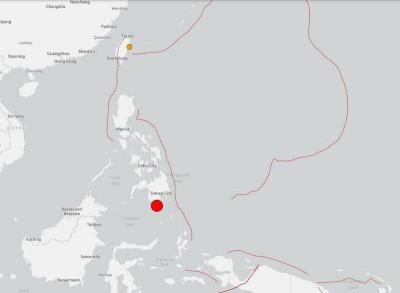
A magnitude 7.8 earthquake struck off the southern coast of Mindanao in the Philippines at 7:38am today, prompting the US Tsunami Warning System to issue an alert for neighboring countries, including Taiwan. The system issued a purple alert indicating a "tsunami threat." The potential threat zone includes Taiwan, the Philippines, Papua New Guinea, Yap and Palau. Philippine authorities were assessing the damage from the quake, with the office of civil defense seeking to verifying initial reports that 15 people had been killed and 129 injured in the region, mostly from falling debris. Arlene Hollero, disaster chief of Maasim town in the Philippines' Sarangani Province,
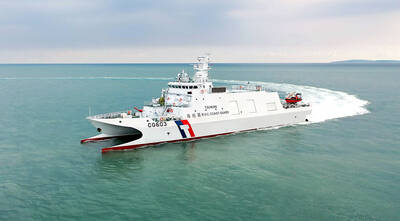
‘GRAY ZONE’ PRESSURE: Beijing’s activities are intended to create the deceitful impression that China has jurisdiction over the area around Taiwan, the CGA said Taiwan’s rights over its territorial waters and exclusive economic zone must not be violated by any country, the Mainland Affairs Council said yesterday, adding that it will not accept any unprovoked actions. The council issued the remarks in response to the China Coast Guard conducting maritime enforcement drills near eastern Taiwan and claiming to fully exercise China’s maritime administrative law enforcement authority. The Coast Guard Administration (CGA) has been closely monitoring the situation and is taking concrete steps to defend the nation’s sovereignty and secure its waters, the council said. China has no sovereign rights over the waters off eastern

RESILIENCE: Taiwan plays a key role in semiconductors, energy, information infrastructure and advanced manufacturing, AIT Director Raymond Greene said Taiwan’s continued investment in deterrence and resilience remains vital, especially in uncrewed systems and other emerging technologies, American Institute in Taiwan (AIT) Director Raymond Greene said yesterday. Greene made the remarks at the annual National Strategic Summit on Supply Chain Resilience held by the Research Institute for Democracy, Society and Emerging Technology (DSET), a government-backed think tank. As Taiwan last year became the US’ fourth-largest trading partner and supply chain security is becoming more important, cooperation in emerging technologies continues to deepen between the two countries, he said. The US is committed to accelerating innovation, building key infrastructure, strengthening cooperation

RIGHT DIRECTION: Taiwan’s efforts to prevent forced labor include a proposal to ‘fully prohibit’ employers from withholding workers’ documents, an official said Taiwan is to establish a mechanism to restrict imports of goods linked to forced labor, the Executive Yuan said yesterday, after the US proposed imposing additional tariffs on Taiwanese goods over labor concerns. “The Ministry of Labor and the Ministry of Economic Affairs are to establish an interministerial review procedure,” Executive Yuan spokesperson Michelle Lee (李慧芝) said at a news briefing in Taipei. “The government is to use the Foreign Trade Act [貿易法] as the legal basis to restrict imports of goods produced with forced labor” and bring its supply chain governance more in line with international standards on human rights, resilience


 RSS
RSS