


China's ranks of critics in the US Congress look set to further enrage Beijing this week when they probe allegations that the organs of executed prisoners are often systematically harvested and sold to transplant patients.
Members of a subcommittee of the House of Representatives International Relations Committee will on Wednesday discuss a bill which seeks to bar Chinese doctors seeking training in organ transplantation from entering the US.
Among those testifying before the committee will be celebrated Chinese dissident Harry Wu (
"An unknown number of lives have been converted to ashes in this macabre fashion in China. And who remembers them?" Wu asks in the preface to his report.
The report alleges through documented interviews with Chinese officials, doctors and relatives of prisoners that organ harvesting is widespread in China's jails.
It claims that some young and healthy death row prisoners are subjected to pre-execution health checks, which are intended to match them to donors.
Donor prisoners are typically shot in the back of the head, so that death will be induced through damage to the brain and leave the lungs, the heart, the liver and kidneys intact, Wu claims.
In what the report describes as one "particularly repulsive" piece of testimony, a medical official from Heilongjiang Province relates how a prisoner was taken to a hospital and then executed by a shot to the back of the head.
His heart was then transferred into a waiting patient, the report says, adding that some prisoners have been shot through the heart, so their teeth and corneas remain intact for use by other patients.
Wu's research claims that "many patients who receive the organs harvested from China's executed prisoners must pay large sums to money to hospital personnel to have the procedure."
As reports of organ harvesting in China have emerged, the government has consistently denied the practice exists -- and pointed out that it is prohibited under Chinese law.
The bill the House committee will consider on Wednesday is also due to be considered in the Senate.
As well as Wu, the committee is expected to hear from a former doctor at a Chinese hospital and US medical experts.
The organ donor bill is part of a sheaf of legislation critical of China's human rights practices circulating in Congress, which is due to consider whether to extend Bei-jing's normal trade relations with Washington in the next few months.
If the organ bill is endorsed by the committee it will be passed to the full House for a vote.
Anti-China coalitions are often forged in the US legislative body between conservative Republicans, who revile Beijing's communist system and liberal Democrats who are active human rights advocates.
One of the most explosive pieces of legislation is a non-binding resolution currently awaiting a vote which would stress the opposition of the chamber to China's bid for the 2008 Olympic Games.
Members of the International Relations Committee last week vigorously condemned China for detaining five scholars who are either US permanent residents or citizens.
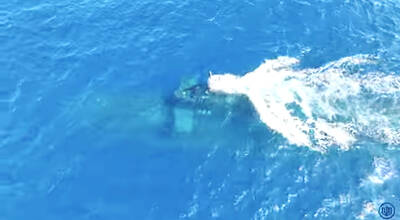
CSBC Corp, Taiwan (台灣國際造船) yesterday released the first video documenting the submerged sea trials of Taiwan’s indigenous defense submarine prototype, the Hai Kun (海鯤), or Narwhal, showing underwater navigation and the launch of countermeasures. The footage shows the vessel’s first dive, steering and control system tests, and the raising and lowering of the periscope and antenna masts. It offered a rare look at the progress in the submarine’s sea acceptance tests. The Hai Kun carried out its first shallow-water diving trial late last month and has since completed four submerged tests, CSBC said. The newly released video compiles images recorded from Jan. 29 to
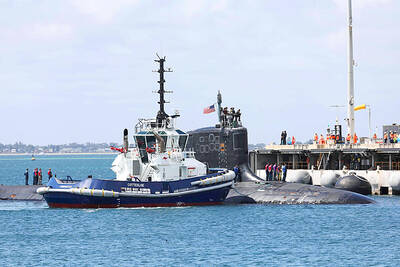
DETERRENCE EFFORTS: Washington and partners hope demonstrations of force would convince Beijing that military action against Taiwan would carry high costs The US is considering using HMAS Stirling in Western Australia as a forward base to strengthen its naval posture in a potential conflict with China, particularly over Taiwan, the Wall Street Journal reported on Saturday. As part of its Indo-Pacific strategy, Washington plans to deploy up to four nuclear-powered submarines at Stirling starting in 2027, providing a base near potential hot spots such as Taiwan and the South China Sea. The move also aims to enhance military integration with Pacific allies under the Australia-UK-US trilateral security partnership, the report said. Currently, US submarines operate from Guam, but the island could
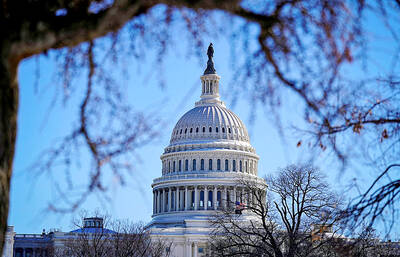
RESTRAINTS: Should China’s actions pose any threat to Taiwan’s security, economic or social systems, China would be excluded from major financial institutions, the bill says The US House of Representatives on Monday passed the PROTECT Taiwan Act, which states that Washington would exclude China from participating in major global financial organizations if its actions directly threaten Taiwan’s security. The bill, proposed by Republican Representative Frank Lucas, passed with 395 votes in favor and two against. It stipulates that if China’s actions pose any threat to Taiwan’s security, economic or social systems, the US would, “to the maximum extent practicable,” exclude Beijing from international financial institutions, including the G20, the Bank for International Settlements and the Financial Stability Board. The bill makes it clear that China must be prepared

Taiwanese trade negotiators told Washington that Taipei would not relocate 40 percent of its semiconductor production to the US, and that its most advanced technologies would remain in the nation, Vice Premier Cheng Li-chiun (鄭麗君) said on Sunday. “I told the US side very clearly — that’s impossible,” Cheng, who led the negotiation team, said in an interview that aired on Sunday night on Chinese Television System. Cheng was referring to remarks last month by US Secretary of Commerce Howard Lutnick, in which he said his goal was to bring 40 percent of Taiwan’s chip supply chain to the US Taiwan’s almost


 RSS
RSS