

Independent lawmaker Lo Fu-chu (
Lo, along with lawmaker Chou Wu-liu (周五六) and Lin Ming-i (林明義), are charged with assaulting DPP lawmaker Yu Cheng-tao (余政道) amid a chaotic fight among lawmakers during a legislative session on July 15 last year.
Chou and Lin did not show up, but Lo, who had never responded to a court subpoena before, made the appearance at a hearing in the Taipei District Court yesterday.
During the hearing, six videotapes of TV news programs which recorded proceedings of the June 15 session were played to review what had happened in the chamber. The court determined that Lo, surrounded by a crowd of lawmakers, forced his way through the crowd to find Yu and then punched him in the head three times.
Chou and Lin were also found to have hit Yu in the chest and belly during the incident.
The video showed Yu, whose glasses were first slapped away by Lo, eventually collapsing on the floor after the violent confrontation.
The fight broke out around 8pm. Allegedly, around noon that day, Lo made intimidating remarks against Yu and other DPP lawmakers, who had voiced strong opposition to Lo's recommendation that independent lawmaker Wu Tse-yuan (伍澤元) be made a legislative representative to the high-profile National Judicial Reform Conference in July last year.
Wu, who was former Pingtung County commissioner, had previously been convicted of graft and is still appealing his conviction. His participation was then widely debated and was eventually rejected by organizers of the conference.
Later that day, Lo was alleged to have had a physical confrontation with several DPP lawmakers as a result of a disagreement over an amendment which dealt with whether employers of the farmer and fishermen associations should be discharged after being convicted of an appealable offense.
Central to the debate over the amendment was that farmer and fishermen associations have long been seen as important bases for the KMT to pull in votes at the grassroots level during elections.
The tension then intensified when several DPP lawmakers threw papers at the vice president of the legislature, Yao Eng-chi (饒穎奇) of the KMT, who was announcing the start of a vote on the amendment despite the ongoing debates. It was at that point that Lo and the other two KMT lawmakers allegedly carried out the violent attacks against Yu.
During the hearing yesterday, Lo alleged that he had been hit first and was only fighting back. He said that it was natural for a person to "spontaneously" defend himself if attacked.
Lo, however, was unable to produce evidence to support his claim.
Lo admitted that it was not good to fight and said he is willing to "talk about" the possibility of an out-of-court settlement with Yu.
However, Yu, who arrived late due to a delayed flight, said outside the court that he did not want a settlement and he hopes the court will rule on the lawmakers' behavior in the case.
"Lawmakers can disagree, but they have no right to use violence against others," he said.
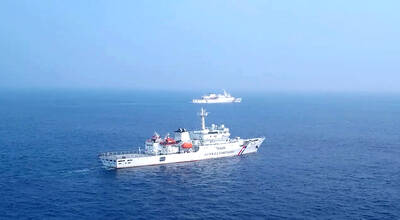
PATROL PARTNERS: The ‘Chiayi’ and the ‘Penghu’ departed for a two-day joint patrol of Palau’s exclusive economic zone, the CGA’s second diplomatic visit to the country The Coast Guard Administration (CGA) set a record for its southernmost deployment of a coast guard vessel as the vessels Chiayi and the Penghu reached Palau’s Pulo Anna Island on Saturday in a cooperative exercise between the two countries. The island, about 217 nautical miles (401km) southwest of Koror in the Palauan state of Sonsorol and 1,220 nautical miles from Taiwan’s southernmost point, Oluanpi (鵝鑾鼻), is the furthest south a CGA vessel has sailed. The two vessels are in Palau for the coast guard’s second diplomatic visit to the country. They docked at Malakal Harbor on Tuesday last week. The coast guard
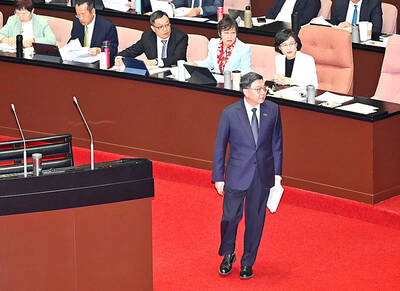
The government is monitoring online rumors that a pneumonic plague outbreak has spread from Russia into China, and it might enhance quarantine measures, Premier Cho Jung-tai (卓榮泰) said yesterday. During a legislative meeting, Democratic Progressive Party Legislator Wang Ting-yu (王定宇) said that rumors had circulated that the disease had spread across several Chinese provinces. He asked Cho whether the government was prepared to prevent the disease spreading to Taiwan, given the volume of traffic between the two sides, and how concerned the government was about the alleged outbreak. The Ministry of Health and Welfare had implemented border quarantine measures after briefing the Executive
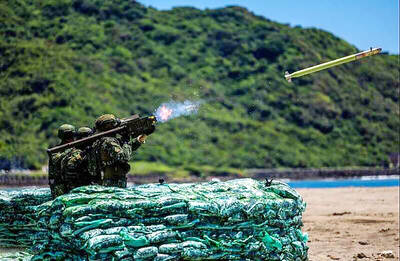
BATCH 1: The military has plans to assign the weapons to the army to defend Taiwan proper, as well as outlying islands and the navy for the Marine Corps, the official said Taiwan is to receive 500 Stinger missiles and 178 launchers from the US by the end of the year, the first batch under a planned two-stage acquisition totaling 2,621 missiles and 763 launchers, a defense official said yesterday on condition of anonymity. The portable missiles would play a vital role in the nation’s air defense capabilities, the source said. The army plans to deploy 2,235 missiles and 657 launchers to defend Taiwan proper and outlying islands, they said, citing military documents. The navy is allotted 295 missiles and 85 launchers to arm the Marine Corps and some surface vessels that lack air defense
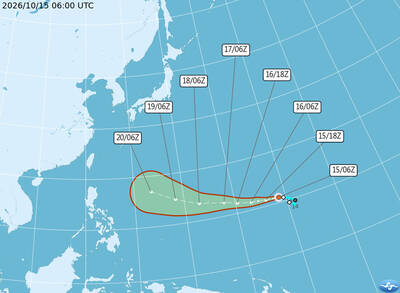
EAST OF GUAM: Tropical Storm Champi is forecast to strengthen into a typhoon, but its effect on Taiwan is uncertain due to the presence of a high-pressure system Tropical Storm Champi formed yesterday and has the potential to increase in strength, the Central Weather Administration (CWA) said yesterday. Forecasters are closely monitoring a Pacific high-pressure system that would dictate whether the storm turns north or moves toward Taiwan next week, the CWA said. The most likely scenario is that it turns northward after passing the Ryukyu Islands, CWA forecaster Cheng Chieh-jen (鄭傑仁) said. As of 8pm yesterday, Champi was east of Guam moving west-northwest at 20kph, CWA data showed. It had maximum sustained winds near the center of 72kph and gusts of up to 101kph, the data showed. If the Pacific high-pressure system


 RSS
RSS