


On the eve of today's presidential inauguration, Tainan County Commissioner Chen Tang-shan (
In what appeared to be a quick recovery from a potentially embarrassing situation for the incoming administration, however, it was announced yesterday that National Cheng Kung University President Weng Cheng-i (
Weng has a PhD in mechanical engineering from Rochester University in the US, and has taught at National Cheng Kung University since 1980. He also currently works as an NSC researcher.
It was believed the sudden adjustment of Cabinet personnel was caused by Chen's resistance to assume his new office unless his choice of stand-in in the Tainan County commissioner's post was not accepted by President-elect Chen Shui-bian (
Instead, Chen Tang-shan is to remain in his current post.
In the process of forming the Cabinet, President-elect Chen invited three current county chiefs to join his new government, while leaving the problem of succession to those stepping up.
Current regulations state that the final decision is in the hands of the interior ministry.
Chen Tang-shan had insisted that the current deputy commissioner, Lin Wen-ting (
Coordination over the issue, however, was less than ideal. A May 17 meeting of DPP factions reached a consensus that Lin would step in. Su, however, apparently become the favored candidate after meeting with Chen on Thursday.
The change in plans appears to have backfired with Chen Tang-shan and Lin, as the latter two days ago publicly criticized President-elect Chen as having "lied."
Despite accepting the NSC chairmanship, and having gone through a "training camp" for the new Cabinet last weekend, Chen Tang-shan told reporters yesterday that he would "consider" whether or not to stay in his current position.
Chen's hesitation, according to Su, was one of the main reasons President-elect Chen had to find a substitute to head the NSC -- instead of worrying about choosing an acting chief for Tainan County.
Su told the Taipei Times that officials from the president-elect's office called him yesterday afternoon, and said that the incoming NSC chairman would be Weng -- a fact later confirmed by Weng himself.
Weng, however, said he was embarrassed about taking over the job under such disputed conditions.
The storm over personnel affairs is also seen as potentially damaging to Chen.
"It has harmed both the DPP and Chen," said DPP legislator Shen Fu-Hsiung (
But President-elect Chen's quick decision on the issue, according to Su, illustrated his boldness in facing disharmony within the government, and was a sign of his ability to build leadership.
Another dispute, meanwhile, has been brewing over the choice of who will head the Taoyuan County Government in place of incoming Vice president Annette Lu (
Among possible candidates, Lu has insisted that her deputy, Hsu Ying-shen (
Unlike the case in Tainan, however, the problem was successfully resolved with Hsu being named to the acting commissioner's post.
Lu, along with Chiayi City Mayor Chang Po-ya (

Right-wing political scientist Laura Fernandez on Sunday won Costa Rica’s presidential election by a landslide, after promising to crack down on rising violence linked to the cocaine trade. Fernandez’s nearest rival, economist Alvaro Ramos, conceded defeat as results showed the ruling party far exceeding the threshold of 40 percent needed to avoid a runoff. With 94 percent of polling stations counted, the political heir of outgoing Costa Rican President Rodrigo Chaves had captured 48.3 percent of the vote compared with Ramos’ 33.4 percent, the Supreme Electoral Tribunal said. As soon as the first results were announced, members of Fernandez’s Sovereign People’s Party
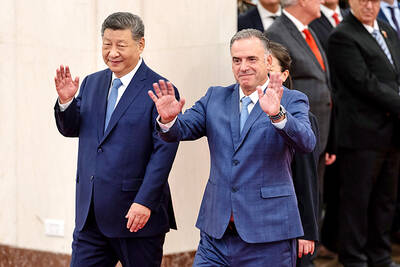
EMERGING FIELDS: The Chinese president said that the two countries would explore cooperation in green technology, the digital economy and artificial intelligence Chinese President Xi Jinping (習近平) yesterday called for an “equal and orderly multipolar world” in the face of “unilateral bullying,” in an apparent jab at the US. Xi was speaking during talks in Beijing with Uruguayan President Yamandu Orsi, the first South American leader to visit China since US special forces captured then-Venezuelan president Nicolas Maduro last month — an operation that Beijing condemned as a violation of sovereignty. Orsi follows a slew of leaders to have visited China seeking to boost ties with the world’s second-largest economy to hedge against US President Donald Trump’s increasingly unpredictable administration. “The international situation is fraught
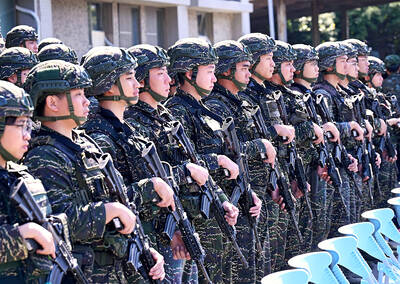
MORE RESPONSIBILITY: Draftees would be expected to fight alongside professional soldiers, likely requiring the transformation of some training brigades into combat units The armed forces are to start incorporating new conscripts into combined arms brigades this year to enhance combat readiness, the Executive Yuan’s latest policy report said. The new policy would affect Taiwanese men entering the military for their compulsory service, which was extended to one year under reforms by then-president Tsai Ing-wen (蔡英文) in 2022. The conscripts would be trained to operate machine guns, uncrewed aerial vehicles, anti-tank guided missile launchers and Stinger air defense systems, the report said, adding that the basic training would be lengthened to eight weeks. After basic training, conscripts would be sorted into infantry battalions that would take

GROWING AMBITIONS: The scale and tempo of the operations show that the Strait has become the core theater for China to expand its security interests, the report said Chinese military aircraft incursions around Taiwan have surged nearly 15-fold over the past five years, according to a report released yesterday by the Democratic Progressive Party’s (DPP) Department of China Affairs. Sorties in the Taiwan Strait were previously irregular, totaling 380 in 2020, but have since evolved into routine operations, the report showed. “This demonstrates that the Taiwan Strait has become both the starting point and testing ground for Beijing’s expansionist ambitions,” it said. Driven by military expansionism, China is systematically pursuing actions aimed at altering the regional “status quo,” the department said, adding that Taiwan represents the most critical link in China’s


 RSS
RSS