


In response to the dramatic escape of two armed prisoners from the Taichung Detention Center on Sunday, officials yesterday trans-ferred the prison's warden as a first step toward assigning responsibility for the embarrassing episode.
The possibility that the jailbreak was planned jointly by the prisoners and at least one of their jailers is also being investigated.
The prison break occurred early Sunday morning when death row inmate Huang Chu-wang (
None of the episode was caught on surveillance video and apparently no one was aware of the escape until one of the guards taken hostage later telephoned the prison after being released.
The car used in the daring escape was found abandoned not far from the scene. But the two escapees, as well as a guard, Hsu Chang-ching (
The likelihood that other detention center staffers were involved in a conspiracy has not been ruled out.
When questioned as to whether Hsu was an inside collaborator who single-handedly smuggled the two felons out of the prison, the Director of the Corrections Department, Huang Chen-nan (
Meanwhile, the official said the incident may have stemmed from widespread problems within Taiwan's prison system, such as a lack of human resources and low pay for prison staff.
The Ministry of Justice held an urgent meeting late Sunday night and into the early hours yesterday morning -- where officials decided to immediately replace the facility's warden, Lee Tai-shun (李太順), and security chief Lin Tu-chih (林篤志). The warden's transfer took place yesterday afternoon.
Ministry officials said the detention center's top officials are responsible for the escape, and the quick replacement of officials would help the ongoing investigation.
Minister of Justice Yeh Chin-fong (
Two investigative task forces have been established -- one from the Public Prosecutors' Office of the Taiwan High Court and another headed by the Taichung District Prosecutors' Office -- with Yeh demanding results within five days.
The minister, whose term will come to end on May 20, asked detention center officials to cooperate with the investigation after the replacement of the two top officials.
"Any misconduct will not be shielded," Yeh said.
"There are still many suspicious points," Corrections Department director Huang said.
He said security gates, for example, should be padlocked on the outside -- but were not even bolted shut.
Huang also clarified yesterday that there were five staffers at the control center at that time but that Hsu was not body-searched when he entered the cell block, as is required procedure.
He denied earlier reports that that there was no one on duty.
Huang said security regulations themselves were not the problem -- rather, that they were not always practiced. The ministry has notified all correction institutions nationwide to follow security regulations strictly and that frequent spot-checks will be conducted.
In the long run, however, the chronic problem of under-staffing at correctional institutions and detention centers must be addressed, Huang said.
"The average ratio of staffers to inmates is 1 to 12, much lower than those of other advanced countries," Huang said, citing the US' 1993 ratio of 1 to 4.15 and the UK's 1994 ratio of 1 to 3.
A five-year development plan could add 1,086 staffers, but even that number is far from sufficient, Huang said.
Security staffer's low pay is another problem. Hsu Chang-ching's full salary -- including extras and benefits -- is only slightly more that NT$40,000 per month.
"Under such conditions, staffers are likely to be lured and used [by the inmates]," Huang said.
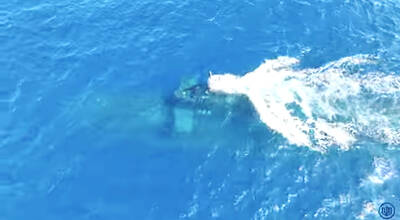
CSBC Corp, Taiwan (台灣國際造船) yesterday released the first video documenting the submerged sea trials of Taiwan’s indigenous defense submarine prototype, the Hai Kun (海鯤), or Narwhal, showing underwater navigation and the launch of countermeasures. The footage shows the vessel’s first dive, steering and control system tests, and the raising and lowering of the periscope and antenna masts. It offered a rare look at the progress in the submarine’s sea acceptance tests. The Hai Kun carried out its first shallow-water diving trial late last month and has since completed four submerged tests, CSBC said. The newly released video compiles images recorded from Jan. 29 to
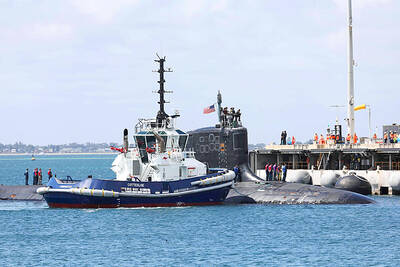
DETERRENCE EFFORTS: Washington and partners hope demonstrations of force would convince Beijing that military action against Taiwan would carry high costs The US is considering using HMAS Stirling in Western Australia as a forward base to strengthen its naval posture in a potential conflict with China, particularly over Taiwan, the Wall Street Journal reported on Saturday. As part of its Indo-Pacific strategy, Washington plans to deploy up to four nuclear-powered submarines at Stirling starting in 2027, providing a base near potential hot spots such as Taiwan and the South China Sea. The move also aims to enhance military integration with Pacific allies under the Australia-UK-US trilateral security partnership, the report said. Currently, US submarines operate from Guam, but the island could

RESTRAINTS: Should China’s actions pose any threat to Taiwan’s security, economic or social systems, China would be excluded from major financial institutions, the bill says The US House of Representatives on Monday passed the PROTECT Taiwan Act, which states that Washington would exclude China from participating in major global financial organizations if its actions directly threaten Taiwan’s security. The bill, proposed by Republican Representative Frank Lucas, passed with 395 votes in favor and two against. It stipulates that if China’s actions pose any threat to Taiwan’s security, economic or social systems, the US would, “to the maximum extent practicable,” exclude Beijing from international financial institutions, including the G20, the Bank for International Settlements and the Financial Stability Board. The bill makes it clear that China must be prepared

Taiwanese trade negotiators told Washington that Taipei would not relocate 40 percent of its semiconductor production to the US, and that its most advanced technologies would remain in the nation, Vice Premier Cheng Li-chiun (鄭麗君) said on Sunday. “I told the US side very clearly — that’s impossible,” Cheng, who led the negotiation team, said in an interview that aired on Sunday night on Chinese Television System. Cheng was referring to remarks last month by US Secretary of Commerce Howard Lutnick, in which he said his goal was to bring 40 percent of Taiwan’s chip supply chain to the US Taiwan’s almost


 RSS
RSS