


In the pouring rain with a backdrop of pounding drums and blaring air-horns, DPP presidential candidate Chen Shui-bian (陳水扁) called on a crowd of over 100,000 to come and help rewrite Taiwan's history on election day.
Standing on a huge stage with a three-story backdrop, Chen called on supporters to take their cue from Lee Yuan-tseh to help the DPP to successfully carry out a shift in power.
"Those who are standing beside Lien Chan and James Soong are gangsters and corrupt officials like Luo Fu-chu (羅福助), Yen Ching-piao (顏清標), Wu Tze-yuan (伍澤元), and Kuo Ting-tsai (郭廷才)," Chen said .
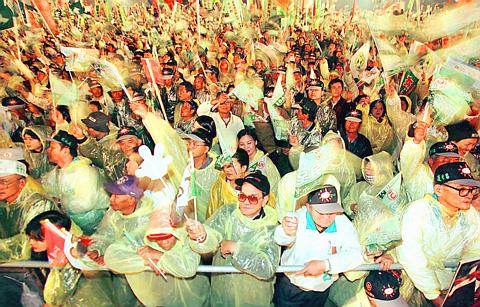
PHOTO: CHIANG YING-YING TAIPEI TIMES
Chen said that people like Lee Yuan-tseh (李遠哲), National Security Council advisor, Chen Pi-chao (陳必照), and leading businessmen like Nita Ing of the Taiwan High Speed Railway Corporation, Chi Mai president Hsu Wen-lung, and Acer CEO Stan Shih (施振榮) were willing to step in behind him.
These supporters have expressed a willingness to join Chen Shui-bian's National Policy Advisory Committee if he is elected.
"The KMT has been in power for 55 years and now elites in our society who have a good image and are eager to reform are here to help us," Chen said as rain continued to fall.
Chen said that corruption would never be eradicated if either independent candidate James Soong (宋楚瑜) or KMT candidate Lien Chan (連戰) were elected.
On the stage with Chen were his running mate, Annette Lu (呂秀蓮), and DPP chairman Lin I-hsiung (林義雄) and his wife.
Former presidential candidate Peng Ming-min (彭明敏) was also on stage wearing an "A-bian" fishing cap along with Academia Sinica member Lee Chen-yuan (李鎮源).
Chen praised those who had stepped forward to support him, most notably Academia Sinica President Lee Yuan-tseh.
Supporters in the crowd were undaunted by the rain, waving flags and standing for the entire duration of the rally.
Chen dismissed his opponents claims that he would provoke China if elected.
Chen said he would not deliberately not press three related moves that might destabilize cross-strait relations.
"I would not push for an amendment to include the `two-state theory,' in the Constitution, nor would I push for a referendum on the issue of whether Taiwan should seek independence or re-unify with China," he said.
He also said that, in the current circumstances, it is not necessary to change Taiwan's official name of the Republic of China, adding that the move wouldn't take place unless China attacks Taiwan.
Chen called on all of his supporters to join together and make an historic choice: to change Taiwan's fate and root out corruption from politics.
"Four years ago Peng Ming-min (彭明敏) and Frank Hsieh (謝長廷) -- the DPP ticket in the 1996 election -- weren't able to see a transition in power and now we do have a chance and we will win," the DPP candidate told the crowd.
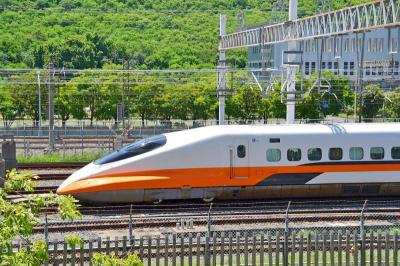
A signaling system malfunction disrupted high-speed rail (HSR) services beginning at 8am today, with trains temporarily reduced to three northbound and three southbound trains per hour as authorities conduct inspections. The malfunction occurred on a section of track in Miaoli County during pre-operation checks early this morning, forcing northbound and southbound trains to use a single track, the HSR operator said. The regular schedule has been replaced with three hourly trains offering only nonreserved seating in each direction, stopping at every station, it said, adding that business class cars would still have reserved seating. Departures from terminal stations are scheduled at the top
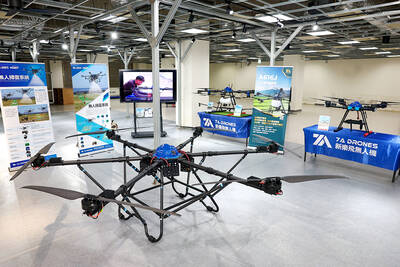
DRONE CENTRAL: Taiwan aims to become Asia’s democratic hub for drones, with most exports focused on high-quality military-grade models, an official said Taiwan’s drone industry is expected to expand significantly by 2030, producing 100,000 units per month and exporting half of them, the Ministry of Economic Affairs said yesterday. Current drone production capacity is about 15,000 units per month, but the industry can quickly scale up as demand increases, Industrial Development Administration Director-General Chiou Chyou-huey (邱求慧) told a news conference in Taipei. Taiwan’s drone output grew 2.5-fold last year to NT$12.9 billion (US$408.3 million) under a government program to develop the uncrewed vehicle sector, he said. The Executive Yuan in October last year approved plans to invest NT$44.2 billion into domestic production of uncrewed aerial
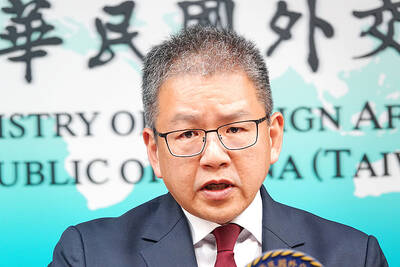
Taiwan is still in the process of assessing the possibility of recruiting workers from Eswatini, the Ministry of Foreign Affairs said yesterday, adding that its goal is to help Eswatini upgrade its vocational training centers. If there are plans to recruit workers from Eswatini, safeguarding national security, protecting public health and ensuring the employment rights of Taiwanese would be prerequisites, Department of West Asian and African Affairs Director-General Yen Chia-liang (顏嘉良) told a news conference. Key considerations would also include filling labor shortages in specific industries, and fostering bilateral professional and technical exchanges, he said. Yen was asked about the progress of labor
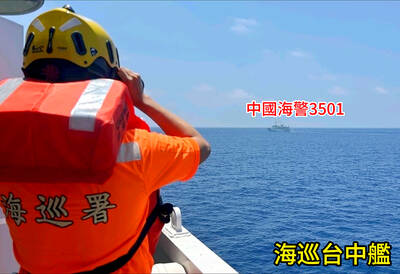
VERBOSE VESSELS: A CGA cutter and a China Coast Guard exchanged verbal barbs for more than a day in Taiwanese-controlled waters before the Chinese vessel left The Taiwanese and Chinese coast guards had a standoff near the strategically located Pratas Islands (Dongsha Islands, 東沙群島) in the north of the South China Sea, the Coast Guard Administration (CGA) said yesterday. The two sides engaged in intense radio exchanges over sovereignty claims during the 33-hour standoff. China Coast Guard vessel 3501 eventually left the restricted waters, 26.6 nautical miles (49.2km) west of the Pratas Islands, at 5pm yesterday, the CGA said. Lying approximately between southern Taiwan and Hong Kong, the Taiwan-controlled Pratas are seen by some security experts as vulnerable to Chinese attack due to their distance — more than


 RSS
RSS