


The Taipei District Court threw out an injunction request by Alstom-Siemens Eurotrain yesterday, deciding that negotiations between Taiwan High Speed Rail Corpora-tion (THSRC) and Japanese-backed Taiwan Shinkansen Consortium (TSC) did not constitute a basis for legal action by the European consortium.
The judge in the case ruled that Eurotrain failed to provide sufficient evidence for an injunction against THSRC.
The court decision came a day after reports of a letter to Premier Vincent Siew (
The Eurotrain consortium, led by Germany's Siemens AG and France's Alstom, has yet to decide whether to appeal the decision in Taiwan court or to file a request with an international arbitration court in Singapore.
Both the Eurotrain consortium and THSRC agreed in a 1997 accord to seek resolutions to any disputes in the arbitration court.
"Both an appeal and international arbitration could be possibilities. The decision will be made after Chinese New Year," said Phai Hua Way (
Furious at losing the construction bid to the Mitsubishi Heavy Industries-led Shinkansen consortium, Eurotrain requested a court order in mid-January to suspend any further negotiations and prevent the signing of a contract between THSRC and the TSC.
The filing of the injunction request was prompted by THSRC's announcement on Dec. 28 that it was awarding priority negotiating rights to TSC.
Eurotrain alleged the dramatic switch was in breach of the 1997 Eurotrain-THSRC agreement, which it claimed had obliged THSRC to sign a contract with it as long as its construction prices were considered reasonable.
In the 1997 deal, THSRC cited Eurotrain as its "preferred bidder" for the supply of train cars, locomotives, electronics and communication systems, and maintenance for the NT$440 billion rail project.
The court found, however, that the agreement did not give Eurotrain a guarantee on obtaining the construction contract, nor did it give the Europeans "exclusive" rights to negotiate with THSRC.
Furthermore, the court said, the provision on reasonable pricing implied that THSRC's negotiations with other parties could continue.
"The agreement does not exclude any other parties from negotiating with THSRC. And the plaintiff [Eurotrain], as a result, cannot assume it had the right to deter THSRC from signing contracts with other parties," the court reasoned.
"The agreement also required continuing negotiations for the parties to reach a common ground and to sign a binding contract. And in the course of negotiations, any disagreements could possibly prevent the contract from being signed," it added.
The court said Eurotrain still might have grounds to assert its negotiating rights on the basis of the 1997 agreement. It ruled, however, that the documents that Eurotrain had presented failed to provide grounds for blocking THSRC and TSC from signing contracts.
Eurotrain has used various means to protest THSRC's switch to the Shinkansen consortium. Prior to Patten's letter, Siemens AG chairman Heinrich von Pierer and heads of the German, French and British trade offices in Taipei had all met with high-ranking Taiwan officials to discuss the deal.

National Taiwan University (NTU) yesterday said it disqualified a person from an entrance examination for using AI smart glasses to cheat, along with two others for making untruthful statements in their curriculum vitae. The three applicants were given null scores, Taiwan’s highest-ranked university said, calling on prospective students to be honest in the admissions process. NTU registrar Lee Hung-sen (李宏森) said that the cheating applicant wore a hat and thick-rimmed glasses to the second written exam for medical school, claiming that they felt cold. Suspicions were aroused when the applicant stared oddly at the test for long stretches while steadily bringing the paper
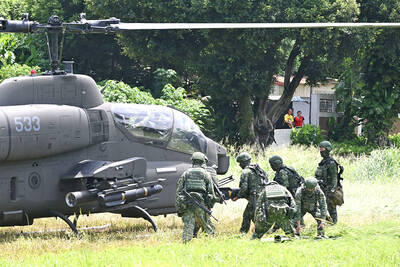
MILITARY ISSUES: A partisan divide between the Cabinet and the legislature ‘raised questions about Taiwan’s ability to adequately fund its defense,’ the report said Taiwan’s defense budget, military personnel numbers and resilience are challenges to its ability to meet national defense goals, the US Naval Institute said in a report published on Tuesday. In response to the perception of a growing military threat posed by China, Taiwan has embarked on an effort to enhance the capabilities needed to deter an attempt by Beijing to annex the nation by force, the institute said in the US Congressional Research Service report, titled Taiwan: Defense and Military Issues, which was filed on Thursday last week. Taiwan’s defense budget increased by about 7.5 percent from 2024 to last year, it

66 FIGHTER JETS: The aircraft is likely undergoing preparations for its transfer to Taiwan — a significant step forward in the nation’s modernization program, a lawmaker said The first of Taiwan’s order of F-16V Block 70 aircraft has been sighted in Texas ahead of delivery, Democratic Progressive Party (DPP) Legislator Wang Ting-yu (王定宇) said. Taiwan’s first F-16V Block 70 two-seat aircraft, tail number 6831, was seen flying from Lockheed Martin’s production facility in Greenville, South Carolina, to Naval Air Station Joint Reserve Base Fort Worth in Texas, Wang wrote on Facebook yesterday. The plane is likely undergoing preparations for its transfer to Taiwan, marking a significant step forward in the Republic of China Air Force’s modernization program, Wang said, citing military analysts. The F-16V Block 70 is a new-build version
NOT JUST NUMBERS: What matters to intelligence work is crucial, reliable information, so even a few credible leads can be highly valuable to national security, a legislator said The National Security Bureau (NSB) yesterday said it has finished the establishment of an information-reporting channel for Chinese nationals, the aim of which is to broaden intelligence gathering on China’s political, military, economic and social developments. Chinese nationals can submit information on the Web page, https://report.nsb.gov.tw, the NSB said in a statement. The move aims to expand the bureau’s diverse intelligence sources and is pursuant to the National Intelligence Services Act (國家情報工作法), it said, adding that it referenced practices adopted by intelligence agencies in the US, the UK and Israel. An increasing number of people are approaching Taiwanese agencies to provide information, as


 RSS
RSS