


Taiwan is not hostage to China's WTO bid and may still be able to conclude all procedures necessary for entering the world trade body by the end of the year, Taiwan's lead WTO negotiator said yesterday.
Lin Yi-fu (
"Even if China manages to conclude bilateral talks with the US soon, it does not mean that China will be formally admitted to the WTO immediately," Lin said.
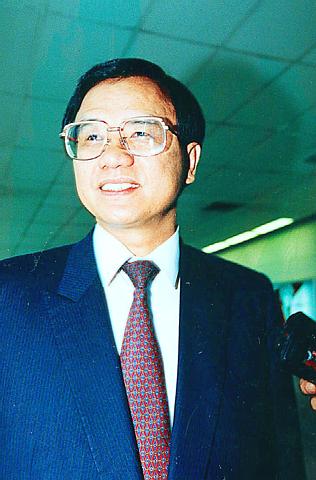
"Taiwan is actually far ahead of China in its negotiations for WTO entry," he said. "We have finalized all bilateral talks with major WTO members, including the US as well as the EU."
He said that Taiwan may still be able to join the world trade body by the end of the year.
Most analysts believe that Taiwan's accession to the WTO is being held captive to China's own accession. Not everyone agrees, though.
"There are some circles discussing whether, in view of China's delays, Taiwan's earlier admission can be used to influence China to come to the table ... with serious discussions on their own issues," said Nicholas Chen (
Chen also pointed out that the EU and the US are not inclined to make special concessions for China to get in and they want China to meet the same rules applied to all other economies. Complex internal political battles within China also seem to be preventing it from reaching consensus domestically, thus holding it back from forging external agreements, he said.
The thorny issue of trade concessions remains a crucial problem to be tackled by both China and the US before a bilateral trade agreement can be reached, Chen Ruei-long (
He said that despite the enthusiastic efforts of President Clinton in pushing forward a trade agreement with China, the key issue is whether either side is willing to make concessions.
According to Chen, among these issues is a five-year extension of textile import quotas past the current expiry date of 2005. Agreements on agriculture and dumping prices have also yet to be reached.
Whether US trade negotiators will bow to pressure from Con-gress is also a sticking point.
As for Taiwan's entry, Chen said that with a new round of trade negotiations beginning next year, further opportunities will exist for Taiwan to have its accession case reviewed, if it fails to gain entry by the end of the year.
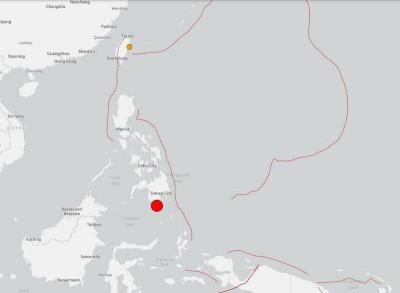
A magnitude 7.8 earthquake struck off the southern coast of Mindanao in the Philippines at 7:38am today, prompting the US Tsunami Warning System to issue an alert for neighboring countries, including Taiwan. The system issued a purple alert indicating a "tsunami threat." The potential threat zone includes Taiwan, the Philippines, Papua New Guinea, Yap and Palau. Philippine authorities were assessing the damage from the quake, with the office of civil defense seeking to verifying initial reports that 15 people had been killed and 129 injured in the region, mostly from falling debris. Arlene Hollero, disaster chief of Maasim town in the Philippines' Sarangani Province,
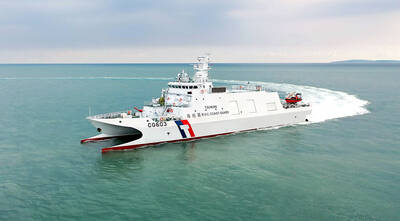
‘GRAY ZONE’ PRESSURE: Beijing’s activities are intended to create the deceitful impression that China has jurisdiction over the area around Taiwan, the CGA said Taiwan’s rights over its territorial waters and exclusive economic zone must not be violated by any country, the Mainland Affairs Council said yesterday, adding that it will not accept any unprovoked actions. The council issued the remarks in response to the China Coast Guard conducting maritime enforcement drills near eastern Taiwan and claiming to fully exercise China’s maritime administrative law enforcement authority. The Coast Guard Administration (CGA) has been closely monitoring the situation and is taking concrete steps to defend the nation’s sovereignty and secure its waters, the council said. China has no sovereign rights over the waters off eastern
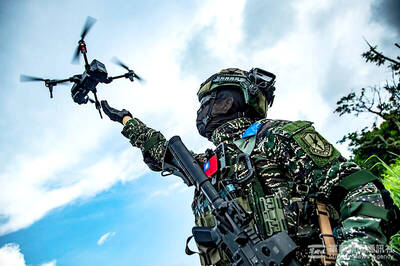
RESILIENCE: Taiwan plays a key role in semiconductors, energy, information infrastructure and advanced manufacturing, AIT Director Raymond Greene said Taiwan’s continued investment in deterrence and resilience remains vital, especially in uncrewed systems and other emerging technologies, American Institute in Taiwan (AIT) Director Raymond Greene said yesterday. Greene made the remarks at the annual National Strategic Summit on Supply Chain Resilience held by the Research Institute for Democracy, Society and Emerging Technology (DSET), a government-backed think tank. As Taiwan last year became the US’ fourth-largest trading partner and supply chain security is becoming more important, cooperation in emerging technologies continues to deepen between the two countries, he said. The US is committed to accelerating innovation, building key infrastructure, strengthening cooperation

RIGHT DIRECTION: Taiwan’s efforts to prevent forced labor include a proposal to ‘fully prohibit’ employers from withholding workers’ documents, an official said Taiwan is to establish a mechanism to restrict imports of goods linked to forced labor, the Executive Yuan said yesterday, after the US proposed imposing additional tariffs on Taiwanese goods over labor concerns. “The Ministry of Labor and the Ministry of Economic Affairs are to establish an interministerial review procedure,” Executive Yuan spokesperson Michelle Lee (李慧芝) said at a news briefing in Taipei. “The government is to use the Foreign Trade Act [貿易法] as the legal basis to restrict imports of goods produced with forced labor” and bring its supply chain governance more in line with international standards on human rights, resilience


 RSS
RSS