


It’s 3am and I’m stranded in a town where there’s nothing but endless stalls selling grilled chicken. I had barely fallen asleep on the grueling sleeper bus — where I have to share a tiny bed with a stranger — when I’m told to get off here.
Using Lao, the attendant tells me how to proceed, and of course I don’t understand. A few women approach the bus and sell a few grilled chickens-on-a-stick, and the bus drives off. As if things aren’t surreal enough, my savior comes in the form of a heavyset Lao man with tattoos all over his shaved head holding two bags of limes. He speaks decent English and helps me get on the right transfer to Savannakhet, the sleepy second-largest city in Laos.
Such is traveling in the central and southern parts of Laos, which is one of the least visited countries in Southeast Asia with 4.1 million international arrivals in 2018. By comparison, its popular neighbor, Thailand, saw 38.3 million foreign visitors that year.
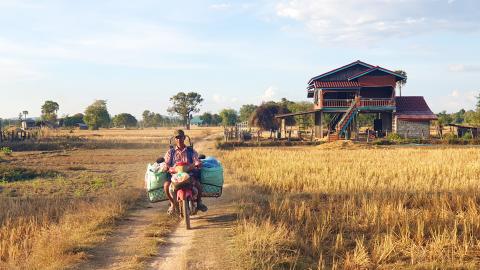
Photo: Han Cheung, Taipei Times
Most tourists seem to prefer the north, flocking to the backpacker havens of Luang Prabang and Vang Vieng and exploring the countryside from there. But anything could happen in a place like Savannakhet, where there’s little foreign tourism infrastructure and locals are still excited to see visitors. I was invited by strangers to family parties and a cock fight, grilled fish with locals in a rural village and shared nachos with a Lao-American in an Indian-run guesthouse that somehow served amazing Tex-Mex.
“I should introduce you to my sister-in-law,” the Lao-American says after a few Beerlaos. “She’s wonderful. Wait, I shouldn’t. You’ll break her heart.”
SANTA IN VIENTIANE
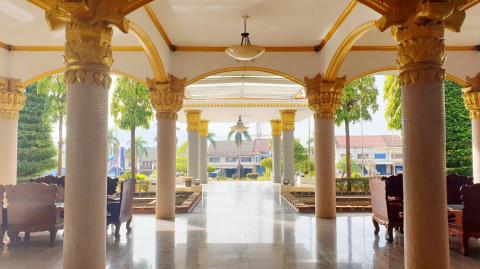
Photo: Han Cheung, Taipei Times
Like most countries in Asia, Laos is changing quickly, especially with Chinese money pouring in. Tourism to the country jumped by over 8 percent from 2017 to 2018, and I felt that now was time to visit.
I flew into the capital Vientiane and followed along side the Mekong River by bus to the very south of the country. The experience was well worth the inconveniences, as even the “touristy” places were relatively devoid of crowds.
Vientiane is probably the most laid back capital I’ve ever been to, but with construction everywhere, it might not stay this way for long. The high speed railway connecting the city to China is slated for completion next year, which will cut the travel time from 18 hours to three. But for now, I stand on top of the Patuxai monument — a Lao version of the Arc de Triomphe — and gaze down at the city’s mostly empty main boulevard.
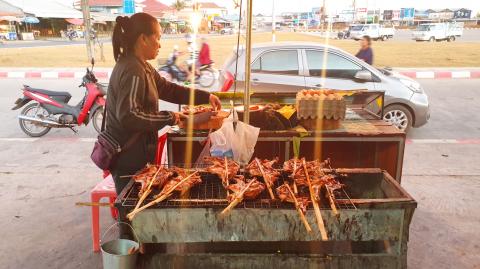
Photo: Han Cheung, Taipei Times
I spend two days biking around the town, visiting ancient temples and watching the stunning sunset over the Mekong River. I pass by store after store selling nothing but Santa suits for all genders and ages, and wonder if the entire city’s population will get dressed up in red and white for Christmas Day.
It’s pleasant, but it isn’t really pretty and there’s not much to do, so I start my trek toward Savannakhet. None of the foreigners I meet are going there — most skip the entire central section of Laos straight to the southern tourism hub of Pakse. Aside from wanting to break up my journey, the history geek in me was drawn to Hotay Pidok, a 17th century Buddhist library containing over 4,000 palm leaf scriptures.
GRILLED CHICKEN BLUES
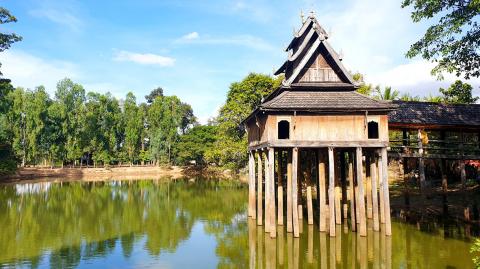
Photo: Han Cheung, Taipei Times
As mentioned, my bed mate on the bus is an affable old fellow, but the ride is still extremely uncomfortable and I probably get about 15 minutes of shut-eye during the seven-hour trip. In retrospect, I should have just purchased two tickets — it would have just cost me an extra NT$350.
After the chicken town ordeal, I wearily arrive in Savannakhet at 5:30am. If Vientiane was sleepy, this place is frozen in time. The French colonial buildings in the historic quarter are slowly crumbling, and there are more dogs on the street than humans. But change seems to be coming here too, as the city is undergoing a massive overhaul of its waterfront. I watch the sunrise here until construction workers arrive to start their day’s work.
Thankfully, the friendly Indian owner of Pilgrim’s Kitchen and Inn lets me check into my room early, and I immediately fall asleep. I wake up in the afternoon and get lost in the streets — it’s both eerie and lovely, the gem being a seemingly abandoned art deco movie theater from the 1970s.
I pass by a karaoke bar where drunken middle-aged men are belting out tunes. They motion for me to join, but I pass.
However, when I’m invited to join a family gathering while strolling through the village of Ban That Ing Hang, I think, why not. It’s a four-generation affair and they generously share their food and drink with me despite only speaking rudimentary English.
I forget where I’m going and let local hospitality lead the way. I end up attending a cock fight, visiting an organic farm and finishing the day with a home-cooked meal of grilled fish. Only one of all the people, Jin, speaks decent English, and she offers to drive me to Hotay Pidok the next day.
On the way back to Savannakhet, Jin suggests getting some of the area’s famous grilled chicken. We approach a familiar intersection, and she parks right in front of the spot where I was stranded two nights before. I look at the chickens-on-a-stick and burst out in laughter.
FROM PALACE TO HAMMOCK
There’s really no need to rough it in Laos since prices are so cheap. I’m paying NT$800 to stay in an actual palace in Pakse, built for a prince who never got to move in as the Pathet Lao, a communist group, overthrew the royal government in 1974.
I try not to spend any time in this town, as there are more tourists on the street than locals. There’s a lot to see in the vicinity, from riverside settlements to quaint islands to the Bolaven Plateau, known for its ethnic minority villages and coffee plantations. Don’t skip Wat Phu even if you’ve been to Angkor Wat. While the architecture cannot compare, I had the entire place to myself — save for vendors and picnicking locals — by skipping the morning tourist crowds and arriving around 3pm.
I pass through the riverside settlement of Champasak on the way back, and enjoy a delicious meal of crispy rice and pork wrapped in lettuce with banana flowers and a plethora of herbs at Homemade Restaurant.
Pressed for time and not yet fully recovered from all the grueling bus travel, I skip Bolaven and opt to relax at Si Phan Don (4,000 islands) at the Laos-Cambodia border. There aren’t actually 4,000 islands, and visitors mostly head to the big three: Don Det is the party island with plenty of backpackers and “happy shakes” sold in the open; Don Khon is the calmer one with waterfalls; and Don Khong is their less-visited but livelier cousin with roads, cars and ATMs.
But I wanted something even more remote. On my way to dinner in Pakse, I happen to see a flyer advertising Don Som and its only guesthouse. I set out the next day, and on a bus full of foreigners, I’m the only one going there.
I spend the day lazing in a hammock, walking through the picturesque farmlands and enjoying Don Som Riverside Guesthouse’s food and hospitality. Locals are incredibly friendly. At one point I get dragged by an elderly man to his garden to munch on fresh cucumbers with his grandkids, while other visitors recount their adventures at a funeral party the previous night.
I do go to Don Det and Don Khon to see what all the fuss is, but I would have been perfectly content chilling on Don Som the whole time. It’s easy to see why people like these islands: they’re pretty and dotted with bars, guesthouses and cafes, and Don Khon has an impressive waterfall, a secluded beach and a riverside coffee bar with comfy bungalow seats.
But the atmosphere is completely different, and the locals look like they’re tired of seeing partying foreigners. I hurry back to undeveloped and tranquil Don Som, its friendly people and my hammock, where I forgo the rest of my plans and extend my stay until it’s absolutely time to go.
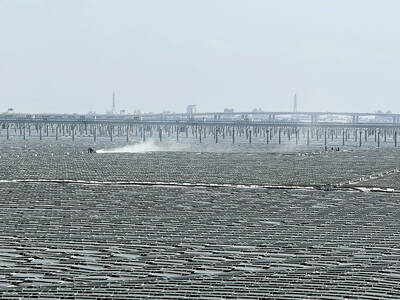
The arithmetic is straightforward and uncomfortable. By the end of 2025, Taiwan had committed itself to a 50-30-20 electricity mix — half natural gas, 30 per cent coal, 20 per cent renewables. The Ministry of Economic Affairs’s (MOEA) own monthly energy reports tell a different story. Natural gas reached 47.8 per cent of generation last year. Coal stood at 35.4 per cent, comfortably above its target ceiling. Renewables came in at 13.1 per cent, well short of the 20 per cent Taipei had pledged a decade earlier. Installed renewable capacity reached roughly half of the 12 gigawatts (GW) the government

There are shadowy cabals plotting to sell out Taiwan to be annexed by China, by invasion if necessary. Fortunately, they are buffoons. In 2019, former Bamboo Union gangster and founder of the China Unification Promotion Party (CUPP), Chang An-le (張安樂, colorfully known as “White Wolf”), led a protest at the Legislative Yuan against comments made by then-premier Su Tseng-chang (蘇貞昌) that in the event of an attack by China, he would never surrender, but would protect the nation by fighting to the end, even if he only had a broom. Chang had party members bring a wooden casket that they
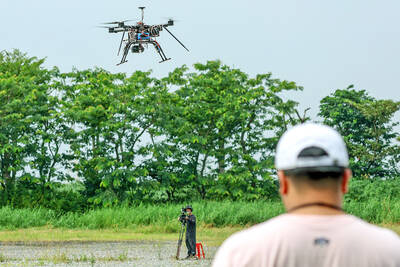
Taiwan’s drone exports are taking off, fuelled by the war in Ukraine, as Taiwanese companies seek a stake in the fast-growing global market for unmanned aerial vehicles (UAV). Low-cost drones used for reconnaissance and strikes are in high demand as governments around the world boost defense spending in the face of intensifying conflicts. A relative new player in the increasingly competitive industry, Taiwan’s pitch is to be an “Asian hub” for the production of UAVs and components free of Chinese materials, or “non-red.” That means its UAVs can be up to three times more expensive than their Chinese competitors, like the world’s biggest
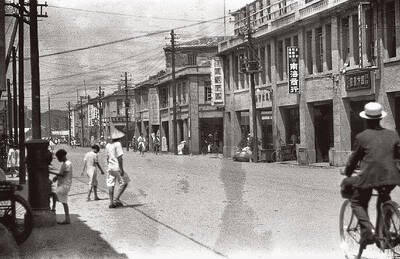
June 1 to June 7 "If all Taiwanese were as afraid of dying as you, then what would happen?” Physician Shih Chiang-nan (施江南) reportedly said this to his wife Chen Chiao-tung (陳焦桐) after she urged him to stop intervening on behalf of Taiwanese soldiers stranded overseas after serving in the Japanese Army during World War II. Shih had clashed with high-ranking officials over the issue, engaged in several heated arguments with Taiwan governor-general Chen Yi (陳儀) and allegedly shouted at general Ko Yuan-fen (柯遠芬), chief of staff of the Taiwan Garrison Command, over


 RSS
RSS