


With two young daughters, Mery Montenegro is preparing to add Disney+ to her list of streaming subscriptions, which already includes Netflix, Hulu and Amazon — and, when combined with her cable TV bill, costs her almost US$1,500 per year.
Her eldest Victoria, 6, asks every day when the new platform will launch, with its impressive catalogue of films and series from all of Disney’s studios.
The answer is Nov. 12: Mery, who works at an advertising agency in Washington, knows the date well. It’s the day she’ll start paying US$6.99 more per month.
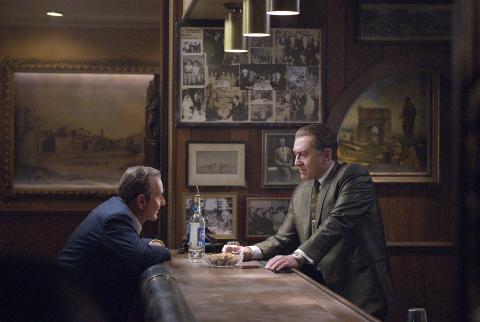
Photo: Netflix via AP
Disney+, HBO Max (AT&T), Peacock (Comcast), Apple TV+ and the new short video platform Quibi are all players in a streaming war that will only grow worse at a time when more Americans prefer streaming to cable.
“It’s going to have a huge impact on people’s budgets,” said Tom Nunan, an Oscar-winning film producer and professor at the University of California, Los Angeles (UCLA) School of Theater, Film and Television. “I don’t think that there is enough room for subscription relationships with all of these streamers for a typical American.”
In a Deloitte survey published in March, 69 percent of respondents said they had at least one streaming subscription, while 65 percent said they had cable. And while many households have cut the cord to go cable-free with the advent of streaming, 43 percent of those surveyed were paying for both.
Mery, 36, is in the third group, and not by choice.
In her neighborhood of Alexandria, west of the US capital, she says she found no Internet-only option cheaper than her current plan, so she pays US$90 per month for a cable subscription she “hardly” uses, other than for news or the occasional baseball game.
To that, she adds US$5.99 each month for Hulu — the service’s cheapest plan, with commercials — and US$16 for Netflix, which she considers essential.
“I use it on the subway when I go to work, to cook, to watch something at home,” she explained.
Mery also pays US$12.99 per month for e-commerce giant Amazon’s Prime membership, which includes its streaming service. Prime is also useful for renting movies, which Mery prefers over the cinema, curling up with a glass of wine after the girls have gone to bed.
That’s US$124.98 per month, soon plus US$6.99 for Disney+. Total: US$131.97 per month, or US$1,583.64 per year.
THE IRONY OF CABLE
That’s where Mery draws the line, since she doesn’t want to spend her whole paycheck on subscriptions. But the streaming options are limitless.
From YouTube, which has a Premium version for US$11.99 per month, to platforms for Broadway lovers or wrestling fans, to all professional sports leagues, which offer different packages for fans.
The Los Angeles Times previously listed 40 streaming options, which would cost a total of US$353.43 per month, but the Deloitte survey mentioned up to 300 different streaming services.
Almost half of people surveyed (47 percent) said they were “frustrated by the growing number of subscriptions and services,” which make it “harder to find the content they want,” the study said.
“Back at the beginning, it wasn’t a hard decision... to sign up for Netflix or Amazon. It was just two streamers,” said Nunan.
“But am I really going to sign up for six streamers or seven? As the normal consumer, I doubt it,” he said.
Gene Del Vecchio, a marketing professor at the University of Southern California (USC) who specializes in entertainment, estimated that users will end up with the same complaint that currently causes them to drop cable: they spend a lot of money for a lot of programs they don’t watch.
“I think what may happen is that they will look for one a la carte menu,” he said.
“They will start to say, I just want these individual shows, and I don’t want to pay for all of this other programming that I never watch.”
Amazon already allows people to buy episodes or seasons, without subscribing to Prime Video.
Del Vecchio also thinks subscription rates will increase over the next decade to finance original shows, and that streamers will seek to end the current strategy where several friends or family members share one account, in an effort to gain new paying users.
Another strategy, similar to cable plans, will be to offer discounted annual contracts. Disney+ is already doing this, as is Amazon.
“Here’ the ironic thing: five, 10 years from now, it’s going to look like the cable industry all over again,” predicted Del Vecchio.

This month the government ordered a one-year block of Xiaohongshu (小紅書) or Rednote, a Chinese social media platform with more than 3 million users in Taiwan. The government pointed to widespread fraud activity on the platform, along with cybersecurity failures. Officials said that they had reached out to the company and asked it to change. However, they received no response. The pro-China parties, the Chinese Nationalist Party (KMT) and Taiwan People’s Party (TPP), immediately swung into action, denouncing the ban as an attack on free speech. This “free speech” claim was then echoed by the People’s Republic of China (PRC),

Exceptions to the rule are sometimes revealing. For a brief few years, there was an emerging ideological split between the Democratic Progressive Party (DPP) and Chinese Nationalist Party (KMT) that appeared to be pushing the DPP in a direction that would be considered more liberal, and the KMT more conservative. In the previous column, “The KMT-DPP’s bureaucrat-led developmental state” (Dec. 11, page 12), we examined how Taiwan’s democratic system developed, and how both the two main parties largely accepted a similar consensus on how Taiwan should be run domestically and did not split along the left-right lines more familiar in

Most heroes are remembered for the battles they fought. Taiwan’s Black Bat Squadron is remembered for flying into Chinese airspace 838 times between 1953 and 1967, and for the 148 men whose sacrifice bought the intelligence that kept Taiwan secure. Two-thirds of the squadron died carrying out missions most people wouldn’t learn about for another 40 years. The squadron lost 15 aircraft and 148 crew members over those 14 years, making it the deadliest unit in Taiwan’s military history by casualty rate. They flew at night, often at low altitudes, straight into some of the most heavily defended airspace in Asia.

Many people in Taiwan first learned about universal basic income (UBI) — the idea that the government should provide regular, no-strings-attached payments to each citizen — in 2019. While seeking the Democratic nomination for the 2020 US presidential election, Andrew Yang, a politician of Taiwanese descent, said that, if elected, he’d institute a UBI of US$1,000 per month to “get the economic boot off of people’s throats, allowing them to lift their heads up, breathe, and get excited for the future.” His campaign petered out, but the concept of UBI hasn’t gone away. Throughout the industrialized world, there are fears that


 RSS
RSS