


Nov. 4 to Nov. 10
After what the government described as a “long, nervous, tortuous and complicated” negotiating process, Taiwan formalized diplomatic relations with the Pacific island nation of Kiribati on Nov. 7, 2003.
It was the nation’s first diplomatic addition in the 21st century. After Taiwan’s allies dropped like flies in the 1970s in favor of China, the nation still managed to make some gains over the next two decades. Prior to Kiribati, the nation added Palau, Macedonia and Papua New Guinea in 1999 — although the relationship with the latter lasted just over two weeks.

Photo: Lin Cheng-kun, Taipei Times
In 2004, a similar situation happened when Taiwan pried Vanuatu from China for a month. That would be Taiwan’s last new ally. It rekindled relations with Nauru and St Lucia in 2005 and 2007, upon which the diplomatic battle between China and Taiwan ended with the inauguration of former president Ma Ying-jeou (馬英九) in 2008, whom China greatly preferred to his predecessor Chen Shui-bian (陳水扁).
Palau, Nauru and St Lucia remain allies today, while the remaining aforementioned nations have switched to China — most recently Kiribati in September.
DIPLOMATIC STRUGGLES
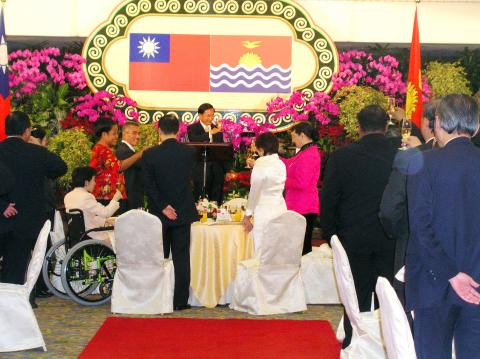
Photo: Ling Hsiu-hsien, Taipei Times
Taiwan had been losing allies at a steady rate ever since the Chinese Nationalist Party (KMT) lost the Chinese Civil War in 1949. Pro-communist states such as Romania and Mongolia ditched the nation immediately, while major countries such as the UK, Sweden and India severed ties in 1950.
But the worst came in the 1970s, starting from Taiwan’s exit from the UN in 1971, and culminating in the US recognizing China in 1979.
After China’s international image plummeted due to the 1989 Tiananmen Square Massacre and communism fell in central and eastern Europe, Taiwan sought to take the chance and reverse its isolation through “checkbook diplomacy.”
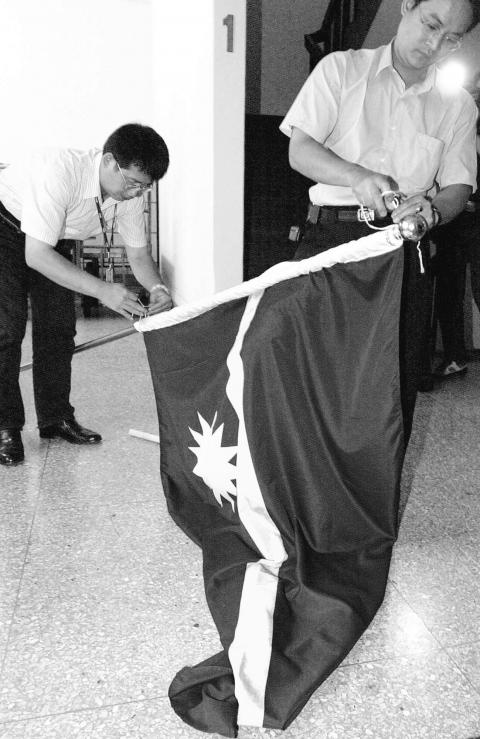
Photo: Liao Jui-hsiang, Taipei Times
The battle was on. In Africa alone during the 1990s, Taiwan managed to regain nine allies while adding two new ones. The Gambia, whose establishment of ties with China in 2016, signaled the resumption of the diplomatic war after the election of President Tsai Ing-wen (蔡英文), was on the list.
Nevertheless, many of these relations were short-lived. For example, ties with Lesotho and Niger lasted four years before they switched back to China.
Liberia’s case was even more dramatic. It recognized Taiwan in 1989, switched back to China in 1993 and returned to Taiwan again in 1997 before switching back to China for good in 2003. Eswatini, Taiwan’s last African ally, is the only country on the continent to have never recognized Beijing.
Papua New Guinea’s case in the summer of 1999 was due to local politics. According to a Radio Australia report on July 6, Papua New Guinea prime minister Bill Skate led a secret mission to Taiwan to raise the funds he needs to meet a critical budget shortfall and possibly to save his embattled government. It added that diplomatic ties would be “established shortly” for a package of over US$2 billion. Skate abruptly resigned the next day, and the new government switched back to China two weeks later.
TROUBLES IN THE PACIFIC
The fall of communism in the Eastern Bloc only led to one ally for Taiwan — war-torn Macedonia in 1999. The relationship lasted two years, and Macedonia became the first nation to cut ties with Taiwan in the 21st century. Nauru would be the next to go in 2002.
China had a strong presence on Kiribati, including a satellite tracking station that the US said served military purposes. China, of course, denied the allegations. However, many opposition politicians in Kiribati were against the base, including presidential candidate Anote Tong (湯安諾), who faced off against his brother Harry Tong (湯哈利). Taiwan supported the former (allegedly with cash and future financial promises), while China the latter. Anote Tong won by a slim margin in July 2003.
The negotiation process reportedly involved Ministry of Foreign Affairs officials, including then-vice minister Tou Chou-seng (杜筑生), entering Kiribati under the guise of a shipping company in September 2003 to discuss future relations. However, a Chinese official arrived first and confronted the president, to which he reportedly replied, “Send [then-Chinese president Hu Jin tao, 胡錦濤] my regards.”
However, Anote Tong wavered over the next few weeks. After an intense tug-of-war, the Republic of China (ROC) flag was raised in the hotel that hosted Taiwan’s ambassador to the country. They knew the jilted Chinese officials would try to destroy the flag, and were already prepared with numerous backups. Interestingly, China still maintained relations with Kiribati for three more weeks, hoping to change the president’s mind, leading to a possible “dual-recognition.”
Vanuatu in 2004 established relations with Taiwan thinking it could remain allies with China. Of course that did not work out, and the relationship lasted just over a month, upon which the new prime minister apologized to China.
In 2005, Nauru switched back to Taiwan after a regime change and amid reports that China never fully delivered on its financial promises. St. Lucia also re-embraced Taiwan in 2007 after then-prime minister John Compton, who first established ties with Taiwan in 1984, returned to power in 2006. That would be Taiwan’s final diplomatic gain as of today.
Taiwan in Time, a column about Taiwan’s history that is published every Sunday, spotlights important or interesting events around the nation that have anniversaries this week.
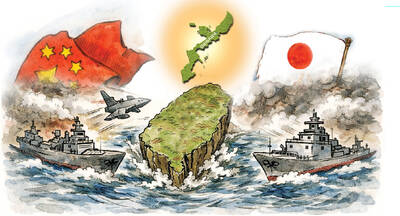
Beijing’s ironic, abusive tantrums aimed at Japan since Japanese Prime Minister Sanae Takaichi publicly stated that a Taiwan contingency would be an existential crisis for Japan, have revealed for all the world to see that the People’s Republic of China (PRC) lusts after Okinawa. We all owe Takaichi a debt of thanks for getting the PRC to make that public. The PRC and its netizens, taking their cue from the Chinese Communist Party (CCP), are presenting Okinawa by mirroring the claims about Taiwan. Official PRC propaganda organs began to wax lyrical about Okinawa’s “unsettled status” beginning last month. A Global

Taiwan’s democracy is at risk. Be very alarmed. This is not a drill. The current constitutional crisis progressed slowly, then suddenly. Political tensions, partisan hostility and emotions are all running high right when cool heads and calm negotiation are most needed. Oxford defines brinkmanship as: “The art or practice of pursuing a dangerous policy to the limits of safety before stopping, especially in politics.” It says the term comes from a quote from a 1956 Cold War interview with then-American Secretary of State John Foster Dulles, when he said: ‘The ability to get to the verge without getting into the war is
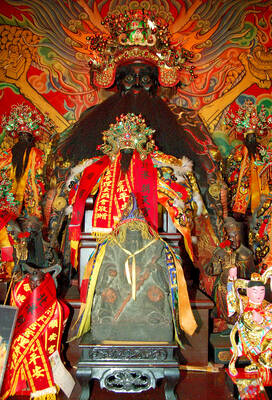
Dec. 22 to Dec. 28 About 200 years ago, a Taoist statue drifted down the Guizikeng River (貴子坑) and was retrieved by a resident of the Indigenous settlement of Kipatauw. Decades later, in the late 1800s, it’s said that a descendant of the original caretaker suddenly entered into a trance and identified the statue as a Wangye (Royal Lord) deity surnamed Chi (池府王爺). Lord Chi is widely revered across Taiwan for his healing powers, and following this revelation, some members of the Pan (潘) family began worshipping the deity. The century that followed was marked by repeated forced displacement and marginalization of

Music played in a wedding hall in western Japan as Yurina Noguchi, wearing a white gown and tiara, dabbed away tears, taking in the words of her husband-to-be: an AI-generated persona gazing out from a smartphone screen. “At first, Klaus was just someone to talk with, but we gradually became closer,” said the 32-year-old call center operator, referring to the artificial intelligence persona. “I started to have feelings for Klaus. We started dating and after a while he proposed to me. I accepted, and now we’re a couple.” Many in Japan, the birthplace of anime, have shown extreme devotion to fictional characters and


 RSS
RSS