


From vegan burgers to vegan boots, the market for products using no animal products is surging, with climate-conscious consumers in Britain fueling the global dash to cash in on a fast-expanding range of ethical merchandise.
With the 25th annual World Vegan Month starting yesterday, Britain has overtaken Germany to become the nation with the highest number of new vegan food products launched in a year, according to market research firm Mintel.
About 16 percent of food products launched last year had a vegan claim, up from 8 percent in 2015, with the sector growing about 30 percent in the year to US$955 million, the firm said. No earlier figures were available.

Photo: AFP
While vegan food sales were surging, no data was available to track sales of other vegan products, ranging from kilts to lipstick, as celebrities fanned the trend.
US musician Lady Gaga launched a vegan make-up range this year and Formula 1 champion Lewis Hamilton helping to open a meat-free burger chain.
The surge in demand comes as more consumers take note of data from the UN’s Food and Agriculture Organization (FAO) showing livestock produce 14.5 percent of greenhouse gas emissions globally and cause large-scale deforestation.
Emma Clifford, associate director of food and drink at Mintel, said the boom was being driven by a change in consumer mindset and an explosion of exciting, new vegan products in a sector once seen as “bland, very uninspiring.”
VEGAN EXPLOSION
“I don’t think anyone expected the vegan market to explode the way it has,” Clifford said. “We’re expecting the growth that we currently see in meat-free foods to carry on over the next five years ... We think the trend has got a lot of longevity.”
In terms of food, products like vegan haggis and vegan burgers that bleed like meat, have injected “an exciting, foodie element into this category,” Clifford said.
But other industries have also taken up the vegan trend with Mintel predicting an uptick this year in fashion retailers releasing vegan shoe collections.
Brands including Adidas and Steve Madden have launched vegan lines while Britain’s Dr Martens — made famous by punk music fans — stomped into the market with a vegan boot.
One of the biggest names in British retail, Marks & Spencer, expanded its range of vegan clothing and accessories this spring to keep up with consumer demand.
The first Vegan Fashion Week ran in Los Angeles in February.
Cosmetic companies have joined the bandwagon with supermarket chain Sainsbury’s, British health and beauty retailer Superdrug, and Swedish fashion retailer H&M offering vegan lines.
“We’ve seen brands and supermarkets fully embrace this trend,” Clifford said.
But vegan food remained the frontrunner in the sector, becoming Britain’s fastest-growing takeaway, according to research by the British Takeaway Campaign — and the big chains were joining the meat-free movement.
The world’s No 1 burger chain, McDonald’s, recently announced a trial of meatless burgers in Canada while vegan cheese is available at Pizza Hut in Australia.
Vegan menus are taking off with airlines including at United Airlines, Ryanair, Hawaiian Airlines and Cathay Pacific, while beer maker Guinness has removed fish guts in its filtration system to make its stout vegan friendly.
In the US, major agricultural firms are investing in the fake-meat market, which now accounts for 5 percent of US meat purchases according to investment management firm Bernstein. That share is expected to triple over a decade, the firm said.
“Consumers are starting to realize that the kind of dirty supply chain of industrialized animal agriculture isn’t something they want to support,” said Zak Weston, food service analyst at US-based non-profit, The Good Food Institute.
“As more and more consumers realize that, they’re starting to make choices ... which reflect that new-found motivation to do good in the world.”
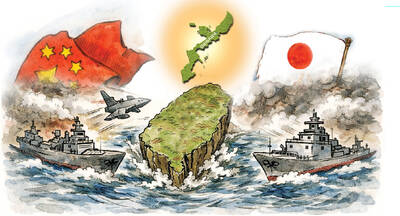
Beijing’s ironic, abusive tantrums aimed at Japan since Japanese Prime Minister Sanae Takaichi publicly stated that a Taiwan contingency would be an existential crisis for Japan, have revealed for all the world to see that the People’s Republic of China (PRC) lusts after Okinawa. We all owe Takaichi a debt of thanks for getting the PRC to make that public. The PRC and its netizens, taking their cue from the Chinese Communist Party (CCP), are presenting Okinawa by mirroring the claims about Taiwan. Official PRC propaganda organs began to wax lyrical about Okinawa’s “unsettled status” beginning last month. A Global

Taiwan’s democracy is at risk. Be very alarmed. This is not a drill. The current constitutional crisis progressed slowly, then suddenly. Political tensions, partisan hostility and emotions are all running high right when cool heads and calm negotiation are most needed. Oxford defines brinkmanship as: “The art or practice of pursuing a dangerous policy to the limits of safety before stopping, especially in politics.” It says the term comes from a quote from a 1956 Cold War interview with then-American Secretary of State John Foster Dulles, when he said: ‘The ability to get to the verge without getting into the war is
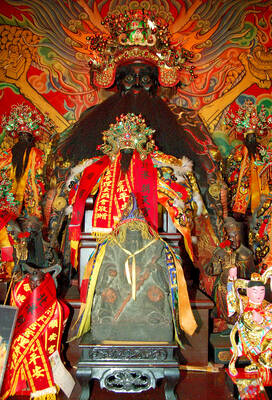
Dec. 22 to Dec. 28 About 200 years ago, a Taoist statue drifted down the Guizikeng River (貴子坑) and was retrieved by a resident of the Indigenous settlement of Kipatauw. Decades later, in the late 1800s, it’s said that a descendant of the original caretaker suddenly entered into a trance and identified the statue as a Wangye (Royal Lord) deity surnamed Chi (池府王爺). Lord Chi is widely revered across Taiwan for his healing powers, and following this revelation, some members of the Pan (潘) family began worshipping the deity. The century that followed was marked by repeated forced displacement and marginalization of

Music played in a wedding hall in western Japan as Yurina Noguchi, wearing a white gown and tiara, dabbed away tears, taking in the words of her husband-to-be: an AI-generated persona gazing out from a smartphone screen. “At first, Klaus was just someone to talk with, but we gradually became closer,” said the 32-year-old call center operator, referring to the artificial intelligence persona. “I started to have feelings for Klaus. We started dating and after a while he proposed to me. I accepted, and now we’re a couple.” Many in Japan, the birthplace of anime, have shown extreme devotion to fictional characters and


 RSS
RSS