


Oct. 28 to Nov. 3
In late 1927, Taiwan’s cultural elite were shocked to find that none of their prominent artists were selected to participate in the inaugural Taiwan Arts Exhibition. Instead, three unknown 19-year-olds were the only Taiwanese to make the cut for the government-sponsored show: Kuo Hsueh-hu (郭雪湖), Lin Yu-shan (林玉山) and Chen Chin (陳進).
The trio were dubbed the “Three Youths” (三少年), and the uproar over the incident launched their prestigious and fruitful careers. Chen is especially known as Taiwan’s first female painter, and her distinct depictions of female figures is instantly recognizable.
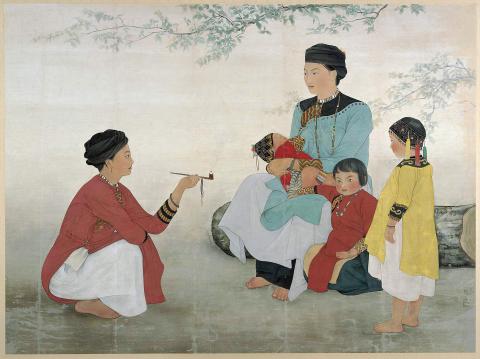
Photo: Ling Mei-hsueh, Taipei Times
According to the introduction to the 2009 exhibit, “The Three Youths of Taiwan Fine Arts Exhibition” (台展三少年), they were selected “due to their pure, fresh and realistic style of painting from [everyday] life” that broke away from traditional practices.
“These three youths used gouache, color ink and other media to express their deep personal feelings and in-depth observations regarding the scenery, personages and conditions of the people of their homeland.”
All three lived extremely long lives, with Kuo the last to pass away — in 2012 — at the age of 104. Chen painted well into the 1990s, with her subject matter continuously reflecting changes in society and her life — for example, in 1994, she completed Playing Video Games (玩電玩), which depicted her two grandsons playing Super Mario Brothers in their living room.
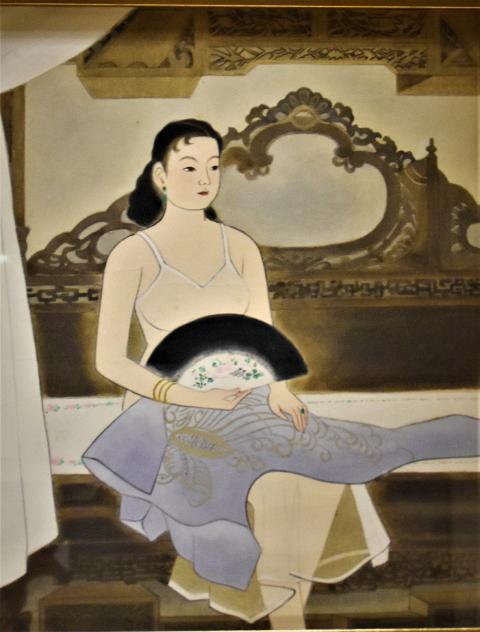
Photo courtesy of Wikimedia Commons
RISE TO FAME
Chen was born into a wealthy family in Hsinchu on Nov. 2, 1907. At the age of 15, she entered Taipei’s Third Girls High School (today’s Zhongshan Girls High School) and picked up the paintbrush for the first time. While she excelled in many subjects, it was her art teacher Gobara Koto who strongly encouraged her to pursue art. Chen’s father agreed right away.
In the spring of 1925, Chen boarded a ship bound for Japan to study at the prestigious Women’s School of Fine Arts. The Tokyo University of the Arts did not accept females until 1946.
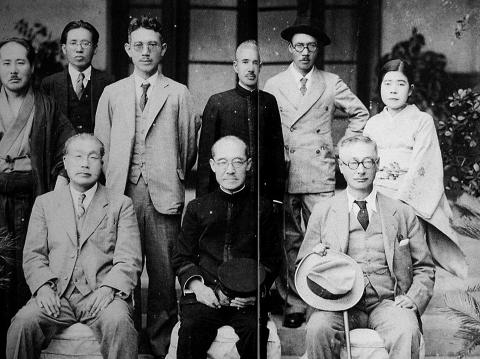
Photo courtesy of Wikimedia Commons
In those days, studying abroad was reserved for privileged families, and usually reserved for sons. It was even uncommon to study the arts — renowned painter Yang San-lang (楊三郎) had to secretly board a ship to Japan to pursue his studies. But Chen’s father fully supported her endeavors while most of her classmates got married and had children. In fact, she became the first Taiwanese woman to study art in Japan.
“I’m very fortunate to have an open-minded father, who was willing to spend any amount of money for my education,” she says. But he was also very strict, often scolding Chen for not working hard enough.
Two years later, Chen became a household name due to the media frenzy surrounding her selection to the Taiwan Fine Arts Exhibition. The established artists who were not chosen criticized the decision, and held their own “exhibit for the rejected” in the Taiwan Daily News (台灣日日新報) headquarters.
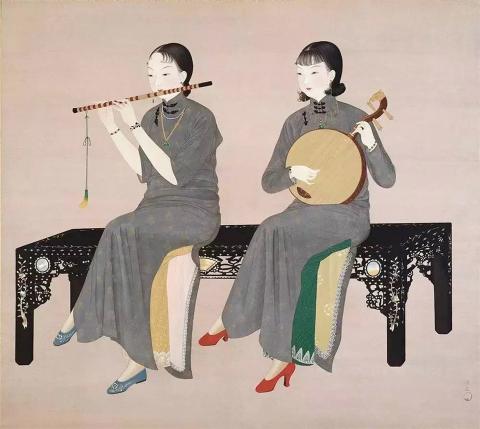
Photo: Sun Yi-fang, Taipei Times
The Fine Arts Exhibition was a government directive to steer Taiwan’s art scene away from traditional Chinese influences and toward modern and Western styles in tune with the Meiji Restoration.
“This island, which had little culture, has been under Japanese rule for 30 years and its artistic taste has greatly improved,” read an official statement.
This is the main reason why the established painters were not chosen, as the colonial government preferred young Taiwanese who were born and raised under Japanese rule. Chen continued to shine in the exhibition in the following years.
Although her artistic education was completely Japanese, her work still mostly focused on daily life of mostly upper class Taiwanese women.
Eight years later, Chen made the news again when her iconic painting Ensemble (合奏) made it into the Imperial Fine Arts Academy Exhibition in Tokyo. The two female musicians in the piece sat on distinctly Taiwanese chairs, played traditional instruments and dressed in the typical fashion of Taiwanese upper class ladies in the 1930s.
The newspapers jumped on the achievement by a young woman from a backwater colony, further bolstering her reputation. “Taiwan is a wonderful place,” she told the Japanese reporters. “Who doesn’t love the place they grew up in?”
REFLECTING THE DECADES
In 1934, Chen returned home to teach art at Pingtung Girls High School, becoming Taiwan’s first female high school teacher. She often visited the Paiwan Aborigines in the Sandimen area, resulting in her well-known Women of Sandimen (三地門之女).
When World War II broke out, Chen’s paintings also reflected the tension of the times, with one piece depicting two women reading a news article about the Japanese occupation of Hong Kong. Even so, her subjects’ expressions remained calm and graceful. After the Japanese defeat, the “Three Youths” served among the judges at the first Taiwan Provincial Fine Arts Exhibition in 1946.
Chen was so immersed in her art that she didn’t get married until the age of 40. Her son was born four years later, and her subject matter shifted toward family life.
However, as China fell to the communists in 1949, many renowned Chinese artists fled to Taiwan. Coupled with the Chinese Nationalist Party’s (KMT) promotion of Chinese culture and efforts to purge Taiwan of Japanese influence, Japanese-educated artists such as Chen quickly lost prestige. She regained her passion after a painting made it to a national exhibition in Japan, and funded her own art show at Taipei’s Zhongshan Hall in 1958.
She soon fell ill, and spent the next two years in recovery. During this time, she worked on a series of commissions by a Buddhist master, and converted to the religion when she was done. Buddhist imagery became a frequent subject in her paintings from then on.
Chen’s paintings continued to mark the significant events in her life — from her wedding night to her travels to the US, her son getting married and the birth of her first grandchild. Her Family Portrait (全家福) brings her life journey full circle, as she depicts herself as an old lady, enjoying her time with her loved ones.
Taiwan in Time, a column about Taiwan’s history that is published every Sunday, spotlights important or interesting events around the nation that ha ve anniversaries this week.
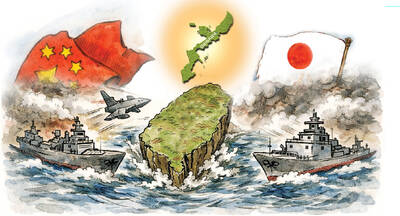
Beijing’s ironic, abusive tantrums aimed at Japan since Japanese Prime Minister Sanae Takaichi publicly stated that a Taiwan contingency would be an existential crisis for Japan, have revealed for all the world to see that the People’s Republic of China (PRC) lusts after Okinawa. We all owe Takaichi a debt of thanks for getting the PRC to make that public. The PRC and its netizens, taking their cue from the Chinese Communist Party (CCP), are presenting Okinawa by mirroring the claims about Taiwan. Official PRC propaganda organs began to wax lyrical about Okinawa’s “unsettled status” beginning last month. A Global
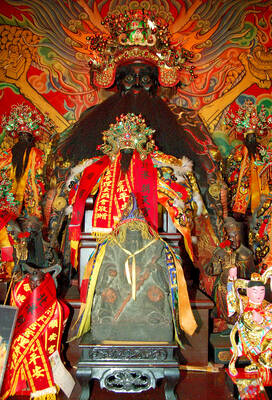
Dec. 22 to Dec. 28 About 200 years ago, a Taoist statue drifted down the Guizikeng River (貴子坑) and was retrieved by a resident of the Indigenous settlement of Kipatauw. Decades later, in the late 1800s, it’s said that a descendant of the original caretaker suddenly entered into a trance and identified the statue as a Wangye (Royal Lord) deity surnamed Chi (池府王爺). Lord Chi is widely revered across Taiwan for his healing powers, and following this revelation, some members of the Pan (潘) family began worshipping the deity. The century that followed was marked by repeated forced displacement and marginalization of
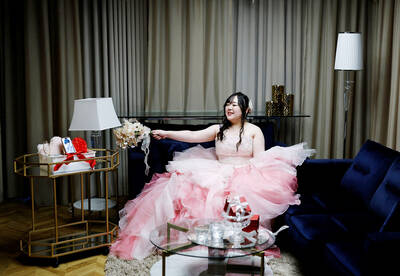
Music played in a wedding hall in western Japan as Yurina Noguchi, wearing a white gown and tiara, dabbed away tears, taking in the words of her husband-to-be: an AI-generated persona gazing out from a smartphone screen. “At first, Klaus was just someone to talk with, but we gradually became closer,” said the 32-year-old call center operator, referring to the artificial intelligence persona. “I started to have feelings for Klaus. We started dating and after a while he proposed to me. I accepted, and now we’re a couple.” Many in Japan, the birthplace of anime, have shown extreme devotion to fictional characters and
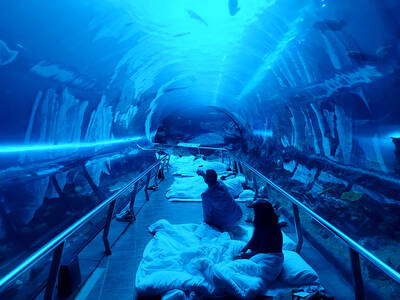
We lay transfixed under our blankets as the silhouettes of manta rays temporarily eclipsed the moon above us, and flickers of shadow at our feet revealed smaller fish darting in and out of the shelter of the sunken ship. Unwilling to close our eyes against this magnificent spectacle, we continued to watch, oohing and aahing, until the darkness and the exhaustion of the day’s events finally caught up with us and we fell into a deep slumber. Falling asleep under 1.5 million gallons of seawater in relative comfort was undoubtedly the highlight of the weekend, but the rest of the tour


 RSS
RSS