


The Hague-based Nederlands Dans Theatre (NDT 1) is back at the National Taichung Theater this weekend — its home away from home in Taiwan — for the first of two weekends of performances that will give fans a chance to see a wide variety of dances.
That Taichung is the hometown of NDT 1 dancer Wu Meng-ke (吳孟珂), the first Taiwanese to join the company — in 2013 after three years with NDT 2, its second iteration for younger performers — might have something to do with the company’s repeat visits.
NDT 1 will perform Shut Eye, Woke up Blind, The Statement and Bedroom Folk in Taichung, and then move to Kaohsiung next week to perform Shut Eye, Solo Echo and Safe as Houses as the National Kaohsiung Center for the Arts (Weiwuying) joined with its sister house to coproduce this tour.
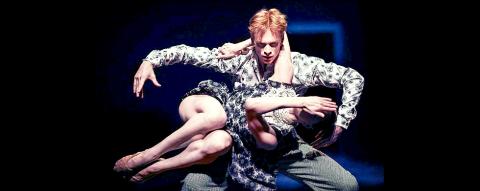
Photo courtesy of the Nederlands Dans Theater
The two mixed-bill programs both feature pieces by NDT’s house choreographers Sol Leon and Paul Lightfoot, and Canadian associate choreographer Crystal Pite.
Works by Marco Goecke, who joined the company as an associate choreographer in 2013 and the partnership of Sharon Eyal and Gai Behar, the cofounders of the Israel-based L-E-V Dance Company, will round out the Taichung shows.
CHALLENGING CHOREOGRAPHY
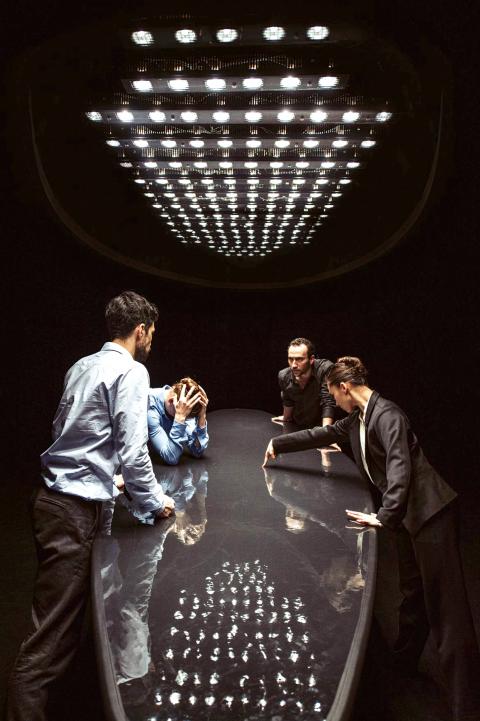
Photo courtesy of Rahi Rezvani
All five are creating some of the most challenging contemporary choreography being performed today.
In Shut Eye, NDT artistic director Lightfoot and Leon ask viewers the question: Is what we see limited by our senses or is it conditioned by how we let our brain manipulate images through our emotions? They use black and white, light and shadow to create a surrealistic fantasy world
For Woke Up Blind, Goecke uses two very different songs by Jeff Buckley, You and I and The Way Young Lovers Do and seven dancers — two women and five men — to explore the intense highs and longings of love.
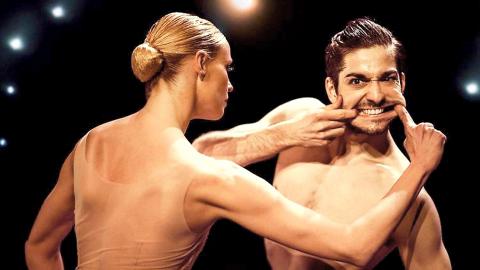
Photo courtesy of Rahi Rezvani
Pite describes The Statement as a one-act play, where the four characters become locked in a battle over responsibility and their own morality after being ordered to fuel a conflict in a distant country.
For 2015’s Bedroom Folk, Eyal and Behar collaborated with musician Ori Lichtik and set and lighting designer Thierry Dreyfus to create a work in which movement, music and light are equal protagonists.
Pite’s 2012 work, Solo Echo was inspired by Mark Strand’s poem Lines for Winter, where the individual is the focal point against a backdrop of whirling snowflakes.
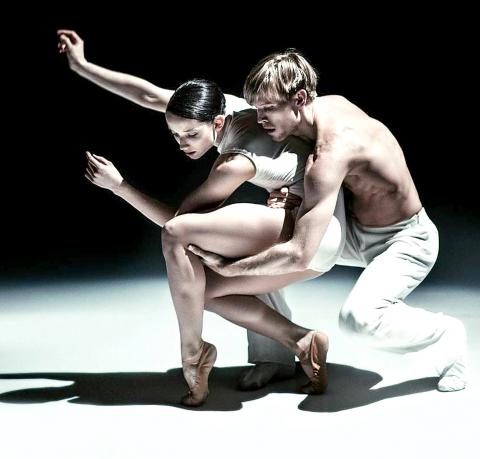
Photo courtesy of the Nederlands Dans Theater
Lightfoot and Leon’s Safe as Houses for which they not only choreographed, but designed the costumes and set, was inspired by the I Ching and set to music by Bach.
It is a piece that ponders humankind’s reliance on physical environment and the capability to survive.
All the shows are more than two hours — 150 minutes for Taichung and 130 minutes for Weiwuying — with intermissions, for those who might need to make travel plans to see one or both programs.
Performance Notes
WHAT: Nederlands Dans Theater
WHEN: Saturday at 7:30pm and Sunday at 2:30pm
WHERE: The Grand Theater at the National Taichung Theater (台中國家歌劇院) 101, Huilai Rd Sec 2, Taichung City (台中市惠來路二段101號)
ADMISSION: Remaining tickets are NT$500 to NT$1,500, available at the theater’s box offices, online at www.artsticket.com and convenience store ticket kiosks
ADDITIONAL PERFORMANCES: June 21 at 7:30pm and June 22 at 2:30pm at the Opera House at the Weiwuying National Kaohsiung Center for the Arts (衛武營國家藝術文化中心) 1, Sanduo 1st Rd, Kaohsiung City (高雄市三多一路1號); tickets NT$300 to NT$2,200, available as above

This month the government ordered a one-year block of Xiaohongshu (小紅書) or Rednote, a Chinese social media platform with more than 3 million users in Taiwan. The government pointed to widespread fraud activity on the platform, along with cybersecurity failures. Officials said that they had reached out to the company and asked it to change. However, they received no response. The pro-China parties, the Chinese Nationalist Party (KMT) and Taiwan People’s Party (TPP), immediately swung into action, denouncing the ban as an attack on free speech. This “free speech” claim was then echoed by the People’s Republic of China (PRC),

Exceptions to the rule are sometimes revealing. For a brief few years, there was an emerging ideological split between the Democratic Progressive Party (DPP) and Chinese Nationalist Party (KMT) that appeared to be pushing the DPP in a direction that would be considered more liberal, and the KMT more conservative. In the previous column, “The KMT-DPP’s bureaucrat-led developmental state” (Dec. 11, page 12), we examined how Taiwan’s democratic system developed, and how both the two main parties largely accepted a similar consensus on how Taiwan should be run domestically and did not split along the left-right lines more familiar in
Many people in Taiwan first learned about universal basic income (UBI) — the idea that the government should provide regular, no-strings-attached payments to each citizen — in 2019. While seeking the Democratic nomination for the 2020 US presidential election, Andrew Yang, a politician of Taiwanese descent, said that, if elected, he’d institute a UBI of US$1,000 per month to “get the economic boot off of people’s throats, allowing them to lift their heads up, breathe, and get excited for the future.” His campaign petered out, but the concept of UBI hasn’t gone away. Throughout the industrialized world, there are fears that

Most heroes are remembered for the battles they fought. Taiwan’s Black Bat Squadron is remembered for flying into Chinese airspace 838 times between 1953 and 1967, and for the 148 men whose sacrifice bought the intelligence that kept Taiwan secure. Two-thirds of the squadron died carrying out missions most people wouldn’t learn about for another 40 years. The squadron lost 15 aircraft and 148 crew members over those 14 years, making it the deadliest unit in Taiwan’s military history by casualty rate. They flew at night, often at low altitudes, straight into some of the most heavily defended airspace in Asia.


 RSS
RSS