


When the Tiananmen Square Massacre came to a head on June 4, 1989, then-president Lee Teng-hui (李登輝) called it a “crazy act that, although within our predictions, has caused us immeasurable grief and shock.”
Lee called for the Chinese Communist Party (CCP) to stop the violence, and for Chinese compatriots around the world to support the brave protesters in a “final showdown” with the CCP.
“This inhumane response will be judged by history, and it will spark greater resistance by our Chinese compatriots. This will just hasten the demise of the CCP... I would like to remind the soldiers and citizens in [Taiwan] to remain alert in case the CCP resorts to desperate action before its collapse,” he said.
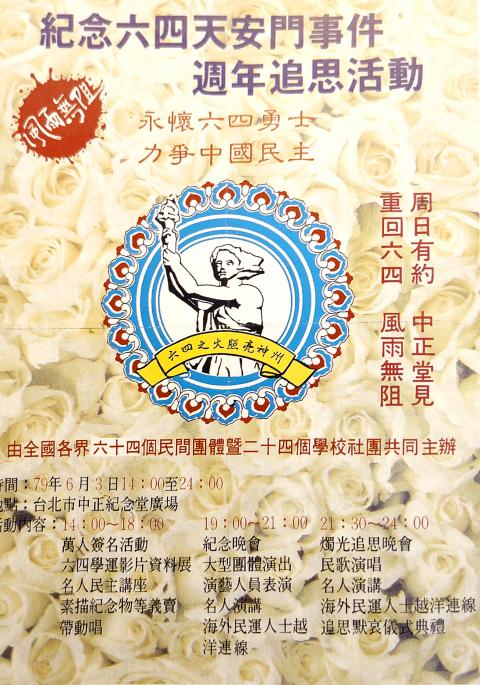
Photo courtesy of National Central Library
Thirty years on, the CCP not only persists, but is stronger than ever. Nobody in Taiwan talks of saving their suffering compatriots in China anymore. Taiwanese presidents still make a statement regarding the massacre each time its anniversary rolls by, and the rhetoric reflects the times.
Last year, President Tsai Ing-wen (蔡英文) posted in simplified Chinese on her Facebook page: “I sincerely believe that if Beijing can own up to the June 4 incident and admit that it was an act of state violence, the unfortunate history of June 4 will become a cornerstone upon which China builds its freedom and democracy.”
“I hope that in the future, Chinese citizens won’t have to breach a firewall to access my Facebook page. I hope that people on both sides of the Taiwan Strait will enjoy freedom and democracy, which will allow for more space for mutual understanding and cooperation,” she continued.
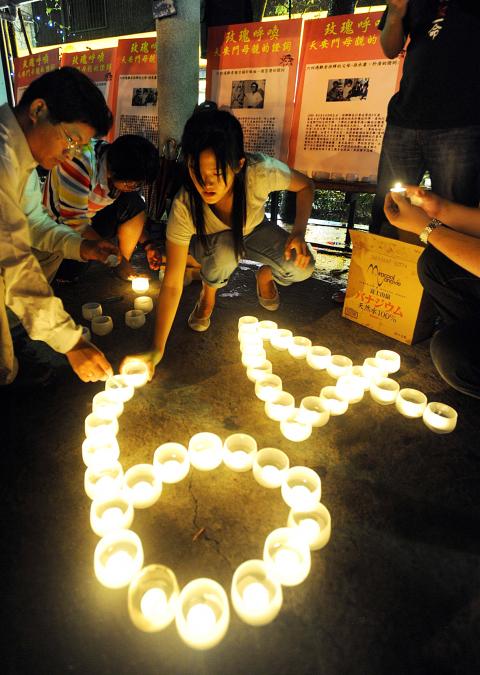
Photo: Wang Yi-sung, Taipei Times
FIRST MEMORIAL CRITICIZED
On the first anniversary of the massacre, 64 non-governmental organizations and 25 student groups put together a remembrance event at Chiang Kai-shek Memorial Hall. In the afternoon, they held a charity sale to “support China’s democracy movement,” followed by a candlelight vigil, performances and video interviews with the surviving activists who had fled abroad.
Curiously, both the state-run Central Daily News (中央日報) and the Taipei Times’ sister paper Liberty Times (自由時報) criticized the event for being too festive. The latter ran a photograph of dancers onstage with the caption: “Commemorate or celebrate?”
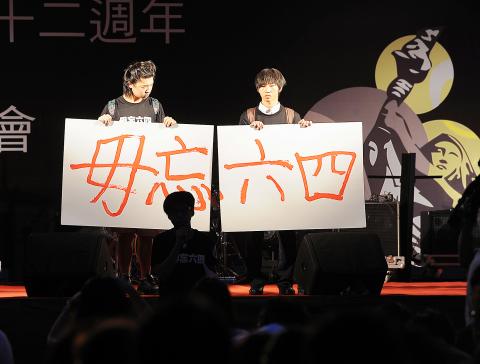
Photo: Fang Ping-chao, Taipei Times
The Central Daily News printed a longer article titled: “The wounds of history have yet to heal, but have the blood and tears already dried up?”
According to the article, not only was attendance sparse in the afternoon, people’s attitudes also seemed indifferent. Few were willing to open their wallets, not even responding when someone made a passionate speech. During the colorful dance performances, upset attendees went backstage to complain to the organizers, sparking a full-blown war of words.
“The only part that stirred emotion was the interviews with the activists, but even that was brief,” the article stated. The activists were choking up onscreen, but “not a single tear was shed at Chiang Kai-shek Memorial Hall.”
Photo: Chen Ping-hung, Taipei Times
That last bit is an exaggeration, but it shows the Chinese Nationalist Party’s (KMT) expectation that people would remain passionate about the tragedy, so they would continue to see the CCP as their enemy.
This was especially so with increasing interaction between both sides of the Taiwan Strait. Taiwanese were allowed to visit their relatives in China from November 1987, investment into China was continuing to grow at a fast pace and cultural and academic exchanges were on the rise.
A notable event in 1990 was the arrival of the cargo ship Goddess of Democracy (民主女神號) in Tainan. Chinese democracy activists in France had purchased the ship and planned to sail it to the South China Sea to broadcast the truth behind the massacre to the Chinese people.
That plan never came to fruition. A Tainan businessman purchased the ship, which arrived at Anping Port (安平港) just in time for the anniversary of the massacre. The ship remained there until 2003, when the government ordered its demolition as the owner owed the port NT$1.8 million (about US$57,000) in docking fees.
FADING MEMORY?
While commemorative events continued to take place on the massacre’s 10th anniversary, both the United Daily News (聯合報) and Liberty Times ran editorials commenting on how Taiwanese attitudes had changed, with each paper offering a different explanation.
The Liberty Times stated that as democracy took root and people shifted toward a Taiwanese identity, they separated themselves from China and became less emotionally affected by the Tiananmen Square Massacre.
Also playing a part in this changing attitude was China’s hostile behavior toward Taiwan, especially during the 1996 Taiwan Strait Crisis, when China launched missile tests in the strait.
What happened in China was still very much the business of people in Taiwan in 1989. But by 1999, even though people turned up to mourn the 10th anniversary of the massacre, the memorial spokesperson said that many attendees seemed to treat it more as a tragedy that had “happened in another country.”
“Taiwanese history and culture have been suppressed for decades, and we have our own historical memories that we need to rediscover,” the editorial concluded. “This change is only natural. There’s no need to reprimand Taiwanese society’s fading passion toward the Tiananmen Square Massacre.”
The United Daily News gave a completely different take, saying that as China’s economy improved, some people saw it as proof that the CCP had been working to stabilize society and better the lives of its citizens.
“Especially with the rise of Chinese patriotism and nationalism, it just doesn’t seem that there is any room for Chinese people to challenge the authoritarianism of their government,” the editorial concluded.
Yet the editorial also stated that as long as the Chinese government refused to acknowledge and take responsibility for the incident, the rest of the world, including Taiwan, would continue to hold commemorative events to remind the CCP of what it did in 1989.
As groups in Taiwan put on events and memorials for the massacre’s upcoming 30th anniversary on Tuesday, and as politicians continue to call for China to apologize for its actions and embrace democracy, it seems that all of these points above still ring true today.
Taiwan in Time, a column about Taiwan’s history that is published every Sunday, spotlights important or interesting events around the nation that have anniversaries this week.
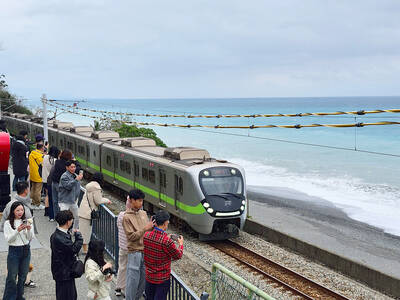
The small platform at Duoliang Train Station in Taitung County’s Taimali Township (太麻里) served villagers from 1992 to 2006, but was eventually shut down due to lack of use. Just 10 years later, the abandoned train station had become widely known as the most beautiful station in Taiwan, and visitors were so frequent that the village had to start restricting traffic. Nowadays, Duoliang Village (多良) is known as a bit of a tourist trap, with a mandatory, albeit modest, admission fee of NT$10 giving access to a crowded lane of vendors with a mediocre view of the ocean and the trains
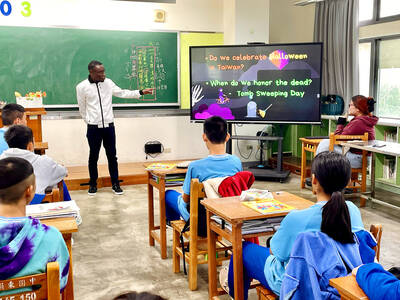
For many people, Bilingual Nation 2030 begins and ends in the classroom. Since the policy was launched in 2018, the debate has centered on students, teachers and the pressure placed on schools. Yet the policy was never solely about English education. The government’s official plan also calls for bilingualization in Taiwan’s government services, laws and regulations, and living environment. The goal is to make Taiwan more inclusive and accessible to international enterprises and talent and better prepared for global economic and trade conditions. After eight years, that grand vision is due for a pulse check. RULES THAT CAN BE READ For Harper Chen (陳虹宇), an adviser
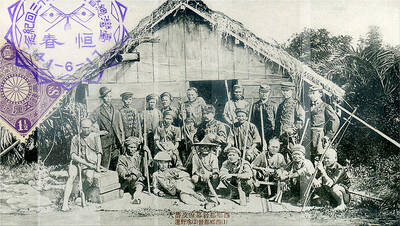
Traditionally, indigenous people in Taiwan’s mountains practice swidden cultivation, or “slash and burn” agriculture, a practice common in human history. According to a 2016 research article in the International Journal of Environmental Sustainability, among the Atayal people, this began with a search for suitable forested slopeland. The trees are burnt for fertilizer and the land cleared of stones. The stones and wood are then piled up to make fences, while both dead and standing trees are retained on the plot. The fences are used to grow climbing crops like squash and beans. The plot itself supports farming for three years.
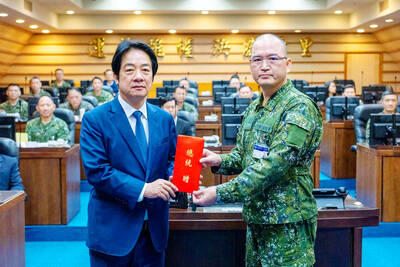
President William Lai (賴清德) on Nov. 25 last year announced in a Washington Post op-ed that “my government will introduce a historic US$40 billion supplementary defense budget, an investment that underscores our commitment to defending Taiwan’s democracy.” Lai promised “significant new arms acquisitions from the United States” and to “invest in cutting-edge technologies and expand Taiwan’s defense industrial base,” to “bolster deterrence by inserting greater costs and uncertainties into Beijing’s decision-making on the use of force.” Announcing it in the Washington Post was a strategic gamble, both geopolitically and domestically, with Taiwan’s international credibility at stake. But Lai’s message was exactly


 RSS
RSS