


It was more of a small step than a giant leap, but the first public outing of a pilotless “drone taxi” in Vienna on Thursday nevertheless offered a glimpse into the possible future of urban travel.
Several big companies such as Boeing and Airbus are working on their own versions of the technology but it was the Chinese firm EHang that unveiled its aircraft to assembled journalists in the Austrian capital’s Generali Arena football stadium.
But anyone expecting to see it gliding over the Danube was to be disappointed — it is as yet not certified for Austrian airspace and stayed firmly within the confines of the stadium after a vertical hop of around 10 meters. Being inside the two-seater EHang 216 was “funny, soft and surprisingly noisy,” said AFP photographer Joe Klamar, one of the first journalists to climb aboard, adding that the cabin was “very cramped.”
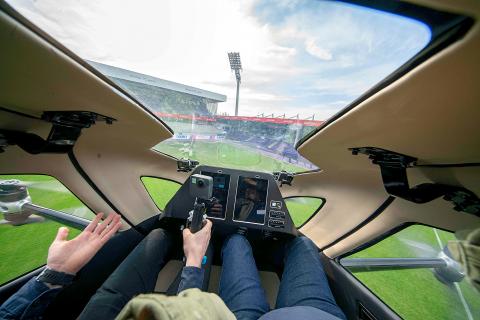
Photo: AFP
“The rotors are scary but we got used to it,” he added.
The EHang 216 is equipped with eight sets of rotors which emit a noise level of 90 decibels, below a normal helicopter but still easily loud enough to be uncomfortable.
The firm says it hopes to get the noise level down to 75 decibels.
RESISTANT ‘MENTALITIES’
EHang says it eventually hopes to use to the drone to carry passengers at low altitude over distances of up to 35 kilometers but for now still needs to be cleared for use by aviation authorities.
“Our biggest challenge is not technology, it’s not regulation, it’s people’s mentality,” says EHang’s chief marketing officer Derrick Xiong, referring to possible reticence on the part of passengers towards the new vehicle.
The company says it has received “thousands” of pre-orders and that is working with Austrian aeronautics company FACC to start mass production as of next year.
Xiong says early interest has come from “oil and gas companies who want to transport engineers from one platform to the other” as well as tourism companies and firms transporting organs for transplant.
He said the EHang is expected to cost around 200,000 euros (US$224,531) but would not be available for private buyers.
“Technically speaking its not a dream, its a reality,” FACC CEO Robert Machtlinger told reporters, adding that the project had already carried out 7,000 flying hours, of which 2,000 have been manned.
The Austrian company, which has a turnover of around 800 million euros (US$900 million), supplies aerospace giants including Airbus, Boeing, Bombardier and Embraer.
It said it hopes to produce around 300 of the drone taxis by mid-2021.
HYBRID TECHNOLOGY
EHang has been carrying out most of its testing in China, as well a test flight in February 2017 in Dubai that was closed to the public.
Manufacturers working on other drone taxi prototypes — notably the German Volocopter — have been in touch with aviation authorities, including the EU’s European Aviation Safety Agency, to try to get authorization for their models.
“Some draft regulations are already existing” says Machtlinger, but adds that getting drone taxis legal status is complicated by their hybrid nature: “It’s not a helicopter, it’s not an aeroplane.”
Austrian Transport Minister Norbert Hofer, who was present at Thursday’s demonstration, said he hoped Austria could be among the first countries to have drone taxis flying regularly in its cities.
Dubai has also expressed interest in being an early adopter of the technology. EHang says its drone taxi can fly unaided for 30 minutes and reach speeds of up to 130 kilometers an hour and carry 260 kilos.
With its 17 kilowatt battery, its energy consumption per journey is “comparable to an electric car in an urban environment,” says Machtlinger.

It’s only half the size of its more famous counterpart in Taipei, but the Botanical Garden of the National Museum of Nature Science (NMNS, 國立自然科學博物館植物園) is surely one of urban Taiwan’s most inviting green spaces. Covering 4.5 hectares immediately northeast of the government-run museum in Taichung’s North District (北區), the garden features more than 700 plant species, many of which are labeled in Chinese but not in English. Since its establishment in 1999, the site’s managers have done their best to replicate a number of native ecosystems, dividing the site into eight areas. The name of the Coral Atoll Zone might
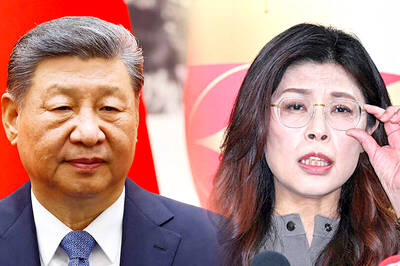
On Monday morning, in quick succession, the Chinese Communist Party (CCP) and the Chinese Nationalist Party (KMT) released statements announcing “that the Central Committee of the Communist Party of China and General Secretary Xi Jinping (習近平) have invited KMT Chairwoman Cheng Li-wun (鄭麗文) to lead a delegation on a visit to the mainland” as the KMT’s press release worded it. The KMT’s press release added “Chairwoman Cheng expressed her gratitude for the invitation and has gladly accepted it.” Beijing’s official Xinhua news release described Song Tao (宋濤), head of the Taiwan Work Office of the CCP Central Committee, as
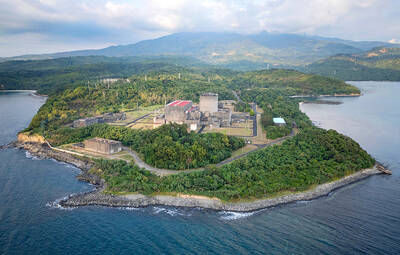
Nuclear power is getting a second look in Southeast Asia as countries prepare to meet surging energy demand as they vie for artificial intelligence-focused data centers. Several Southeast Asian nations are reviving mothballed nuclear plans and setting ambitious targets and nearly half of the region could, if they pursue those goals, have nuclear energy in the 2030s. Even countries without current plans have signaled their interest. Southeast Asia has never produced a single watt of nuclear energy, despite long-held atomic ambitions. But that may soon change as pressure mounts to reduce emissions that contribute to climate change, while meeting growing power needs. The
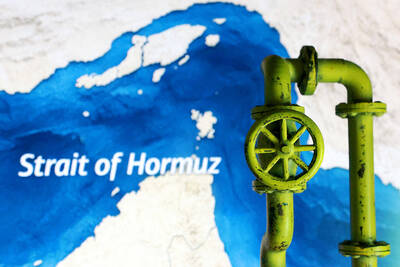
The US war on Iran has illuminated the deep interdependence of Asia on flows of oil and related items as raw materials that become the basis of modern human civilization. Australians and New Zealanders had a wake up call. The crisis also emphasizes how the Philippines is a swatch of islands linked by jet fuel. These revelations have deep implications for an invasion of Taiwan. Much of the commentary on the Taiwan scenario has looked at the disruptions to world trade, which will be in the trillions. However, the Iran war offers additional specific lessons for a Taiwan scenario. An insightful


 RSS
RSS