


The stone-stepped path up Elephant Mountain (象山) in Taipei’s Xinyi District must be (along with the Pipeline Trail in Tianmu) Taipei’s most popular short hike. It’s definitely not the place to get away from the crowds, especially on weekends. Aside from that remarkable view of Taipei 101 from the top, however, it strikes me as a rather dull little walk, and hikers can do a lot better in the immediate area.
A popular choice, after scaling the Elephant, is to continue straight ahead and up onto the main ridge behind, to the little rocky flourish of Thumb Mountain (拇指山).
The steep final climb to the peak ensures this is a much less popular destination, but it’s still far from being off the beaten track. Surprisingly, though, just a few minutes’ walk from those very well-trudged routes are several trails and places that are off the radar.
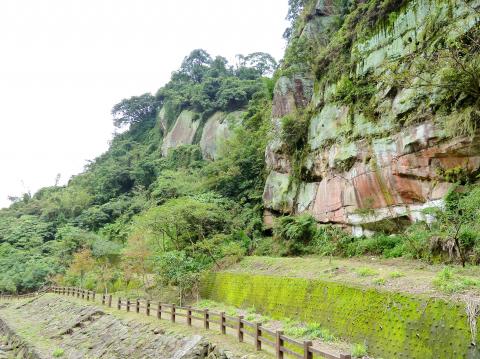
Photo: Richard Saunders
THE BEASTS
The Four Beasts Mountains (四獸山) area consists of about nine rocky little sandstone peaks along two parallel ridges, rising directly above Taipei’s modern city center and Taipei 101.
The lower ridge at the front comprises the four beasts themselves: Elephant, Lion (獅山), Leopard (豹山) and Tiger (虎山) mountains. Behind is the rather higher main ridge of Thumb Mountain. The “thumb” is the rocky peak at the far southwestern end, while the ridge reaches its highest point at the twin peaks of Nangang Mountain (南港山, 374m) and Nine-Five Peak (九五峰, 375m) before slowly petering out as it extends northeast towards Taipei’s Nangang District.
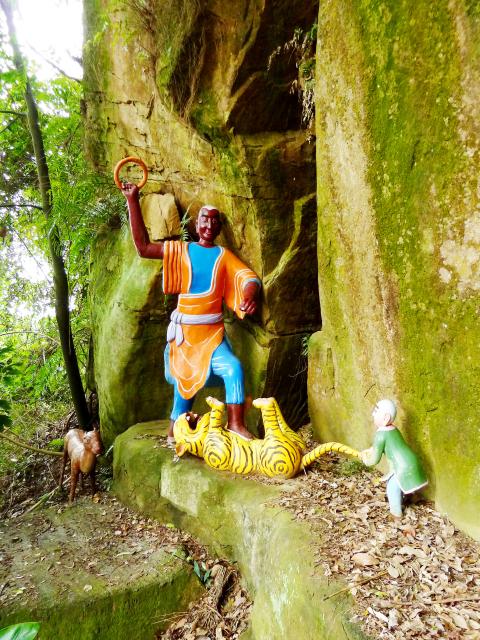
Photo: Richard Saunders
For such a compact area, there’s a remarkable wealth of natural, scenic and cultural variety to discover. It’s also a good work out. Expect to climb nearly a thousand vertical meters on a loop hike covering the four beasts and the three main peaks on the main ridge behind.
The trailhead for Elephant Mountain is clearly signposted from Xiangshan MRT Station (the terminus of the red line), about 500m away, and this is the favored (read: most crowded) route in the whole area.
ALTERNATIVE TRAILHEAD
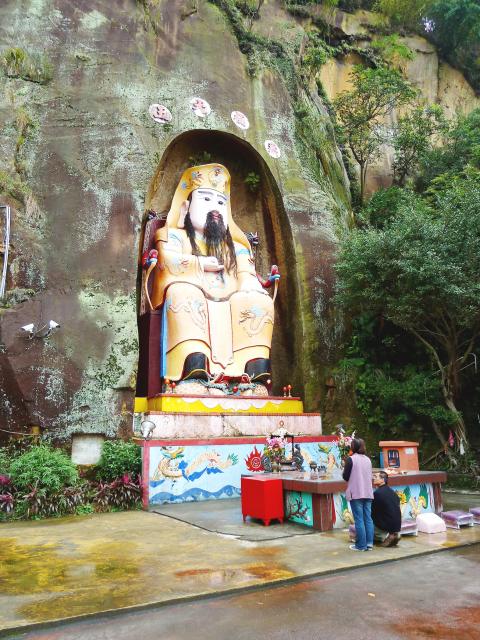
Photo: Richard Saunders
A more interesting and scenic alternative way into the hills starts from Fengtian Temple (奉天宮), a 10-minute walk from Houshanpi MRT Station on the blue line. The temple itself is quite grand and well worth a quick look, and the stepped path from the back of the complex leading up onto the mountainside, although steep, is short.
At the top of the first climb, Longshan Cave (龍山洞), artificially hollowed out of the sandstone, was once an air raid shelter, but now doubles, rather incongruously, as a cave temple and a karaoke parlor.
The trail follows the ridge, passing a series of rocky outcrops commanding fine views of Taipei 101 and the city, and the path eventually reaches a viewing platform atop the summit of Tiger Mountain. Follow the path past the summit, and when it comes out at a road, turn right. Pass a temple, and just after it turns right along a short dirt trail that leads past an aerial and ends at the edge of a cliff and a fine view — the rather dull summit of Lion Mountain.
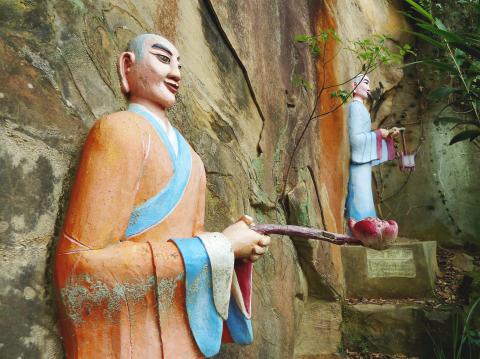
Photo: Richard Saunders
The summits of the Elephant, Lion and Tiger are easy to reach and popular, but finding the remaining beast, the Leopard, is a harder proposition, as the trail lies in the least explored part of the ridge. Climb Elephant Mountain, and just before reaching the famed Six Giant Rocks (六巨石) viewpoint, turn left onto a level path contouring the wooded hillside.
SCALING THE LEOPARD
The trail passes an exposed cliff of attractive orange sandstone and passes through a cleft known as a Thread of Sky (一線天). It then turns right, up steps to the summit of Elephant Mountain. Don’t take these steps, but instead continue ahead on a dirt trail that continues to contour the hillside.
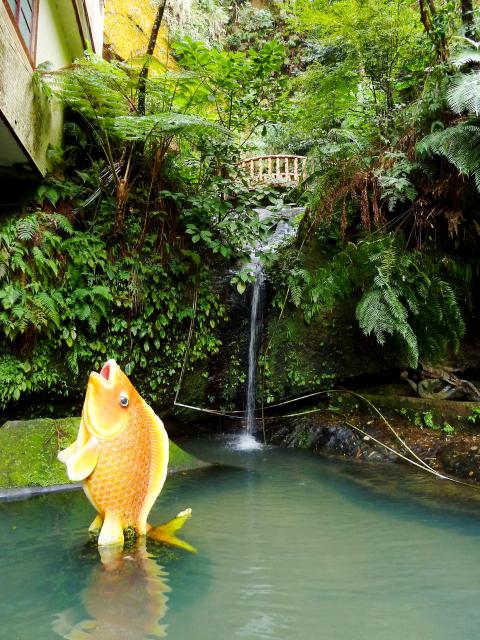
Photo: Richard Saunders
The sighting of other hikers become rarer as the trail gradually descends. Be sure to keep close to the base of the cliffs below Elephant Mountain, while passing several Buddhist inscriptions and monuments carved out of the soft rock.
The trail emerges five minutes later at Tianbao Temple (天寶宮), remarkable for the huge, colorful image of a Taoist god carved — Bamiyan-like — into a niche in the sandstone cliff, which is beside a tiny shrine and shortly before the main temple building. Following the base of the cliff, the trail passes a rather comical statue that always reminds me of the cartoon character Tweetie Pie, but in fact represents a phoenix newly risen, featherless, from the ashes.
Pass through the dark, still unfinished halls of Tianbao Temple itself, cross the large open terrace in front of the temple building, and pick up the trail, still along the base of the cliffs, on the far side. For me this is the most interesting part of the whole hike, as the path passes a series of colorful statues depicting the Taoist immortals known as the Eighteen Arhats (十八羅漢).
Several trails have been shoehorned into cracks in the vertical cliff face on the right. Two of them are dead ends, finishing at moldering but still striking statues. The third, however, zig-zags steeply up the cliff face, veers left through the woods at the top of the cliff, and ends in five minutes at a post marking the summit of the elusive Leopard Mountain (豹山).
Richard Saunders is a classical pianist and writer who has lived in Taiwan since 1993. He’s the founder of a local hiking group, Taipei Hikers, and is the author of six books about Taiwan, including Taiwan 101 and Taipei Escapes. Visit his Web site at www.taiwanoffthebeatentrack.com.

Jason Han says that the e-arrival card spat between South Korea and Taiwan shows that Seoul is signaling adherence to its “one-China” policy, while Taiwan’s response reflects a reciprocal approach. “Attempts to alter the diplomatic status quo often lead to tit-for-tat responses,” the analyst on international affairs tells the Taipei Times, adding that Taiwan may become more cautious in its dealings with South Korea going forward. Taipei has called on Seoul to correct its electronic entry system, which currently lists Taiwan as “China (Taiwan),” warning that reciprocal measures may follow if the wording is not changed before March 31. As of yesterday,

The Portuguese never established a presence on Taiwan, but they must have traded with the indigenous people because later traders reported that the locals referred to parts of deer using Portuguese words. What goods might the Portuguese have offered their indigenous trade partners? Among them must have been slaves, for the Portuguese dealt slaves across Asia. Though we often speak of “Portuguese” ships, imagining them as picturesque vessels manned by pointy-bearded Iberians, in Asia Portuguese shipping between local destinations was crewed by Asian seamen, with a handful of white or Eurasian officers. “Even the great carracks of 1,000-2,000 tons which plied
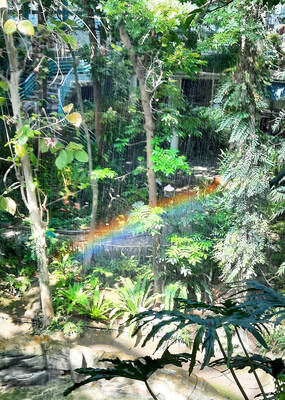
It’s only half the size of its more famous counterpart in Taipei, but the Botanical Garden of the National Museum of Nature Science (NMNS, 國立自然科學博物館植物園) is surely one of urban Taiwan’s most inviting green spaces. Covering 4.5 hectares immediately northeast of the government-run museum in Taichung’s North District (北區), the garden features more than 700 plant species, many of which are labeled in Chinese but not in English. Since its establishment in 1999, the site’s managers have done their best to replicate a number of native ecosystems, dividing the site into eight areas. The name of the Coral Atoll Zone might
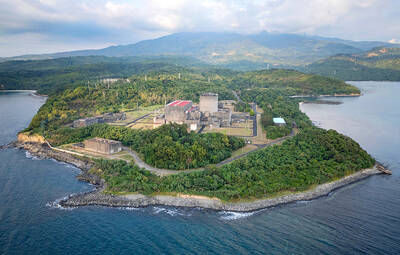
Nuclear power is getting a second look in Southeast Asia as countries prepare to meet surging energy demand as they vie for artificial intelligence-focused data centers. Several Southeast Asian nations are reviving mothballed nuclear plans and setting ambitious targets and nearly half of the region could, if they pursue those goals, have nuclear energy in the 2030s. Even countries without current plans have signaled their interest. Southeast Asia has never produced a single watt of nuclear energy, despite long-held atomic ambitions. But that may soon change as pressure mounts to reduce emissions that contribute to climate change, while meeting growing power needs. The


 RSS
RSS