


With the big heat of summer just around the corner, the mass weekend exodus to the beaches of northern Taiwan is once again fast approaching. Since three or four of Taiwan’s finest are just an hour or so from the capital, a day beside the sea is a popular choice for Taipei residents.
Sadly however, all is not well on northern Taiwan’s beaches. Carelessly dropped trash continues to be a problem, greatly magnified by a huge volume of garbage swept in from overseas on the incoming tide. The good news is that there are many people, both Taiwanese and foreign residents, who are determined to do something about it. Among them are Ryan Hevern and Dustin Craft, the two American guys behind Taiwan Adventure Outings (TAO), an outfit they founded in late 2015.
Hevern says TAO was set up “as a means to get outdoors ourselves, to explore new places in Taiwan and to meet new people who had the same drive to be adventurous.”
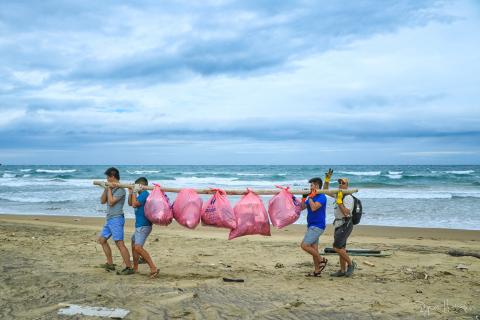
Photo courtesy of Ryan Hevern
Hevern says the outfit wanted to give something back to the community and the environment by hosting monthly beach and forest cleanups, as well as connecting travelers with small-scale local tourism initiatives that would expose people to the nation’s beauty, culture and adventures, as well as providing opportunities to contribute towards maintaining these beautiful locations.”
Hevern and Craft organized an initiative on May 20 called Taiwan National Clean Up Day, their biggest and most ambitious cleanup operation to date, involving a total of 10 groups working to clear trash from parts of Taipei City and Yilan County.
The majority of the sites targeted were popular beaches, but four of the groups worked to clear trails in the area around New Taipei City’s Pingsi District (平溪), where fallen sky lanterns continue to mar the landscape despite local efforts to retrieve them.

Photo courtesy of Ryan Hevern
Hevern says that beach clean-ups can be potentially dangerous.
“Unfortunately, we find hypodermic needles every clean up.” Hevern says. “One time in Shalun Beach in Tamsui we found 37 of them in the sand.”
It’s hard and potentially risky work cleaning up Taiwan’s beaches and mountains, but the efforts of the volunteers didn’t go unappreciated last weekend. According to Jan Willem Overmars, one of the volunteers, “Drivers and passengers were encouraging our cleanup: cheering, clapping, [and giving us a] thumbs up. This kept us going.”
Hevern says anyone can play a part in improving the local environment.
“Everyone on a hike or outdoor adventure can take back garbage they find. Beyond this we can also take steps to reduce our consumption of plastic. Bring your own chopsticks and spoons, metal straw and thermos [when you go out to eat]. Resist using a plastic bag when you buy something in a shop.”
To sign up for future TAO cleanups, head to their Facebook group at www.facebook.com/groups/505284866320444

This month the government ordered a one-year block of Xiaohongshu (小紅書) or Rednote, a Chinese social media platform with more than 3 million users in Taiwan. The government pointed to widespread fraud activity on the platform, along with cybersecurity failures. Officials said that they had reached out to the company and asked it to change. However, they received no response. The pro-China parties, the Chinese Nationalist Party (KMT) and Taiwan People’s Party (TPP), immediately swung into action, denouncing the ban as an attack on free speech. This “free speech” claim was then echoed by the People’s Republic of China (PRC),

Exceptions to the rule are sometimes revealing. For a brief few years, there was an emerging ideological split between the Democratic Progressive Party (DPP) and Chinese Nationalist Party (KMT) that appeared to be pushing the DPP in a direction that would be considered more liberal, and the KMT more conservative. In the previous column, “The KMT-DPP’s bureaucrat-led developmental state” (Dec. 11, page 12), we examined how Taiwan’s democratic system developed, and how both the two main parties largely accepted a similar consensus on how Taiwan should be run domestically and did not split along the left-right lines more familiar in
Many people in Taiwan first learned about universal basic income (UBI) — the idea that the government should provide regular, no-strings-attached payments to each citizen — in 2019. While seeking the Democratic nomination for the 2020 US presidential election, Andrew Yang, a politician of Taiwanese descent, said that, if elected, he’d institute a UBI of US$1,000 per month to “get the economic boot off of people’s throats, allowing them to lift their heads up, breathe, and get excited for the future.” His campaign petered out, but the concept of UBI hasn’t gone away. Throughout the industrialized world, there are fears that

Most heroes are remembered for the battles they fought. Taiwan’s Black Bat Squadron is remembered for flying into Chinese airspace 838 times between 1953 and 1967, and for the 148 men whose sacrifice bought the intelligence that kept Taiwan secure. Two-thirds of the squadron died carrying out missions most people wouldn’t learn about for another 40 years. The squadron lost 15 aircraft and 148 crew members over those 14 years, making it the deadliest unit in Taiwan’s military history by casualty rate. They flew at night, often at low altitudes, straight into some of the most heavily defended airspace in Asia.


 RSS
RSS