


For the 50-year-old Chinese opera performer, every aspect of the dimly-lit backstage room was a reminder that things had changed.
The elaborate costumes carelessly thrown aside, the young troupe members playing with their smartphones, the half-eaten noodles abandoned in the corner — all were tokens of disorder that made Li Zhiguo grimace in his blue and gold cap.
“I get angry sometimes watching my students perform, because their heart isn’t in it,” Li said. “But when they ask me if rehearsing diligently will guarantee them a good living, I have nothing to say.”

Photo: AFP/Wang Zhao
When Li joined the Yu County Jin Opera Troupe in Hebei Province 35 years ago, he and his fellow teenage recruits believed that they had secured stable futures as the public guardians of a traditional art.
But policy reforms in 2005 turned their government-sponsored project into a private venture without a concrete business strategy, gutting the performers’ salaries and threatening the future of an early Qing Dynasty opera form.
Jin opera, which is characterized by upbeat songs and wooden clapper instruments, originated in the Shanxi Province bordering Yu County.
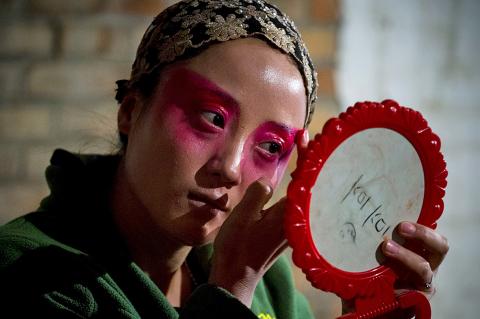
Photo: AFP/Wang Zhao
From the Spring Festival to the end of March, the troupe travels from village to village in Hebei, performing on ramshackle rural stages to mostly elderly crowds.
Despite their new business designation, they still rarely charge for performances — most attendees wouldn’t pay — and rely heavily on support from local governments.
Backstage at one of their last shows of the season, Li sighed as he recounted all the departures in recent years. Many of his students had left the troupe after struggling to support their families.
“If it’s about the art, I’ll tell them to stay,” said Li. “If it’s about survival, I’ll tell them: go.”
AN ‘IRON RICE BOWL’ NO MORE
The group of 90 has been active since 1985, drawing its members from auditions held across Yu County. The performers join when they are between 13 and 15 years old; those who stay have known each other their entire adult lives.
Liu Donghai, a former actor who now helps manage the troupe, recalled that being chosen from among more than a thousand kids had felt like winning the lottery.
His parents were thrilled because, being a state institution at the time, the troupe offered him an “iron rice bowl” — the Chinese parlance for a secure job.
However, since they were stripped of their public status, some performers have started driving pedicabs between shows for supplementary income.
Even the most senior members of the troupe make less than 2,500 yuan (US$363) a month, while the average actor makes closer to 1,500 yuan (US$217) in a district where the minimum monthly wage is 1,590 yuan (US$231).
Over the 23 years that Liu, 36, has been with the group, he has seen his cohort shrink, but a sense of loyalty has kept him from leaving.
“This is my family,” he said. “Our troupe leader is like a father to me. Whatever he says, I’ll do.”
Sometimes that means singing in negative degree Celsius weather, or dancing while snow settles on his elaborate costumes.
But as Geng Liping, a 30-year-old actress, said, “When you’re on stage you never feel cold.”
‘Sword DANGLING OVER THEIR HEADS’
Jin opera recounts ancient Shanxi history, with storylines soaked in nostalgia for the province’s imperial past. Modern audiences have different tastes, said Wang Jia, founder of the China Jin Opera Network.
“Even our notion of beauty has changed, so everything — from the costumes to the dialogue — is being adapted for contemporary viewing,” Wang said. The greatest problem they face now is attracting young recruits willing to endure the nomadic life of an actor, a life without financial guarantees.
“Most of them don’t have health insurance,” Wang said. “The question of whether their basic needs will be met is like a sword dangling over their heads.”
At a March performance in Yu County’s Baocao Village, there were no chairs in the viewing area, but some attendees had brought their own. Others watched from inside their cars, or found perches along a crumbling brick fence as a harsh wind blew around them.
More people used to come, the performers said, before the county’s coal plants closed and the migrants left.
Now there were about 50 mostly elderly locals, some with babies in their arms. They heard about the show through word of mouth.
One of the few young people, 20-year-old Zhang Zehui, had attended several performances with her grandmother.
“It’s lively and interesting, but I don’t really understand it,” Zhang said.
Garbed in a colorful robe, Li stood backstage, awaiting his cue.
“Has it been worth it?” he asked as he looked out at the crowd. “That’s a big question mark in my heart.”

Taiwan’s English education system is being pulled apart by three opposing forces. Bilingual Nation 2030 pulls students toward English and global communication. Artificial Intelligence (AI) readiness pulls them toward digital judgment, verification and AI-mediated work. But Taiwan’s old exam culture pulls them back toward memorization, grammar drills, timed reading and correct answers. If the education system keeps using old exams to define success, it risks producing graduates who are neither genuinely bilingual nor genuinely AI-ready, but trained for tasks machines can already perform. The first force is Bilingual Nation 2030. Launched in 2018, the policy aimed to “help Taiwan’s workforce connect
It seems every few days one bumps into one of those “real man” comments in which Taiwan is urged to “face reality” or similar, and “make a deal,” with the speaker implying that soon it will be too late. “Deal” advocates always present themselves as having a superior grip on reality, and the manly ability to make the “hard choice.” Their testosterone-laden language often echoes that of Taiwan sellout advocates. Note that such commentary always specifies a process (“make a deal, work with, make progress”), never the end state of what occupation by a violent authoritarian colonialist state will entail. In
June 1 to June 7 "If all Taiwanese were as afraid of dying as you, then what would happen?” Physician Shih Chiang-nan (施江南) reportedly said this to his wife Chen Chiao-tung (陳焦桐) after she urged him to stop intervening on behalf of Taiwanese soldiers stranded overseas after serving in the Japanese Army during World War II. Shih had clashed with high-ranking officials over the issue, engaged in several heated arguments with Taiwan governor-general Chen Yi (陳儀) and allegedly shouted at general Ko Yuan-fen (柯遠芬), chief of staff of the Taiwan Garrison Command, over

“Taiwan’s Opposition Leader Comes to US With a Message Straight Out of Beijing” read a May 31 headline in the Wall Street Journal. Top US administration officials and members of Congress almost certainly read the WSJ, and if there was a bullet point takeaway that people in Washington should absorb ahead of Chinese Nationalist Party (KMT) Chair Cheng Li-wun’s (鄭麗文) arrival in DC on June 9, that headline is it. The last few columns have discussed this very topic, and the timing is not coincidental. While those top officials likely do not read the Taipei Times, judging by the number


 RSS
RSS