


Choreographer Jade Hua (華碧玉) has often found inspiration in China’s famed cave temples near Dunhuang in Gansu Province in creating dances for her Jade Dance Theatre (肢體音符舞團).
The massive repository of Buddhist art on the Silk Road was central to Echoes from Tun Huang (聽見飛天在唱歌), which premiered in 2006, and 2009’s Crystal Tun-Huang (水晶瓶中的敦煌) — but that was before Hua actually traveled to Gansu to see the caves for herself in 2011.
When most people think of the caves they think of the thousands of Buddhas and images of floating maidens trailing long sleeves, and Hua said her earlier pieces were very much in that mode, a blend of traditional Chinese dance and contemporary movement that helped make her reputation.
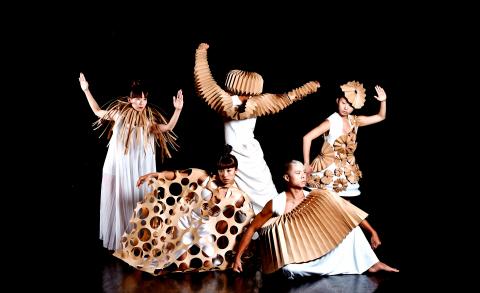
Photo Courtesy of Jade Dance Theatre
The choreography for her newest show, Quantum Dance — Crescent Lake (月牙泉), which opens tomorrow night at the National Taiwan University of Arts Performance Hall in New Taipei City’s Banciao District (板橋), also seeks to capture the gestures and images of the flying maidens and the serenity of the Buddhas.
However, she said she approached the new production, named after a tiny oasis near Dunhuang, from a more modern point of view.
While the “essence” of Dunhuang and the spirit of the maidens still exists today, the caves and their artwork are changing year by year and some are disappearing, Hua said in a telephone interview on Tuesday.
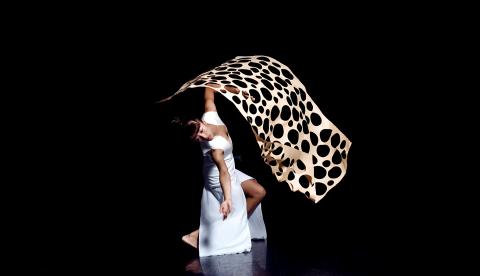
Photo Courtesy of Jade Dance Theatre
That made her think of another historic legacy from China that is slowly vanishing in the modern world: paper.
Papermaking is an ancient craft, but it is disappearing bit by bit because of technology, and so she decided to use paper for some of the costumes in her new piece, she said.
One obstacle was that costume designer Weng Ming-ching (翁孟晴), who has worked with Hua on several shows, was not enthusiastic, at least not initially.
Weng said that she could make everything needed out of fabric, so she was initially hired just to design the cloth costumes, Hua said.
However, as rehearsals progressed, she added, Weng became intrigued by the paper challenge and ended up having a lot of fun.
Set designer Tsai Ying-han (蔡茵涵) also used paper for some of his creations.
Despite the focus on ancient arts, Hua has incorporated some of the latest technology in her new show. The seven dancers will be wearing pressure sensors that will trigger projections of images of Dunhuang and the universe on the cyclorama behind them as they dance.
The idea is that the dancers are existing in the moment even as they present the eternity of Dunhuang.
For the score, Hua tapped avant-garde composer Tung Chao-ming (董昭民), who composed some music along with Wang Le-lun (王樂倫), as well as serving as the show’s technical director.
She then reached out to another former collaborator — and an old university classmate — pipa player Lin Hui-kuan (林慧寬), one of three musicians who will perform alongside the dancers.
After two shows in Banciao this weekend, the company moves on to the Taoyuan Arts Center the following weekend.


The US war on Iran has illuminated the deep interdependence of Asia on flows of oil and related items as raw materials that become the basis of modern human civilization. Australians and New Zealanders had a wake up call. The crisis also emphasizes how the Philippines is a swatch of islands linked by jet fuel. These revelations have deep implications for an invasion of Taiwan. Much of the commentary on the Taiwan scenario has looked at the disruptions to world trade, which will be in the trillions. However, the Iran war offers additional specific lessons for a Taiwan scenario. An insightful
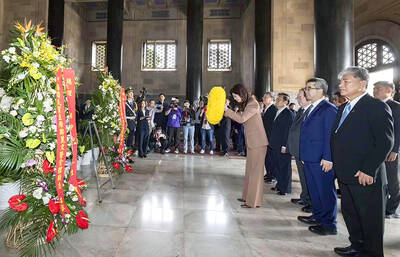
The problem with Marx’s famous remark that history repeats itself, first as tragedy, the second time as farce, is that the first time is usually farce as well. This week Chinese Nationalist Party (KMT) Chair Cheng Li-wun (鄭麗文) made a pilgrimage to the People’s Republic of China (PRC) “to confer, converse and otherwise hob-nob” with Chinese Communist Party (CCP) officials. The visit was an instant international media hit, with major media reporting almost entirely shorn of context. “Taiwan’s main opposition leader landed in China Tuesday for a rare visit aimed at cross-strait ‘peace’”, crowed Agence-France Presse (AFP) from Shanghai. Rare!
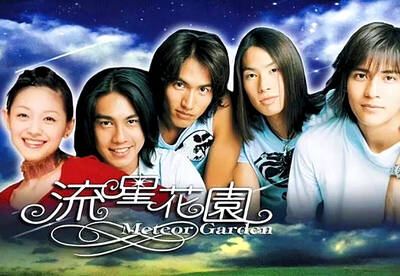
April 6 to April 13 Few expected a Japanese manga adaptation featuring four tall, long-haired heartthrobs and a plucky heroine to transform Taiwan’s television industry. But Meteor Garden (流星花園) took the nation by storm after premiering on April 12, 2001, single-handedly creating the “idol drama” (偶像劇) craze that captivated young viewers across Asia. The show was so successful that Japan produced its own remake in 2005, followed by South Korea, China and Thailand. Other channels quickly followed suit, with more than 50 such shows appearing over the following two years. Departing from the melodramatic
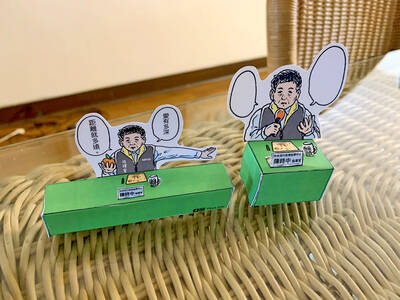
Sunflower movement superstar Lin Fei-fan (林飛帆) once quipped that the Democratic Progressive Party (DPP) could nominate a watermelon to run for Tainan mayor and win. Conversely, the DPP could run a living saint for mayor in Taipei and still lose. In 2022, the DPP ran with the closest thing to a living saint they could find: former Minister of Health and Welfare Chen Shih-chung (陳時中). During the pandemic, his polling was astronomically high, with the approval of his performance reaching as high as 91 percent in one TVBS poll. He was such a phenomenon that people printed out pop-up cartoon


 RSS
RSS