


Taiwan-born celebrity chef Ching-he Huang (黃靜億) has spent most of her life in the UK but has never forgotten her roots, with the nation’s capital city featuring prominently in her new TV series Ching’s Amazing Asia (黃靜億的亞洲佳餚).
In addition to Taipei, the program showcases the food scene in Hong Kong, Macau, Okinawa and Tokyo. It currently airs every Monday on the Asia Food Channel.
Huang, who has been nominated for a daytime Emmy and recently received an award from the Taiwan Tourism Bureau for the series, says the program was a dream come true.
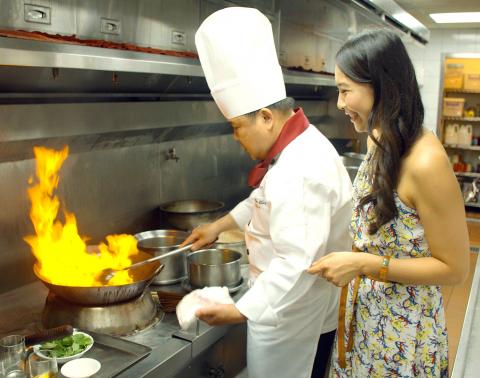
Photo courtesy of Ching’s Amazing Asia, Food Network UK
“I really wanted to celebrate the chefs in Asia and Asian cuisine and take people on a tour so they can see with their own eyes the beauty of the signature dishes of the chefs and really kick open the kitchen doors,” Huang says.
Huang, who has also called South Africa her home, says there is a commonly held assumption in the West that Asian kitchens are “secretive” because the chefs don’t share their recipes.
“I wanted to dissolve those myths.”
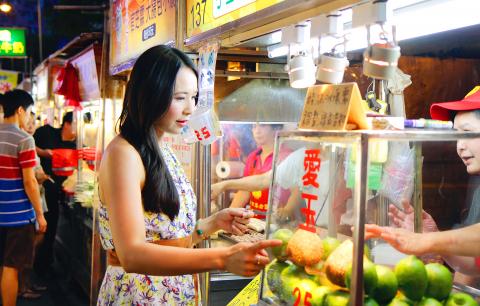
Photo courtesy of Ching’s Amazing Asia, Food Network UK
CULINARY ROOTS
Huang says the highlights of her adventure, which incorporated everything from street stalls to Michelin-starred restaurants, were both culinary and nostalgic.
“This is not because I’m biased, but I really, really enjoyed Taipei,” she says.
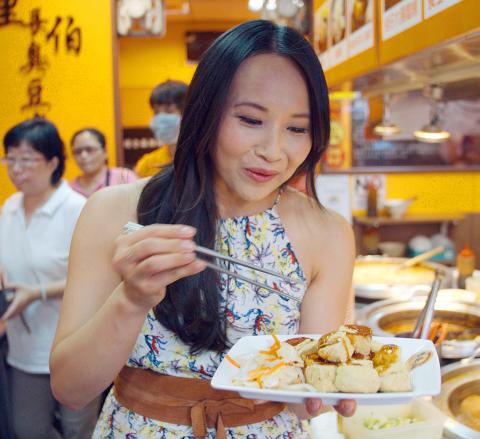
Photo courtesy of Ching’s Amazing Asia, Food Network UK
Street food classics were the dishes Huang most enjoyed filming and eating. She includes Ningxia Night Market’s (寧夏夜市) stinky tofu, her favorite, as well as oyster omelet (蚵仔煎) and Aiyu (愛玉) jelly, as well as a small sausage encased in a big sausage with rice.
Huang says that when deciding what to include in the series, dishes were chosen first and then the eateries.
Things did not always go according to plan, like the time she went to James Kitchen (大隱酒食), a restaurant in Taipei’s Da-an District (大安), to sample their famous braised pork rice and was given youtiao (油條, fried dough sticks) with oysters instead.
“I said ‘sure, why not, that sounds delicious,’” Huang says.
Filming was a family affair, with husband and co-executive producer Jamie Cho behind the camera. Huang says it is an ideal partnership because they communicate well and any conflict is worked out quickly.
“I couldn’t have done this project without him,” Huang says.
Putting the series together involved hard work and a tight schedule, the five-and-a-half weeks of shooting incorporating five locations and approximately 70 different eateries.
TAIWAN IN THE UK
Shows such as Ching’s Amazing Asia have helped raise the profile of Taiwanese cuisine and Huang highlights the burgeoning Taiwanese food scene in London.
As well as a proliferation of bubble tea joints, it is becoming easier to sample the delights of three-cup chicken, oyster omelet and gua bao (割包), a steamed flat bun stuffed with stewed pork.
She’s also acquired a taste for the food of her adopted homeland to go with her love for Taiwanese dishes, a sort of culinary yin and yang.
“I love British food,” Huang says. “For my Western fix my husband and I will go out for fish and chips. I love Cornish pasties. If I’m traveling on the train I’ll grab one.”
At home, Huang likes to cook simple, healthy dishes that are nourishing.
“I always make something comforting like a Taiwanese-style danhuatang (蛋花湯) — egg flower drop soup, lots of vegetables, noodles,” she says.
Huang says the popularity of Taiwanese food in the UK is growing.
“Taiwanese restaurants, Taiwanese-style dumplings, Taiwanese baozi. A lot of students who have stayed here [in the UK] are cooking up some wonderful things,” she says.
■ Ching’s Amazing Asia airs every Monday from 10pm to 10:30pm on the Asia Food Channel, which can be seen on channel 135 on MOD.

If one asks Taiwanese why house prices are so high or why the nation is so built up or why certain policies cannot be carried out, one common answer is that “Taiwan is too small.” This is actually true, though not in the way people think. The National Property Administration (NPA), responsible for tracking and managing the government’s real estate assets, maintains statistics on how much land the government owns. As of the end of last year, land for official use constituted 293,655 hectares, for public use 1,732,513 hectares, for non-public use 216,972 hectares and for state enterprises 34 hectares, yielding

The small platform at Duoliang Train Station in Taitung County’s Taimali Township (太麻里) served villagers from 1992 to 2006, but was eventually shut down due to lack of use. Just 10 years later, the abandoned train station had become widely known as the most beautiful station in Taiwan, and visitors were so frequent that the village had to start restricting traffic. Nowadays, Duoliang Village (多良) is known as a bit of a tourist trap, with a mandatory, albeit modest, admission fee of NT$10 giving access to a crowded lane of vendors with a mediocre view of the ocean and the trains

The March/April volume of Foreign Affairs, long a purveyor of pro-China pablum, offered up another irksome Beijing-speak on the issues and solutions for the problems vexing the People’s Republic of China (PRC) and the US: “America and China at the Edge of Ruin: A Last Chance to Step Back From the Brink” rang the provocative title, by David M. Lampton and Wang Jisi (王緝思). If one ever wants to describe what went wrong with US-PRC relations, the career of Wang Jisi is a good place to start. Wang has extensive experience in the US and the West. He was a visiting
One of the challenges with the sheer availability of food in today’s world is that lots of us end up spending many of our waking hours eating. Whether it’s full meals, snacks or desserts, scientists have found that it’s not uncommon for us to be mindlessly grazing at some point during all of our 16 or so waking hours. The problem? As soon as this food hits the bloodstream in the form of glucose, it initiates the release of the hormone insulin. This in turn activates a switch present in every one of our cells, which is responsible for driving cell


 RSS
RSS