


Jonathan Waxman was a Berkeley, California hippy who fell into the restaurant trade, running the kitchens at Alice Waters’s Chez Panisse in the late 1970s and palling around with culinary rock-stars like Jeremiah Tower and Michael McCarty. Together they brought a relaxed, ingredient-focused sensibility to eating that came to be known as “California cuisine.”
Waxman’s seminal restaurant Jams closed in the ‘80s, but he kept in the game. He’s been running the more Italian-focused Barbuto in New York’s West Village since 2004 and last year opened Adele’s in Nashville, Tennessee, which is named after his mother and features a giant wood-burning oven at its center. He’s become the gentle grandfather of a new generation of chefs. As he prepares to reopen Jams in 1 Hotel Central Park this month, another Adele’s in Toronto and a possible return to his home turf in San Francisco, Bloomberg Brief’s Peter Elliot caught up with him at Barbuto.
Peter Elliot: You’re a grilling master. What’s the best advice for home grillers??
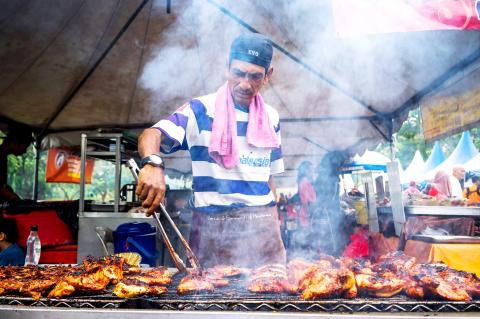
Photo: Bloomberg
Jonathan Waxman: Don’t get the fire too hot or too low. Fill the chimney up, get it hot and dump it out, then add fresh coals immediately. Number two, if you’re using a gas grill everyone turns it on too full and that just makes for [food] fires. Or they turn it way too low because they are afraid. So, medium on a gas grill.
PE: Your rule on gas vs charcoal?
JW: Never use gas and only use charcoal. I recommend a Weber-style kettle grill. That’s all you need.
PE: And what’s your grilling technique?
JW: Let’s say you want to do steak and potatoes; keep it simple. The trick is to wrap the potatoes and throw them in the bottom where the coals are — but double wrap them with tinfoil so they don’t get burnt. Then you can grill the steaks after about 20 minutes. Here’s the trick: make sure when you grill them you’re doing that over the hot parts of the coals. If it’s not hot you have to push the coals to one part of the grill to really get intense heat. Grill the steaks 75 percent on one side. Everyone wants to flip their meat back and forth, but put it in one place and forget about it. It’s important for chicken, it’s important for fish, it’s important for vegetables. Seventy- five percent.
PE: The Waxman 75/25 rule, I like it. What about the rest of the meal?
JW: When you want to get ready for your meal, you want to get everything ready at the same time. Let’s say your potatoes are done, you pull them out and your steak feels a little rare to you, put some fresh coals on, get the potatoes ready, get your salad ready, get the wine ready, throw the steaks on for two minutes a side to reheat them and you’re good.
PE: Explain the transition from being the father of “California cuisine” to Adele’s in Nashville and Mr Barbecue.
JW: Four years ago this rock and roller, Caleb Followill [Kings of Leon lead singer] started coming into Barbuto a lot. One day we started talking about rock and roll, food, everything. We got to be very good friends. One day he looks at me and asks “How come I can’t get this food in Nashville?” I said, “Well let’s do something about it.” He’s represented by Ken Levitan who’s one of my partners and I have other amazing partners who are local Nashvillians.

Ajay Verma, a consultant gastroenterologist at Kettering general hospital in Northamptonshire, says our gut is a “complex machine.” “It is constantly providing us with the nutrition we need, initially to grow and develop, and then for us to survive, thrive and repair from injury and illness.” How can we keep it functioning well? Put simply: “Make sure what you put into it is balanced, and that you clear out its waste products adequately,” Verma says. “In a general gastroenterology clinic, the most common conditions we see are irritable bowel syndrome (IBS), gastroesophageal reflux disease, inflammatory bowel disease and constipation,” says Nisha
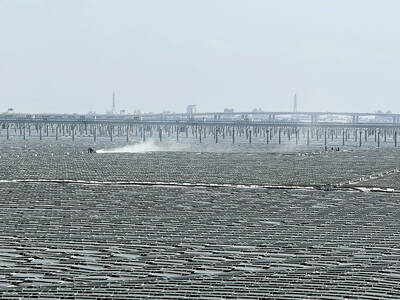
The arithmetic is straightforward and uncomfortable. By the end of 2025, Taiwan had committed itself to a 50-30-20 electricity mix — half natural gas, 30 per cent coal, 20 per cent renewables. The Ministry of Economic Affairs’s (MOEA) own monthly energy reports tell a different story. Natural gas reached 47.8 per cent of generation last year. Coal stood at 35.4 per cent, comfortably above its target ceiling. Renewables came in at 13.1 per cent, well short of the 20 per cent Taipei had pledged a decade earlier. Installed renewable capacity reached roughly half of the 12 gigawatts (GW) the government

Last week US President Donald Trump was asked by a reporter whether he would speak on the phone to the President of Taiwan. “l’ll speak to him. I speak to everybody. We have that situation very well in hand,” Trump said. This marked the second time in a couple of weeks he had said he would talk to the President of Taiwan. In 2016 he famously took a call from then-president Tsai Ing-wen (蔡英文), when he was president-elect. Despite warnings that the apocalypse was nigh because of a phone call, the world quickly forgot about the conversation between two democratically-elected presidents.

Taiwan’s drone exports are taking off, fuelled by the war in Ukraine, as Taiwanese companies seek a stake in the fast-growing global market for unmanned aerial vehicles (UAV). Low-cost drones used for reconnaissance and strikes are in high demand as governments around the world boost defense spending in the face of intensifying conflicts. A relative new player in the increasingly competitive industry, Taiwan’s pitch is to be an “Asian hub” for the production of UAVs and components free of Chinese materials, or “non-red.” That means its UAVs can be up to three times more expensive than their Chinese competitors, like the world’s biggest


 RSS
RSS