


Do not expect there to be real lanterns at the Treasure Hill Environmental Art Lantern Festival (寶藏巖環境藝術燈節), set to open at 7pm tomorrow at Taipei’s Treasure Hill Artist Village (寶藏巖國際藝術村). Instead, installations will illuminate the hills, creating a pensive mood for visitors to contemplate the controversial history of this now popular cultural attraction.
Launched in 2012, the annual festival features performances and installations by contemporary artists from Taiwan and Japan, some of whom were former artists-in-residence.
“We don’t come up with a theme and give it to the artists. The artists have to come here and examine the place first, and then start to think about what they want to do,” says Yang Hsiao-wei (楊筱薇) from the Taipei Culture Foundation’s Department of Artist-in-Residence (台北市文化基金會藝術村營運部).
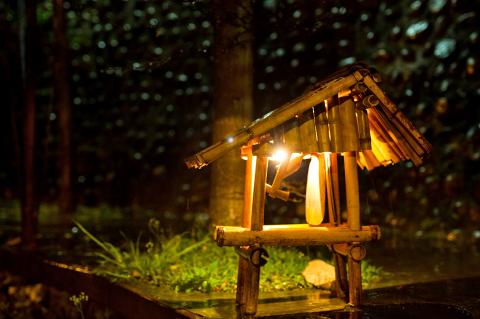
Photo courtesy of Taipei Culture Foundation
While there is no thematic focus, crossover collaborations feature predominantly in this year’s lineup. For the festival’s opening show, multimedia artist Chou Yu-cheng (周育正) creates a large tent-like structure as the set for a performance by Scarecrow Contemporary Dance Company (稻草人現代舞蹈團).
Building a stage with recycled clothing, artist Chen Sung-chih (陳松志) collaborates with dancer-choreographer Yu Yen-fang (余彥芳) from the improvisational dance troupe Ku & Dancers (古舞團), for a performance on April 18 and April 25.
HISTORICAL BENT
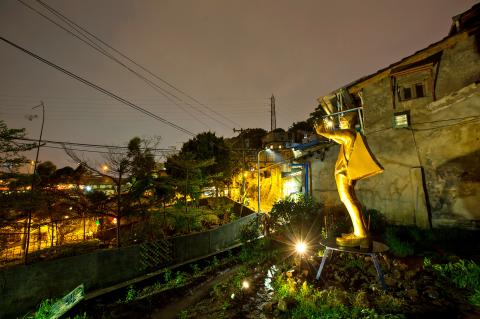
Photo courtesy of Taipei Culture Foundation
Once a squatter community whose inhabitants were primarily war veterans who retreated to Taiwan with the Chinese Nationalist Party (KMT), Treasure Hill was designated a historical site in 2004. It underwent renovations by the Department of Cultural Affairs in 2007. Most of the tenants were relocated, with only a few remaining. The artist village was officially put into operation in 2010.
Tai Han-hong’s (戴翰泓) wobbly wood-and-iron structure is inspired by the inhabitants’ persistence despite repeated relocation attempts.
Yet Luo Jr-shin’s (羅智信) work is probably the most critical. Transforming an old, above-ground cistern into a swimming pool with a beach chair on the side, Luo intends to show how the squatter settlement became a weekend hot spot frequented by camera-wielding visitors. Sound artist Betty Apple (鄭宜蘋) will perform in the pond on April 6 and April 11.
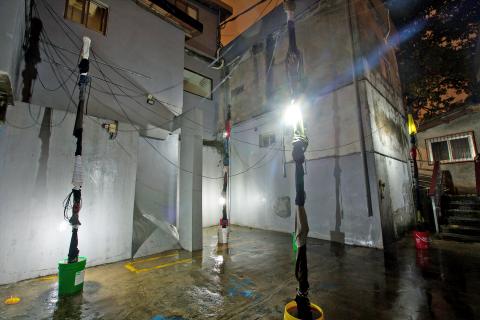
Photo courtesy of Taipei Culture Foundation
The exhibited artworks are scattered throughout Treasure Hill’s labyrinth of piecemeal buildings, so visitors are encouraged to wander through the alleys. The best time to visit is after sunset since most of the installations use light as one of their creative elements.
All live performances are scheduled to take place on weekends, free of admission. For more information, visit www.artistvillage.org or www.facebook.com/artthav.

Photo courtesy of Taipei Culture Foundation

The small platform at Duoliang Train Station in Taitung County’s Taimali Township (太麻里) served villagers from 1992 to 2006, but was eventually shut down due to lack of use. Just 10 years later, the abandoned train station had become widely known as the most beautiful station in Taiwan, and visitors were so frequent that the village had to start restricting traffic. Nowadays, Duoliang Village (多良) is known as a bit of a tourist trap, with a mandatory, albeit modest, admission fee of NT$10 giving access to a crowded lane of vendors with a mediocre view of the ocean and the trains
For many people, Bilingual Nation 2030 begins and ends in the classroom. Since the policy was launched in 2018, the debate has centered on students, teachers and the pressure placed on schools. Yet the policy was never solely about English education. The government’s official plan also calls for bilingualization in Taiwan’s government services, laws and regulations, and living environment. The goal is to make Taiwan more inclusive and accessible to international enterprises and talent and better prepared for global economic and trade conditions. After eight years, that grand vision is due for a pulse check. RULES THAT CAN BE READ For Harper Chen (陳虹宇), an adviser

Traditionally, indigenous people in Taiwan’s mountains practice swidden cultivation, or “slash and burn” agriculture, a practice common in human history. According to a 2016 research article in the International Journal of Environmental Sustainability, among the Atayal people, this began with a search for suitable forested slopeland. The trees are burnt for fertilizer and the land cleared of stones. The stones and wood are then piled up to make fences, while both dead and standing trees are retained on the plot. The fences are used to grow climbing crops like squash and beans. The plot itself supports farming for three years.

President William Lai (賴清德) on Nov. 25 last year announced in a Washington Post op-ed that “my government will introduce a historic US$40 billion supplementary defense budget, an investment that underscores our commitment to defending Taiwan’s democracy.” Lai promised “significant new arms acquisitions from the United States” and to “invest in cutting-edge technologies and expand Taiwan’s defense industrial base,” to “bolster deterrence by inserting greater costs and uncertainties into Beijing’s decision-making on the use of force.” Announcing it in the Washington Post was a strategic gamble, both geopolitically and domestically, with Taiwan’s international credibility at stake. But Lai’s message was exactly


 RSS
RSS