


3D printing will revolutionize war and foreign policy, say experts, not only by making possible incredible new designs but by turning the defense industry — and possibly the entire global economy — on its head.
For many, 3D printing still looks like a gimmick, used for printing useless plastic figurines and not much else. But with key patents running out this year, new printers that use metal, wood and fabric are set to become much more widely available — putting the engineering world on the cusp of major historical change. The billion-dollar defense industry is at the bleeding edge of this innovation, with the US military already investing heavily in efforts to print uniforms, synthetic skin to treat battlewounds, and even food, said Alex Chausovsky, an analyst at IHS Technology.
Scientists at the Massachusetts Institute of Technology have already invented “4D printing” — creating materials that change when they come into contact with elements such as water. One day, that could mean things like printed uniforms that change color depending on their environment.
In the real world, the baby steps are already being taken. Late last year, British defense firm BAE Systems put the first printed metal part in a Tornado jet fighter. The company recently put out an animated video showing where they think such humble beginnings could one day lead. It imagined a plane printing another plane inside itself and then launching it from its undercarriage. “It’s long term, but it’s certainly our end goal to manufacture an aerial vehicle in its entirety using 3D printing technology,” Matt Stevens, who heads BAE’s 3D printing division, told AFP.
REVOLUTIONIZING WAR AND POLITICS
But the real revolution of 3D printing is less about the things you can make and more about where you make them. Being able to take printers to a warzone promises a radical shake-up of combat and the defense industry, says Peter W Singer, an expert in future warfare at the New America Foundation.
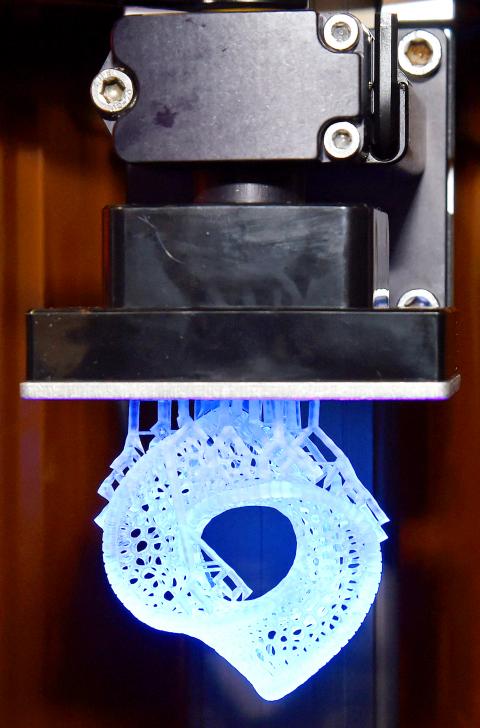
Photo: AFP/Ethan Miller
“Defense contractors want to sell you an item but also want to own the supply chain for 50 years,” he says. “But now you’ll have soldiers in an austere outpost in somewhere like Afghanistan who can pull down the software for a spare part, tweak the design and print it out.”
This could lead militaries to cut out private defense companies altogether. And by combining 3D printing with assembly line robotics, those that remain will be enormously streamlined. That sort of disruption carries huge political implications in places like the US where defense firms are purposefully spread around the country and support millions of jobs. “The Pentagon and defense industry have an incredibly tough time with innovation, but you don’t want to wait to lose a major battle before you do it,” says Singer.
3D printing could even change foreign policy, for instance by undermining sanctions. “The US has sanctioned everything from fighter jet spare parts to oil equipment. 3D printing could turn sanctions — which have been a crucial part of foreign policy for a generation or more — into an antiquated notion,” says Singer.
Then there are the scarier prospects that come with reducing the barriers to arms manufacturing. “Think of master bombmakers in the Middle East making new designs that look like everyday products or a lone wolf operator printing a plastic gun he can get past security at the White House,” says Chausovsky.
But all of that may pale in comparison to the security risks that 3D printing could trigger by revolutionizing economies. If anyone can print retail goods, economies that rely on cheap factory labor to make things like clothes and toys may find themselves in deep trouble — with all the security consequences that go with that. “If you want to know where the big threat of 3D printing is, think about how reliant China is on its low-cost merchandising sector,” says Chausovsky.
‘CAN’T DRILL A CURVED HOLE’
3D printing — invented in the 1980s — is much older than many realize. The recent upsurge in interest is tied to the fact that patents on the original technology are expiring — opening the way for competition that will drive up quality and push down prices. The first major patents to run out were in 2009 for a system that used plastics known as “fused deposition modeling.” But the next big ones, that expired in the first half of 2014, are related to “selective laser syntering” that prints metals such as aluminum, copper and steel, and with much greater definition.
And rather than working with solid lumps of metal, engineers can create complex new shapes that use much less material without losing any strength.
“You can’t drill a curved hole,” says Chausovsky. “With 3D printing, you’re creating products that would never be possible with traditional methods.
The full implications are still hard to imagine. “It’s the first time in a very long time that there’s been such a radical shake up in industrial engineering,” says Stevens at BAE. “We’re not just improving things — we’re re-writing the rule book.”

Growing up in a rural, religious community in western Canada, Kyle McCarthy loved hockey, but once he came out at 19, he quit, convinced being openly gay and an active player was untenable. So the 32-year-old says he is “very surprised” by the runaway success of Heated Rivalry, a Canadian-made series about the romance between two closeted gay players in a sport that has historically made gay men feel unwelcome. Ben Baby, the 43-year-old commissioner of the Toronto Gay Hockey Association (TGHA), calls the success of the show — which has catapulted its young lead actors to stardom -- “shocking,” and says

The People’s Republic of China (PRC) invaded Vietnam in 1979, following a year of increasingly tense relations between the two states. Beijing viewed Vietnam’s close relations with Soviet Russia as a threat. One of the pretexts it used was the alleged mistreatment of the ethnic Chinese in Vietnam. Tension between the ethnic Chinese and governments in Vietnam had been ongoing for decades. The French used to play off the Vietnamese against the Chinese as a divide-and-rule strategy. The Saigon government in 1956 compelled all Vietnam-born Chinese to adopt Vietnamese citizenship. It also banned them from 11 trades they had previously

Inside an ordinary-looking townhouse on a narrow road in central Kaohsiung, Tsai A-li (蔡阿李) raised her three children alone for 15 years. As far as the children knew, their father was away working in the US. They were kept in the dark for as long as possible by their mother, for the truth was perhaps too sad and unjust for their young minds to bear. The family home of White Terror victim Ko Chi-hua (柯旗化) is now open to the public. Admission is free and it is just a short walk from the Kaohsiung train station. Walk two blocks south along Jhongshan

Snoop Dogg arrived at Intuit Dome hours before tipoff, long before most fans filled the arena and even before some players. Dressed in a gray suit and black turtleneck, a diamond-encrusted Peacock pendant resting on his chest and purple Chuck Taylor sneakers with gold laces nodding to his lifelong Los Angeles Lakers allegiance, Snoop didn’t rush. He didn’t posture. He waited for his moment to shine as an NBA analyst alongside Reggie Miller and Terry Gannon for Peacock’s recent Golden State Warriors at Los Angeles Clippers broadcast during the second half. With an AP reporter trailing him through the arena for an


 RSS
RSS