


The Ice Bucket Challenge poses a conundrum. Though it was for a good cause, it was a waste of drinking water. US actor Matt Damon highlighted this when he substituted toilet water for drinking water as did Taiwanese-Japanese actor Takeshi Kaneshiro (金城武), who opted for water from his dehumidifier. Water scarcity is one of the concerns at Run for Water, Water for Run (水逐跡特展), a must-see exhibition currently on view at the Songshan Cultural and Creative Park (松山文創園區).
Organized by Delta Electronics Foundation (台達電子文教基金會), which has dedicated itself to environmental research and education since its inception in 1990, the exhibition aims to raise public awareness of the global water crisis as well as sustainability and efficiency of water use.
Explaining scientific facts through an audio-visual presentation in a way people will understand was the biggest challenge organizing the exhibition says Guo Shan-shan (郭珊珊), executive director of the foundation.

Photo courtesy of Delta Electronics Foundation
“Promoting environmental education is much like advocating a green lifestyle. People need to understand and accept it before taking action ... We address the issue through people’s relations with water, hoping that visitors can understand the effects of water scarcity and be willing to change their habits,” Guo told the Taipei Times.
The water footprint concept is expressed using simple examples. If you drink a cup of coffee every day, for example, yearly water consumption is equal to the amount of water carried by 27 fire trucks.
Wim Chang (張楊乾), the foundation’s deputy executive director who has practiced water conservation, shares his experiences with a nifty device he uses at home. It is designed to recycle water from his washing machine, which when combined with other water saving measures reduces his water consumption by 88 percent when compared to the average household in Taiwan.
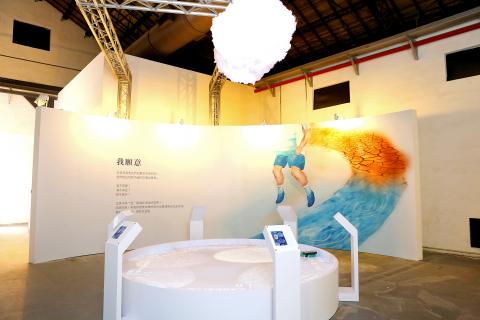
Photo courtesy of Delta Electronics Foundation
GLOBAL MATTERS
With technical support from Delta Electronics Inc, the technically polished multi-media exhibition is divided into several sections. Upon entering the exhibition, visitors are greeted by several short films provided by Water.org, a non-profit organization co-founded by Damon and Gary White that is dedicated to tackling water and sanitation problems in developing countries.
Highlighting the lack of clean water for millions of people around the world, the films reveal some shocking facts. For example, in rural Ethiopia, villagers, usually women and children, walk four to eight hours to gather water, often from shallow ponds they share with animals. Many die from preventable water-related diseases.
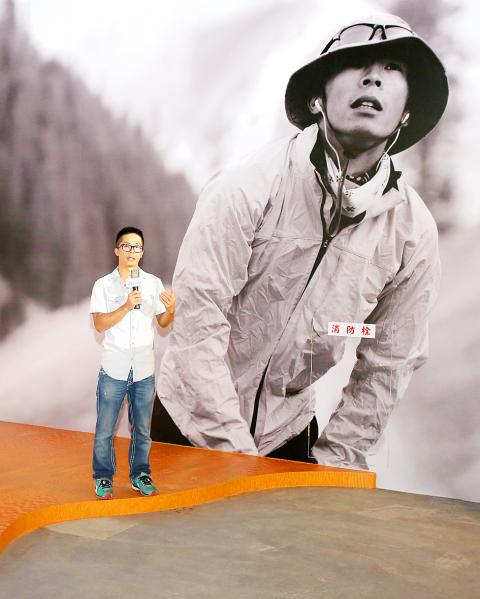
Photo courtesy of Delta Electronics Foundation
Across the room, one work shows that in Tuvalu, an island nation that is likely to be the world’s first casualty of climate change if sea levels continue to rise, locals have built mangrove plantations designed to help protect the coastline from erosion. Composed of photographs and explanatory notes, the display is based on the first-hand experience of one of the foundation’s employees, who has done volunteer work in Tuvalu for two years.
Guo says the water crisis that is occuring in most parts of the world is closely related to global warming, a key issue addressed in the fifth assessment report from the UN’s Intergovernmental Panel on Climate Change (IPCC). The report has been translated into Chinese and made available for public use by the foundation.
LOCAL STORIES

Photo courtesy of Delta Electronics Foundation
One section focuses on water-related issues in Taiwan. The past and present of Chianan Irrigation System (嘉南大圳), built by the Japanese colonial government in the 1920s, is told through stories by a local octogenarian, who worked on the canal decades ago.
The exhibition team filmed a documentary in Greater Kaohsiung’s Namasiya Township (那瑪夏), devastated by Typhoon Morakot in 2009. It shows how villagers from an indigenous community have to trek into a mountain to obtain spring water because they lack the infrastructure for providing drinking water.
KEEP RUNNING
Another display introduces the expeditions ultramarathon runner Kevin Lin (林義傑) took to the Sahara Desert in 2006, along the Silk Road in 2011 and the Gobi Desert last year.
A clean water advocate, Lin says his journeys have opened his eyes to the hardships caused by water shortage.
A series of photographs show a little boy Lin encountered while running through the Sahara Desert. Alone, the boy was waiting for the return of his parents, who had set out on a two-day trek to get water.
During the exhibition period, lectures will be given every Saturday and Sunday from 3pm to 4pm. Today’s invited speaker will be Ke Chin-yuan (柯金源), an experienced environmental documentary filmmaker, while Taiwanese poet Wu Sheng (吳晟) will take the floor on Saturday.
For non-Chinese speakers, exhibition handouts that explain the content of each section are available in English. A 40-minute English guided tour is provided every Saturday at 1:30pm and 4pm. Other weekend time slots can also be arranged by making requests online. More information can be found at the exhibition’s bilingual Web site: waterforrun.blogspot.tw.
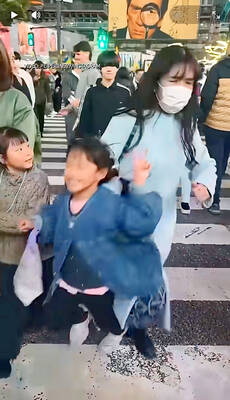
It starts out as a heartwarming clip. A young girl, clearly delighted to be in Tokyo, beams as she makes a peace sign to the camera. Seconds later, she is shoved to the ground from behind by a woman wearing a surgical mask. The assailant doesn’t skip a beat, striding out of shot of the clip filmed by the girl’s mother. This was no accidental clash of shoulders in a crowded place, but one of the most visible examples of a spate of butsukari otoko — “bumping man” — shoving incidents in Japan that experts attribute to a combination of gender

The race for New Taipei City mayor is being keenly watched, and now with the nomination of former deputy mayor of Taipei Hammer Lee (李四川) as the Chinese Nationalist Party’s (KMT) candidate, the battle lines are drawn. All polling data on the tight race mentioned in this column is from the March 12 Formosa poll. On Christmas Day 2010, Taipei County merged into one mega-metropolis of four million people, making it the nation’s largest city. The same day, the winner of the mayoral race, Eric Chu (朱立倫) of the Chinese Nationalist Party (KMT), took office and insisted on the current
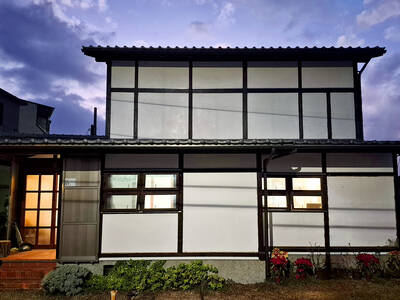
When my friend invited me to take a tour of a wooden house hand-built by a Pingtung County resident, my curiosity was instantly piqued and I readily agreed to join him. If it was built by a single person, it would surely be quite small. If it was made of wood, it would surely be cramped, dingy and mildewy. If it was designed by an amateur, it would surely be irregular in shape, perhaps cobbled together from whatever material was easily available. I was wrong on all counts. As we drove up to the house in Fangliao Township (枋寮鄉), I was surprised
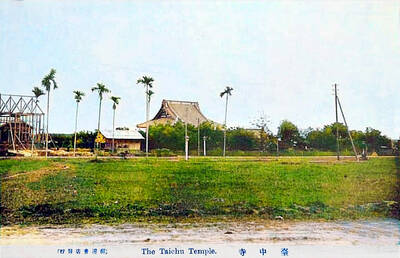
March 16 to March 22 Hidden for decades behind junk-filled metal shacks, trees and overgrowth, a small domed structure bearing a Buddhist swastika resurfaced last June in a Taichung alley. It was soon identified as a remnant of the 122-year-old Gokokuzan Taichuu-ji (Taichung Temple, 護國山台中寺), which was thought to have been demolished in the 1980s. In addition, a stone stele dedicated to monk Hoshu Ono, who served as abbot from 1914 to 1930, was discovered in the detritus. The temple was established in 1903 as the local center for the Soto school


 RSS
RSS