


Sorcery, plate-smashing and animal sacrifice are not often associated with Sufi festivals, but they all feature at a popular annual pilgrimage to a Moroccan shrine linked to the “queen of the genies.”
In the town’s main square, to a chorus of trilling pipes and banging drums, spectators press around a cluster of believers, who sway to the hypnotic rhythms in a trance-like state, sometimes leaping up and down in ecstasy, sometimes cutting themselves on the scalp with sharp tools. One of the men runs into the middle of the circle, holds up a large terracotta plate and throws it high into the air. It shatters as it lands on his head, prompting a loud cheer from the crowd.
The festival of Sidi Ali Ben Hamdouch brings Moroccans from far and wide to venerate a 17th century Muslim saint and his servant Lalla Aicha, a mythical Muslim princess from the desert who dwells in the spirit world and is a powerful unseen force for her followers.
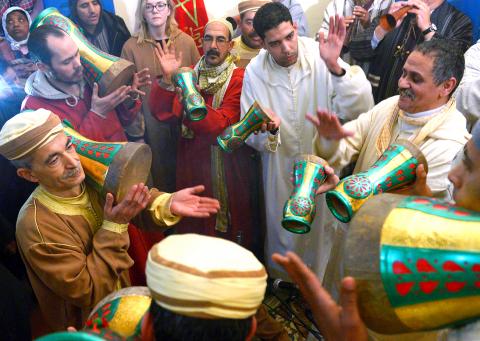
Photo: AFP
Traditionally, worshippers have come to Mghrassyine for spiritual guidance and divine blessing, sometimes seeking higher states of consciousness through music and dance, as a form of communion with God. But for a growing number of people, the week-long religious festival, or moussem, is a journey into the supernatural world of genies, incantations and shawafa — women who claim to be able, for a fee, to help people find love and feel better, to maybe cast or break a spell.
LAND OF THE SUPERNATURAL
Madame Khayat, from the city of Fez, says she comes every year, despite the disapproval of many Moroccans, including her husband, who view the rituals as un-Islamic.
“We come here to be purified of the evil spirits, of the ‘jinn,’” she says with a smile. “It’s a kind of pilgrimage if you like. People go to Mecca to be purified of their sins. People come here to be purified of evil spirits.”
“There are many people who think it’s savagery, who don’t believe in this. Even my husband doesn’t like me to come here. So when he wasn’t looking, I just got in the car and came with my two maids,” she adds with a laugh.
Good and bad genies (jnun in Arabic) are frequently mentioned in the Koran, although orthodox Islamic tradition holds that Muslims should rely on God alone to protect them from malevolent spirits. But the spirits hold a special place in Moroccan folklore and popular culture, and not just among the poor and uneducated. A study published in 2012 by the Pew Research Centre, a US think tank, showed that an estimated 86 percent of Moroccans believe in these supernatural beings, more than any of the other countries surveyed.
Aziz Hlaoua, a Moroccan sociologist, says that under King Mohamed VI there has been a clear revival of Sufism, the beliefs and practices of mystical Muslim sects, which in Morocco are commonly linked to the world of magic and healing.
In 2002, the king appointed Ahmed Toufiq, known for his Sufi sympathies, as minister of religious affairs, to pioneer this revival and reverse the marginalization of Sufi fraternities under his father, the late king Hassan II.
“The political role of this new policy of favoring Sufism as a moderate, open, tolerant form of Islam is a means of confronting extremism,” Hlaoua said. “And the moussem have seen a continuous comeback since Ahmed Toufiq’s appointment as minister.”
MUSIC AND MEDITATION
On the last day of the Sidi Ali festival, thousands gather to accompany a procession of flag bearers and drummers as they lead a sacrificial bull donated by the king down the hill to the shrine of Sidi Ali. Other creatures, notably black chickens and goats, the color supposedly favored by Lalla Aicha, are on sale around the town, to be slaughtered as part of an Islamic tradition that has assumed occult overtones in Mghrassyine.
“When they sacrifice the animal, they believe the genies drink its blood. It’s a way of pacifying the spirits,” Hlaoua explained.
An alleyway winding down to the valley below the shrine is lined with evidence of sorcery — shawafa salons and stalls selling festival accessories, from goat horns to dried chameleons, which are placed in boiling water to produce healing vapors.
At the bottom of the path, women light prayer candles and burn incense in the cave of Lalla Aicha, calling on the so-called queen of the genies to intercede on their behalf, or they purify themselves with a ritual bath in the adjacent natural spring. Two sheep lie dead on the ground nearby, their throats slit.
A more cerebral atmosphere prevails in the room, not far from the shrine, where members of the Sidi Ali fraternity congregate for an evening of spiritual music and meditation, or lilla.
After hours of chanting and swaying that lasts late into the night, a man in the audience starts throwing his head about violently, apparently entering a state of trance, before collapsing on the ground.

It seems every few days one bumps into one of those “real man” comments in which Taiwan is urged to “face reality” or similar, and “make a deal,” with the speaker implying that soon it will be too late. “Deal” advocates always present themselves as having a superior grip on reality, and the manly ability to make the “hard choice.” Their testosterone-laden language often echoes that of Taiwan sellout advocates. Note that such commentary always specifies a process (“make a deal, work with, make progress”), never the end state of what occupation by a violent authoritarian colonialist state will entail. In

There are shadowy cabals plotting to sell out Taiwan to be annexed by China, by invasion if necessary. Fortunately, they are buffoons. In 2019, former Bamboo Union gangster and founder of the China Unification Promotion Party (CUPP), Chang An-le (張安樂, colorfully known as “White Wolf”), led a protest at the Legislative Yuan against comments made by then-premier Su Tseng-chang (蘇貞昌) that in the event of an attack by China, he would never surrender, but would protect the nation by fighting to the end, even if he only had a broom. Chang had party members bring a wooden casket that they
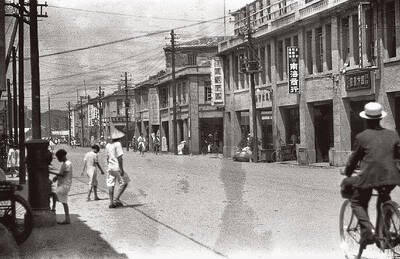
June 1 to June 7 "If all Taiwanese were as afraid of dying as you, then what would happen?” Physician Shih Chiang-nan (施江南) reportedly said this to his wife Chen Chiao-tung (陳焦桐) after she urged him to stop intervening on behalf of Taiwanese soldiers stranded overseas after serving in the Japanese Army during World War II. Shih had clashed with high-ranking officials over the issue, engaged in several heated arguments with Taiwan governor-general Chen Yi (陳儀) and allegedly shouted at general Ko Yuan-fen (柯遠芬), chief of staff of the Taiwan Garrison Command, over

Food prices have often played a major role in Taiwan’s history. The first major wave of migration from China occurred in 1628. A moderate drought, the Ming Dynasty maritime ban that prohibited fishing and trading (intended to reduce piracy) and a temporary tax, conspired to exhaust local resources, leading to famine in Fujian Province. The famed pirate and trader Zheng Zhilong (鄭芝龍), scooped up starving people from Fujian and transported them across the Taiwan Strait, where they settled under the Dutch. Two factors enabled Zheng. First, by 1624 he had settlements around today’s Beigang (北港) in Yunlin County with a small


 RSS
RSS