


In Hans Christian Andersen’s The Red Shoes, the girl is ostensibly condemned for her vanity and ordered to dance forever.
But Lin Meng-huan (林孟寰), director of the Puppet and Its Double Theater (無獨有偶工作室劇團), isn’t buying it. He thinks the girl was punished for daring to defy state-sanctioned morality and unjust rules.
The idea for a contemporary update of the 19th-century tale came a few years ago when the Arab Spring surprised the world, and just when the ongoing struggles for land justice were gaining momentum.
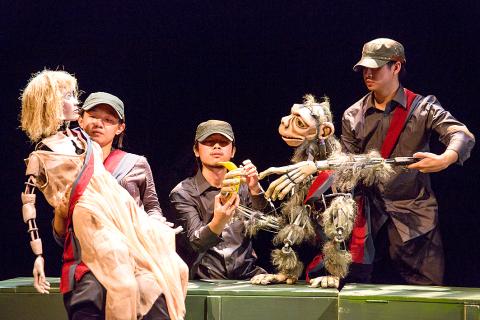
Photo courtesy of Puppet and Its Double Theater
“It got me to start thinking how an individual fights against the state apparatus. To me, the red shoes are not a curse. Rather, they encourage the girl to pursue freedom and what she think is right,” Lin told the Taipei Times.
Lin’s reflections led to his version of The Red Shoes, a collaboration between his contemporary puppet theater and In Tap (音踏), a tap dance group noted for collaborating with artists from different fields.
It is performed by a group of puppeteers “who are really interested in tap dancing.” says Lin, who writes and directs the play.
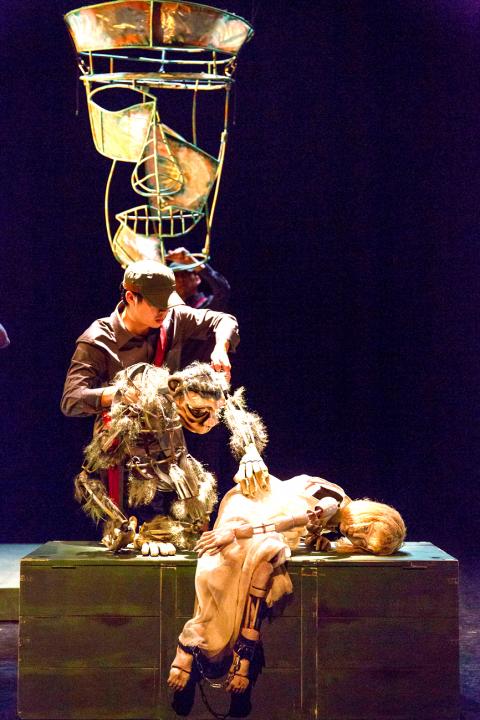
Photo courtesy of Puppet and Its Double Theater
Without uttering a word, five performers — including veteran tap dancer Chou Chun-peng (周浚鵬) — click across the stage, manipulating puppets to tell a rather dark story about a girl using her body to rebel against her oppressors. The performance is choreographed to live music by Lei Sheng (雷昇), who plays a melodica (a flute affixed with a keyboard) as well as electric and acoustic guitars on stage. The versatile musician also composes the pre-recorded music for the work, mixing historical recordings of talks by Chiang Kai-shek (蔣介石) and other dictators from human history.
The creations by puppet designer Liang Meng-han (粱夢涵) are mostly crude and skeletal figures suitable more for conveying emotions than for depicting realistic actions.
Also, the structures of the string puppets don’t try to conceal the relationship between puppet and puppeteer.
“Audiences can clearly see how the puppets are manipulated by the performers. To me, it is a magical moment to witness inert puppets coming to life,” the director explains.
The marriage of puppetry and tap dance, however, poses a challenge to even the most veteran of artists on both sides.
“Puppetry is somewhat similar to modern dance because both arts pay attention to fluidity and body rhythm. Tap dance, on the other hand, gets its rhythm mostly from the feet … For inexperienced dancers, their bodies tend to be stiff, and their attention is all on the steps,” Lin notes.
Since both puppetry and tap dance require years of training to master, Lin believes The Red Shoes is only the beginning of an exciting marriage between the two art forms.
“As the performers have gotten more and more relaxed, the two very different bodies have gradually grown to accept each other,” the director says.

Ajay Verma, a consultant gastroenterologist at Kettering general hospital in Northamptonshire, says our gut is a “complex machine.” “It is constantly providing us with the nutrition we need, initially to grow and develop, and then for us to survive, thrive and repair from injury and illness.” How can we keep it functioning well? Put simply: “Make sure what you put into it is balanced, and that you clear out its waste products adequately,” Verma says. “In a general gastroenterology clinic, the most common conditions we see are irritable bowel syndrome (IBS), gastroesophageal reflux disease, inflammatory bowel disease and constipation,” says Nisha

And so, in the wake of US President Donald Trump’s trip to the People’s Republic of China (PRC), all the experts on the Strait of Hormuz suddenly became experts on US-China-Taiwan relations. The Internet has certainly expanded human knowledge. Lots of these sudden experts made noise this week about Trump’s words after the meeting with PRC dictator Xi Jin-ping (習近平). Trump is going to sell out Taiwan! Longtime Taiwan commentator J. Michael Cole summed the situation up neatly in the Guardian: “We need to keep in mind that he has a tendency to say many things — sometimes contradicting himself within

Last week US President Donald Trump was asked by a reporter whether he would speak on the phone to the President of Taiwan. “l’ll speak to him. I speak to everybody. We have that situation very well in hand,” Trump said. This marked the second time in a couple of weeks he had said he would talk to the President of Taiwan. In 2016 he famously took a call from then-president Tsai Ing-wen (蔡英文), when he was president-elect. Despite warnings that the apocalypse was nigh because of a phone call, the world quickly forgot about the conversation between two democratically-elected presidents.
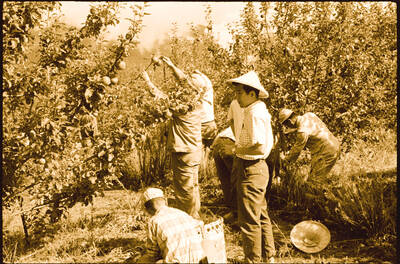
May 25 to May 31 Few believed that apples could be cultivated on a commercial scale in Taiwan’s high mountains. When horticulturalist Cheng Chao-hsiung (程兆熊) first proposed the idea in 1955, both American and Taiwanese colleagues dismissed it as implausible, arguing that temperate fruit could not be reliably grown on a subtropical island, especially on rugged terrain. However, it was this terrain in the Central Mountain Range where many Chinese Civil War veterans were resettled in the late 1950s. With limited job prospects and no family in Taiwan, they were placed on cooperative farms aimed toward self-sufficiency. Some say the conditions


 RSS
RSS