


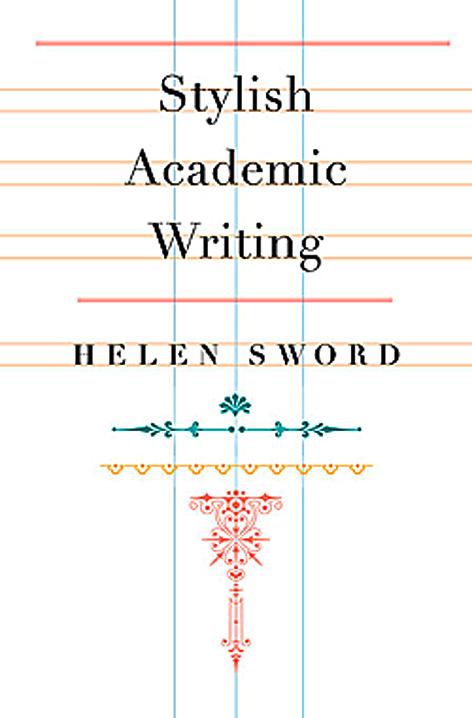
Mid-way through this book the author quotes the opening of Hunter S Thompson’s Fear and Loathing in Las Vegas:
“We were somewhere around Barstow on the edge of the desert when the drugs began to take hold. I remember saying something like ‘I feel a bit lightheaded; maybe you should drive … ’ And suddenly there was a terrible roar all around us and the sky was full of what looked like huge bats, all swooping and screeching and diving around the car, which was going about a hundred miles an hour with the top down to Las Vegas. And a voice was screaming ‘Holy Jesus! What are these goddamn animals?’”
This may seem a bizarre model to offer to academics afflicted by the advanced stages of what could be called jargonitis. Stylish Academic Writing isn’t all like this, perhaps unfortunately, but Helen Sword’s point is that the best imaginative writers know how to grab their readers’ attention, and that academics, without going quite this far, could profitably learn more than a thing or two from them.
Professor Sword, who teaches in New Zealand, remembers how, as a graduate student in comparative literature, she dropped the phrase “psychosexual morphology” into a seminar discussion of Thomas Hardy, and knew from the smiling reaction that she’d been accepted on the spot into an elite community. Jargon, in other words, was a badge that showed that only you and a very few others knew what it meant, and those on the yellow brick road to tenure intended to keep it that way.
She doesn’t want to be a member on those terms of any community any longer, and the fact that Harvard University Press has accepted her assault on incomprehensibility in our ivory towers for publication may be sending a few shivers up some affluent spines. God forbid, but maybe things are actually soon going to change! The general reading public is jargon’s enemy No 1, and if they can understand an article on Hardy, then there must be something wrong with it as “research.”
A classic text that inevitably appears in this book is Orwell’s essay Politics and the English Language, in which he argued that clarity of prose was a safeguard against political tyranny. Tyrants don’t say what they mean, he said, because if they did no one would tolerate them. Instead, they clothe their true intentions in euphemism and long words.
This doesn’t really fit Professor Sword’s argument, however, as her targets are academics, not politicians. And these academics, in the humanities at least, are very often on the political left, and hence in theory against tyranny of any kind. This makes their obfuscation all the more absurd, of course, because the very people they hope to help are denied any access to their arguments.
It’s of some interest that Orwell’s famous essay has been questioned only this month in London’s New Statesman. Commentator Ed Smith there observes that the besetting sin of today’s politicians isn’t obscurity but a deceptive simplicity. Preceding their remarks with “Let me be honest with you,” they proceed to make simplistic points that no sane man could disagree with, but which have little connection with the devious policies they are in fact pursuing.
This new book’s focus is on the academic research paper. As a result, the author gives advice on everything from titles down to footnotes. And the emphasis is always the same — concrete words rather than abstractions, original verbs rather than “is” and “was,” the incorporation of anecdotes, and the use where permitted (and even where it’s not) of “I” and “we.” Plus, of course, the avoidance of jargon.
But wait a minute, some academics will say, what you call jargon is often the deployment in shorthand of concepts already familiar to other specialists in the field. We aren’t trying to talk to the general public — we’re professionals talking to each other.
On the surface this looks like a valid argument. But there are two problems with it. The first is that in the humanities these days such technical language often embodies highly controversial political positions, frequently taken direct from the thought of Michel Foucault, that the writers would rather were not re-examined. We all agree on these things, they’re in fact saying, and despite our high salaries we all agree on the need to overthrow the state and subvert the universities we’re teaching in. Let’s not waste time going into all that stuff all over again. Let’s, instead, look at Thomas Hardy or Charles Dickens and see if we can find evidence that they supported us.
The second objection to the use of technical jargon in the humanities is that it’s an attempt to imitate science. Science has authority because it’s dealing with things that are demonstrably true. Someone who discovers something new about, say, fruit-flies, is adding to our understanding of the world and how it works. The humanities, by contrast, can’t claim any comparable objectivity. In the worlds of literature or history, conflicting viewpoints are possible and frequently taken. But, the jargon-users implicitly argue, if we secretly agree on a revolutionary program, we can appear to be as unified and as objective as our scientific colleagues.
It may be unfair to bring up again the case of Alan Sokal who in the 1990s had a parody of such jargon-filled discourse accepted as the genuine thing by a cultural studies periodical. But surely it’s time to declare war on terms such as postsemioticist, flip-flop gates and feature theory, terms Orwell would surely have included under his definition of obscurity as a cuttlefish defensively spurting out ink.
Anyway, let’s hope this excellent new book is a sign that things are about to change. Don’t, though, expect anything remotely approaching Hunter S Thompson from the groves of academe any time soon.

Michael slides a sequin glove over the pop star’s tarnished legacy, shrouding Michael Jackson’s complications with a conventional biopic that, if you cover your ears, sounds great. Antoine Fuqua’s movie is sanctioned by Jackson’s estate and its producers include the estate’s executors. So it is, by its nature, a narrow, authorized perspective on Jackson. The film ends before the flood of allegations of sexual abuse of children, or Jackson’s own acknowledgment of sleeping alongside kids. Jackson and his estate have long maintained his innocence. In his only criminal trial, in 2005, Jackson was acquitted. Michael doesn’t even subtly nod to these facts.

Writing of the finds at the ancient iron-working site of Shihsanhang (十 三行) in New Taipei City’s Bali District (八里), archaeologist Tsang Cheng-hwa (臧振華) of the Academia Sinica’s Institute of History and Philology observes: “One bronze bowl gilded with gold, together with copper coins and fragments of Tang and Song ceramics, were also found. These provide evidence for early contact between Taiwan aborigines and Chinese.” The Shihsanhang Web site from the Ministry of Culture says of the finds: “They were evidence that the residents of the area had a close trading relation with Chinese civilians, as the coins can be
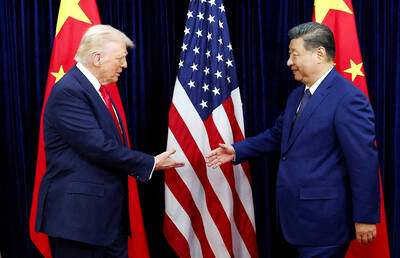
The March/April volume of Foreign Affairs, long a purveyor of pro-China pablum, offered up another irksome Beijing-speak on the issues and solutions for the problems vexing the People’s Republic of China (PRC) and the US: “America and China at the Edge of Ruin: A Last Chance to Step Back From the Brink” rang the provocative title, by David M. Lampton and Wang Jisi (王緝思). If one ever wants to describe what went wrong with US-PRC relations, the career of Wang Jisi is a good place to start. Wang has extensive experience in the US and the West. He was a visiting

The January 2028 presidential election is already stirring to life. In seven or eight months, the primary season will kick into high gear following this November’s local elections. By this point next year, we will likely know the Democratic Progressive Party (DPP) candidate and whether the Taiwan People’s Party (TPP) will be fielding a candidate. Also around this time, the Chinese Nationalist Party (KMT) will either have already completed their primary, or it will be heading into the final stretch. By next summer, the presidential race will be in high gear. The big question is who will be the KMT’s


 RSS
RSS