


The Lion The Beast The Beat, Grace Potter and the Nocturnals, Hollywood
Maybe it was Kenny Chesney who found the darkness inside Grace Potter. A couple of years ago, the breezy country beach bum took a turn to the self-lacerating on You and Tequila, one of the most devastating songs of his career. It was a duet about love and addiction, shared with Potter, and it carried both of them to desperate, shadowy places they’d not previously been.
For years before that, Potter and her band, the Nocturnals, had been pushing conservative, fundamentally polite, un-self-consciously retro 1960s rock and soul, with a touch of jam-band ooze. Hers was the sort of band that sprinkled live albums in between each studio album, and which started a rootsy annual festival in its home state of Vermont.

That version of Grace Potter and the Nocturnals was a band with a lot of muscle but no wit or savvy. There were glimmers of purpose on its self-titled third album from 2010, which had smears of grease on its rock but still felt overly concerned with decorum, despite Potter’s increasingly evident range.
The Lion the Beast the Beat is the fourth, and by far best, studio album by this band, which has finally allowed itself to try new poses and found give where previously there’d been only stiffness. By turns, it’s eerie, skittish, bruising and panting. And it touches on plenty of new sounds — on Never Go Back, the band’s chilly strut recalls Blondie; One Heart Missing recalls Kim Carnes; and the title track even suggests a hint of the art-rock churn of the Yeah Yeah Yeahs (until it shifts directions halfway and begins to sound like a Bad Company cover band, one of a handful of egregious missteps on this album).
Potter, always a strong singer, is now a dangerous one, too, finding a tone that’s ragged and loose on Keepsake and Runaway. On Loneliest Soul, she peels off the vocals slowly and alluringly, letting each line settle in before starting the next.

That is one of three songs here written with and produced by Dan Auerbach of the Black Keys, who adds in a bit too much vintage-organ filigree but who also encourages the band to use its guitars as weapons, and nudges Potter into more tousled territory.
At her best on this album, she calls to mind Stevie Nicks in her least drowsy phase. “I lit a fire with the love you left behind/ It burned wild and crept up the mountainside,” she sings on Stars. On Parachute Heart, which, like You and Tequila, captures love’s uncontrollable urges, she sounds like a woman getting lost, and finally taking flight:
There’s trouble in the friendly skies tonight
Love can never last when you’re flying up this high
You took the leap but I’m not ready to come down
So long baby
I’ll see you someday
When we’re both on the ground.
— Jon Carmanica, NY Times News Service
PUNCHING BAG, Josh Turner, MCA Nashville
Country singer Josh Turner has grown around a bass-baritone voice of great beauty and skill, and his producers and engineers lean in close to capture it. His lowest register is not plummy, like Tennessee Ernie Ford’s, or casually haunted, like Johnny Cash’s. It is balanced and alert; the notes come deep and grainy, almost the sound of bow on strings.
As an artist, Turner is at least half-classicist, drawn to mandolins, courtly love lyrics and the 1960s and 1980s Nashville sounds, but he is first and maybe last a larynx. This is not quite enough. His records over the past nine years, including the new Punching Bag, slide too easily into benign corniness. He’s a songwriter too, and he knowingly uses his lowest notes for the lines that sell the songs. But you can’t overuse an effect — even his most famous fan, last year’s American Idol winner Scotty McCreery, knows this — and the greater portion of Turner’s singing stays evenly bland, at one with his songwriting character.
That character is about as straight-arrow and cracker-barrel as commercial country music will allow. Basically, he wants to marry or stay married, and he is determined to accomplish his goal by traditional means, without wile, flash, low humor or surface emotions. “Nothing’s deeper than my love,” he sings (in Deeper ... Than My Love), the closest he gets to a boast. “Even when we’re six feet under/they’ll never have to wonder/if we ever drifted apart,” he sings (in Left Hand Man), the closest he gets to — is that a threat? Anyway: He is patient, constant, stoic, uxorious, deep deep deep.
The strengths of the album live in its valleys, far into the track listing. Not in Punching Bag, the title song that is about what Turner does when he’s taken too many hits: He persists. Not the album’s single, Time Is Love, a soft homily about how relationships must come before business. Not Find Me a Baby, about togetherness and family, in which he sings a ghastly na-na-na chorus with his real wife and sons.
It’s in the tracks about religion and metaphorical death on which something else emerges. In the minor-key Pallbearer, he never leaves his lower registers; harmonizing with Marty Stuart and Iris DeMent, he sings about carrying and interring his own dead relationship. (Depths, again.) And there’s a slightly different cast to his voice; he sounds a little bit moved. In the bluegrass-gospel For the Love of God, he’s driven by true moral zeal: He sings about out-of-control lives, vowing that his faith will never lead him that way.
And in the ballad I Was There, he delivers on what he has perhaps been implicitly promising with that voice of authority all these years, a song sung from the point of view of the creator. (It begins: “I was there, that night in Bethlehem/and when Neil and the boys came to the moon in that tin can.” The rest basically writes itself.) Unblameable, always there, ever-forgiving, deep in the valley, high in the sky: This is the persona from which all his others descend.
— Ben Ratliff, NY Times News Service
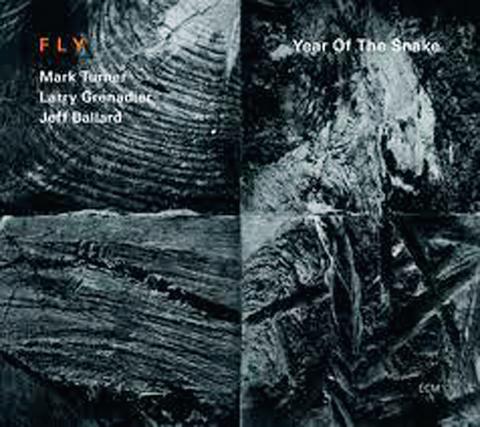
Year of the Snake, Fly, ECM
A radical sort of empathy winds through Year of the Snake, the third album by the jazz entity known as Fly. It’s something beyond the usual standard of cohesion for a serious postbop band, with a feeling both effortless and hard-won. For the members of this collective trio — Mark Turner on tenor saxophone, Larry Grenadier on bass and Jeff Ballard on drums — it represents the attainment of an equilibrium and the refinement of a strategy. For the rest of us it’s a reminder of how attractively weird this band can be.
Since the release of its self-titled debut album in 2004, Fly has made a point of thwarting structural hierarchies, an unusual move for a group of its makeup. (Tenor trios have always tended to reflect a pragmatic division of labor, with the saxophonist at the top of a pyramid and the others forming the base.) On this album the musicians go further, giving the impression of inhabiting each other’s headspace, with mesmerizing composure.
Five of the album’s 12 tracks are spontaneous miniatures bearing the title The Western Lands, presumably after the visionary William S. Burroughs novel. On the first and most striking of these pieces, which come numbered like classical variations, Turner conjugates a four-note phrase while Grenadier offers a counterline, first plucked and then bowed. The third piece, more fully developed, suggests a spirit trance. In each instance the mood is ghostly, deliberate, governed by mystery and sobriety.
Through coiled restraint and an ascetic dryness of timbre, Fly makes luxury out of sparseness. When the musicians create a rhythmic churn, as on Festival Tune and the album’s title track, both by Turner, there’s no danger of crowding the canvas. And when their parts enact a complex crosshatching, as on Diorite, composed by Ballard with West African music apparently in mind, they make the execution feel unburdened.
There are tunes here that reflect a similar ease, like Salt and Pepper, a slow-sauntering number that could almost have been written by Dexter Gordon. (It’s by Ballard and Turner.) But the spirit of the album rests with conceptual oddities like Turner’s Brothersister, in which his stern long tones waft above a determined bass line (in uneven groupings like five or seven); and Grenadier’s Kingston, which begins as a mournful bit of chamber music with an unfixed tempo, eventually locks into a pointillist funk groove and concludes with a Coplandesque flourish, roiling but ultimately calm.
— Nate Chinen, NY Times News Service

In late October of 1873 the government of Japan decided against sending a military expedition to Korea to force that nation to open trade relations. Across the government supporters of the expedition resigned immediately. The spectacle of revolt by disaffected samurai began to loom over Japanese politics. In January of 1874 disaffected samurai attacked a senior minister in Tokyo. A month later, a group of pro-Korea expedition and anti-foreign elements from Saga prefecture in Kyushu revolted, driven in part by high food prices stemming from poor harvests. Their leader, according to Edward Drea’s classic Japan’s Imperial Army, was a samurai

The following three paragraphs are just some of what the local Chinese-language press is reporting on breathlessly and following every twist and turn with the eagerness of a soap opera fan. For many English-language readers, it probably comes across as incomprehensibly opaque, so bear with me briefly dear reader: To the surprise of many, former pop singer and Democratic Progressive Party (DPP) ex-lawmaker Yu Tien (余天) of the Taiwan Normal Country Promotion Association (TNCPA) at the last minute dropped out of the running for committee chair of the DPP’s New Taipei City chapter, paving the way for DPP legislator Su

It’s hard to know where to begin with Mark Tovell’s Taiwan: Roads Above the Clouds. Having published a travelogue myself, as well as having contributed to several guidebooks, at first glance Tovell’s book appears to inhabit a middle ground — the kind of hard-to-sell nowheresville publishers detest. Leaf through the pages and you’ll find them suffuse with the purple prose best associated with travel literature: “When the sun is low on a warm, clear morning, and with the heat already rising, we stand at the riverside bike path leading south from Sanxia’s old cobble streets.” Hardly the stuff of your

Located down a sideroad in old Wanhua District (萬華區), Waley Art (水谷藝術) has an established reputation for curating some of the more provocative indie art exhibitions in Taipei. And this month is no exception. Beyond the innocuous facade of a shophouse, the full three stories of the gallery space (including the basement) have been taken over by photographs, installation videos and abstract images courtesy of two creatives who hail from the opposite ends of the earth, Taiwan’s Hsu Yi-ting (許懿婷) and Germany’s Benjamin Janzen. “In 2019, I had an art residency in Europe,” Hsu says. “I met Benjamin in the lobby


 RSS
RSS