


The eight-year-long relationship between model and actress Sonia Sui (隋棠) and her boyfriend Yao Yuan-hao (姚元浩) has had its ups and downs, but recent revelations about Yao’s on-again, off-again romance with singer Cyndi Wang (王心凌) have led to public scenes, as well as long distance recriminations and contrition, which have risen to operatic proportions.
On Wednesday, when Sui faced the media as part of a public event in Kaohsiung, she broke down and was in tears for over an hour. She was quoted as saying about the ongoing revelations that Yao was on a number of occasions less than faithful: “Like everyone else, I watch the news, and each time there are revelations [about Yao], things I never knew. There are no words to express my shock and despair. Every time I read the new revelations, it is like a knife cutting into my heart, again and again.”
The news of Wang’s involvement came out as an incidental item in yet another breakup between Sui and Yao. That Yao has been successfully two-timing two such high-profile women has been manna from heaven for the media, which have since been picking through the minutiae of Yao’s career to see if his romantic activities encompass other persons of interest. A suggestion that he might have had a fling with Penny Lin (林韋君), the B-movie actress and TV host notorious for her amorous adventures back in 2007, has been forcefully denied by her in the press.

Photo: Taipei Times
Speaking from Hangzhou, China, Yao has apologized to both Sui and Wang, and maintains that Sui “is still the most important person in my life.”
A report in the United Daily News quoted Yao’s agent as saying that “At that time [May to August, 2011], Yao’s relationship status was single, so naturally he had the right to make new friends.”
Earlier in the week, Wang rejected the accusation from elements of the media that she was a home-wrecker. She admitted to the romantic relationship with Yao, but added that after Yao got back with Sui again, she voluntarily backed off, stating that “yielding was a way of rounding off the affair” (退讓也是一種成全).
Sui and Yao have emerged as TV celebrities of the first rank and are treated as the darlings of the entertainment industry. Sui, who first achieved eminence as the first lady of Catwalk (凱渥), Taiwan’s foremost modeling agency, then became a household name with successful acting roles in the police drama Black and White (痞子英雄) and family soap The Fierce Wife (犀利人妻). Yao managed to parley his relationship with Sui into greater media exposure, and hit gold with his role in the TV series Rookies’ Diary (新兵日記). According to an analysis of their careers by United Daily News, publicity stunts featuring purported real-life romantic involvements between on-screen characters put huge pressure on the relationship, especially media suggestions last year of a connection between Sui and Fierce Wife co-star Chris Wang (宥勝).
Another relationship that has seen more than its share of ups and downs has been that between Nicolas Tse (謝霆鋒) and Cecilia Cheung (張柏芝). It has generally been agreed that the marriage had come to an end with the divorce of the couple following the notorious “airplane incident” (機上事件), when Cheung and ex-flame Edison Chen (陳冠希) snapped pictures of themselves on a flight to Hong Kong, a painful reminder to Tse of the explicit photos of the two that had been leaked on the Internet some years earlier. A divorce was announced in August last year, but now there are rumors that the two might get back together again, and even that the divorce has not yet been formalized according to Hong Kong law.
A report in the Hong Kong’s Oriental Daily said that Cheung had brought in spiritual practitioners to facilitate the reunion though various elaborate rituals, and this seems to have had some effect as she has been photographed recently together with Tse. The media is clearly gearing up for the makeup of the decade.
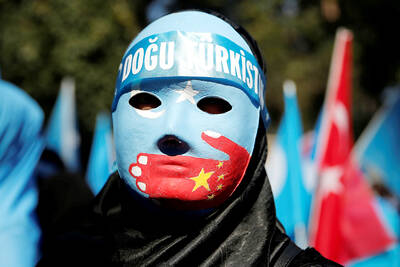
It seems every few days one bumps into one of those “real man” comments in which Taiwan is urged to “face reality” or similar, and “make a deal,” with the speaker implying that soon it will be too late. “Deal” advocates always present themselves as having a superior grip on reality, and the manly ability to make the “hard choice.” Their testosterone-laden language often echoes that of Taiwan sellout advocates. Note that such commentary always specifies a process (“make a deal, work with, make progress”), never the end state of what occupation by a violent authoritarian colonialist state will entail. In
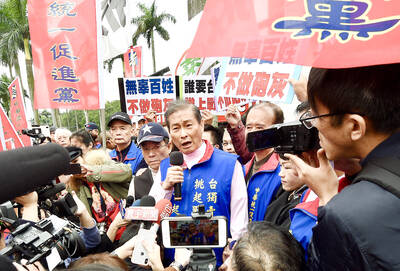
There are shadowy cabals plotting to sell out Taiwan to be annexed by China, by invasion if necessary. Fortunately, they are buffoons. In 2019, former Bamboo Union gangster and founder of the China Unification Promotion Party (CUPP), Chang An-le (張安樂, colorfully known as “White Wolf”), led a protest at the Legislative Yuan against comments made by then-premier Su Tseng-chang (蘇貞昌) that in the event of an attack by China, he would never surrender, but would protect the nation by fighting to the end, even if he only had a broom. Chang had party members bring a wooden casket that they
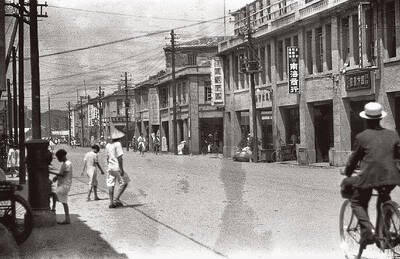
June 1 to June 7 "If all Taiwanese were as afraid of dying as you, then what would happen?” Physician Shih Chiang-nan (施江南) reportedly said this to his wife Chen Chiao-tung (陳焦桐) after she urged him to stop intervening on behalf of Taiwanese soldiers stranded overseas after serving in the Japanese Army during World War II. Shih had clashed with high-ranking officials over the issue, engaged in several heated arguments with Taiwan governor-general Chen Yi (陳儀) and allegedly shouted at general Ko Yuan-fen (柯遠芬), chief of staff of the Taiwan Garrison Command, over

Food prices have often played a major role in Taiwan’s history. The first major wave of migration from China occurred in 1628. A moderate drought, the Ming Dynasty maritime ban that prohibited fishing and trading (intended to reduce piracy) and a temporary tax, conspired to exhaust local resources, leading to famine in Fujian Province. The famed pirate and trader Zheng Zhilong (鄭芝龍), scooped up starving people from Fujian and transported them across the Taiwan Strait, where they settled under the Dutch. Two factors enabled Zheng. First, by 1624 he had settlements around today’s Beigang (北港) in Yunlin County with a small


 RSS
RSS