


While vegetarian food is not hard to find in Taipei, it certainly suffers from a lack of variety. This is, admittedly, the observation of a confirmed carnivore, whose periodic ventures into the world of vegetarian cuisine have usually left me uninspired.
The newly opened Chamkar, which serves Cambodian-inspired vegetarian food prepared by French owner Nicolas Devaux, is therefore a welcome addition to the fold.
Chamkar sports a clean, simple design that mixes exposed concrete with wood furnishings and a restrained use of Cambodian ornamentation. The overall effect is contemporary without being cold, and the widely spaced tables make for a very comfortable dining environment. The glass frontage looks over a small garden, softening the overall effect further.
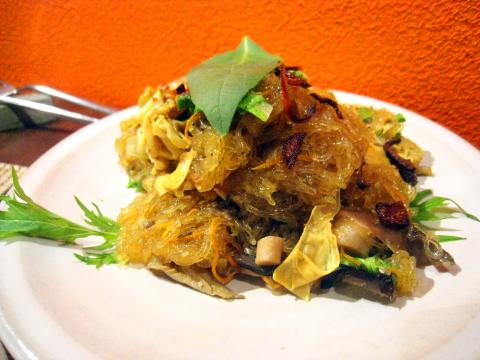
Photo: Ian Bartholomew, Taipei TImes
An absence of Buddhist chanting, religious knickknacks, or servers in ostentatiously homespun robes,boded well.
The restaurant offers a lunch set menu (NT$270), two dinner set menus (NT$340 and NT$390), a children’s set menu (NT$190) and an a la carte selection. The lunch set, from which I ordered, offered a choice of two appetizers, six mains and three desserts, and a beverage. The selection looked very appealing on the page, and on the whole, the dishes I tried did not disappoint.
The winter salad of green leaves, sunflower seeds and wolfberries (枸杞) tossed with a mustard dressing suffered from a lack of variety in the leaves, dominated by the ubiquitous iceburg lettuce, but the dressing was bold without being overwhelming and the wolfberries provided a vibrant burst of flavor. It was a contrast to the other appetizer, a grilled papaya and vegetable soup. This was a light, clear soup subtlety infused with cinnamon, and while it did not blow me away, its flavors were nicely balanced.
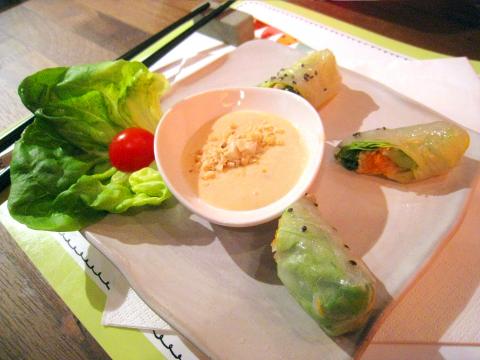
Photo: Ian Bartholomew, Taipei TIme
A dish of pumpkin and pineapple with curry paste, coconut milk, toasted peanuts and fresh herbs was a highlight, packed with creamy, rich flavors. It was served with nicely cooked brown rice. The fresh herbs that Devaux uses really shine through.
The set was letdown by a dish of stir-fried glass noodles with curry paste, tofu skin and vegetables, which strived for elegance but didn’t quite achieve it and was visually less appealing.
Not having eaten Cambodian food before, I at least had the feeling that I was trying something different (rather than Thai or Vietnamese food under a different label). Chamkar is an offshoot of a restaurant that Devaux already runs in Cambodia, and he explained that Cambodian food is more closely related to Thai than Vietnamese, though more sweet and less spicy.
The children’s set menu was well thought out. The fresh spring rolls with a sweet peanut and chili sauce looked very attractive, immediately attracting the attention of the four-year-old I had brought along, and the Italian pasta with vegetable Bolognese sauce provided something familiar for children without compromising the restaurant’s commitment to the use of fresh herbs. All dishes can be prepared without garlic.
Chamkar offered a chocolate and a banana cake for dessert the day I visited. Both were tasty, though more home-cooking than restaurant food in their presentation.
Taken as a whole, the food was better, and more thoughtfully prepared and presented, than many other establishments offering a three-course set at a similar price point. Most notably, the flavors were clean and strong without resorting to heavy seasoning, a feat that must be applauded. While the absence of meat was disappointing (I thought the pumpkin dish would be really splendid with a red beef curry), I left Chamkar with the feeling of having enjoyed a satisfying gastronomic experience.
Ajay Verma, a consultant gastroenterologist at Kettering general hospital in Northamptonshire, says our gut is a “complex machine.” “It is constantly providing us with the nutrition we need, initially to grow and develop, and then for us to survive, thrive and repair from injury and illness.” How can we keep it functioning well? Put simply: “Make sure what you put into it is balanced, and that you clear out its waste products adequately,” Verma says. “In a general gastroenterology clinic, the most common conditions we see are irritable bowel syndrome (IBS), gastroesophageal reflux disease, inflammatory bowel disease and constipation,” says Nisha
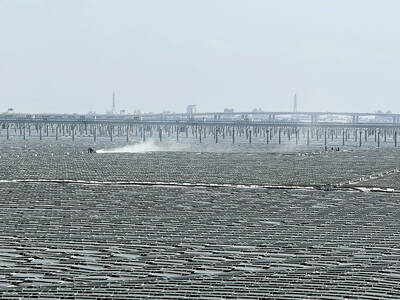
The arithmetic is straightforward and uncomfortable. By the end of 2025, Taiwan had committed itself to a 50-30-20 electricity mix — half natural gas, 30 per cent coal, 20 per cent renewables. The Ministry of Economic Affairs’s (MOEA) own monthly energy reports tell a different story. Natural gas reached 47.8 per cent of generation last year. Coal stood at 35.4 per cent, comfortably above its target ceiling. Renewables came in at 13.1 per cent, well short of the 20 per cent Taipei had pledged a decade earlier. Installed renewable capacity reached roughly half of the 12 gigawatts (GW) the government

Last week US President Donald Trump was asked by a reporter whether he would speak on the phone to the President of Taiwan. “l’ll speak to him. I speak to everybody. We have that situation very well in hand,” Trump said. This marked the second time in a couple of weeks he had said he would talk to the President of Taiwan. In 2016 he famously took a call from then-president Tsai Ing-wen (蔡英文), when he was president-elect. Despite warnings that the apocalypse was nigh because of a phone call, the world quickly forgot about the conversation between two democratically-elected presidents.
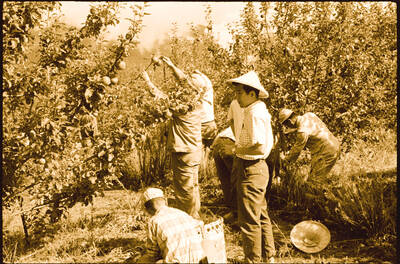
May 25 to May 31 Few believed that apples could be cultivated on a commercial scale in Taiwan’s high mountains. When horticulturalist Cheng Chao-hsiung (程兆熊) first proposed the idea in 1955, both American and Taiwanese colleagues dismissed it as implausible, arguing that temperate fruit could not be reliably grown on a subtropical island, especially on rugged terrain. However, it was this terrain in the Central Mountain Range where many Chinese Civil War veterans were resettled in the late 1950s. With limited job prospects and no family in Taiwan, they were placed on cooperative farms aimed toward self-sufficiency. Some say the conditions


 RSS
RSS