


Moroccan food has never been easy to find in Taipei. Over the past decade, the city has seen the opening and subsequent closure of both Bistro Le Casanova in Tianmu and Moroccan Restaurant (北非心情), which operated branches on Dunhua North Road and later on in Tamsui and Guandu. But a shop that opened two months ago near Tonghua Night Market (通化夜市) is keeping a flame burning for fans of this North African cuisine.
Tajin, run by Moroccan expat Hicham Samh and his partner Sandy Wu (吳宜謙), specializes in the dish of its namesake. Tajine, as it’s more commonly spelled in English, is a slow simmered stew that shares the same name as the two-piece earthenware pot with a gourd-shaped lid in which it is cooked.
The restaurant offers a basic menu consisting of a half-dozen tajine dishes, in addition to several panini sandwiches and rice dishes. The decor is similarly modest: Samh and Wu designed their cafe-sized space to have a simple but tasteful Mediterranean-Arabic theme, with white walls, desert scene paintings, colored lanterns and a few imported Moroccan knick-knacks on display.
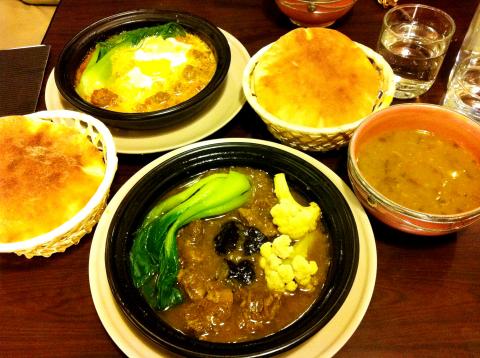
Photo: David Chen, Taipei Times
Samh, a soft-spoken and easygoing 41-year-old native of Casablanca, says he has been an avid cook since he was a teenager, but never made it his profession until now. A resident of Taipei for 14 years, he held a variety of jobs that included teaching English and French and working at trading companies before deciding to open shop after Moroccan Restaurant closed, which left Taipei without a place serving food from his home country.
The beef with plums tajine (NT$250) won me over from the first bite. Cooked with a medley of traditionally used spices that included saffron, turmeric, ginger and cumin, the beef chunks were soft and tender and heavily accented by the plums. The dish was flavorful and rich yet not too heavy, as one might expect given the ingredients.
My dining companion ordered the kofta and cheese tajine (NT$220), also a hearty choice. The kofta meatballs are made of beef and stewed in similar spices as the beef with plums tajine, but topped with melted cheese, tomato sauce and a fried egg. This dish was less refined in flavor, but still tasty enough to keep in mind for a return trip.
All meals come with fresh and delicious pita bread (NT$20 when sold separately) that’s made-to-order by a local bakery. The other tajine choices include olive chicken (NT$250), seafood (NT$270) and vegetable (NT$270). Samh is Muslim, and as such the beef and chicken are halal. Unfortunately, the restaurant doesn’t serve lamb as it’s hard to find a halal supply, Samh says.
Those who want couscous will have to wait until the weekend. Samh says the beef couscous dish (NT$280) is his personal favorite, but he only makes it on Saturdays and Sundays as he finds that Taiwanese customers rarely order it. Hopefully this will change as his customer base expands.
On a second visit for lunch, I had the chicken panini (NT$170), which makes for a nice light meal. The diced chicken filling, doused in a flavorful yellow curry sauce, was delicious, but I wished that they used the pita bread instead of regular white bread slices. Still, it’s a very good sandwich.
The panini, also available with beef and tuna for NT$170 and cheese, egg and tomato for NT$150, won’t fill you up like a chicken leg lunchbox will, so those with bigger appetites should consider a bowl of lentil soup cooked with curried spices (haira soup, NT$100). This fragrant and hearty soup is also a great accompaniment to tajine and is available as part of a set meal that includes rice pudding for dessert and mint tea (served in traditional Moroccan teaware) for an additional NT$150.
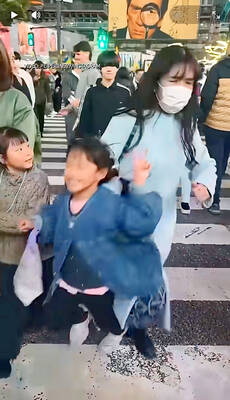
It starts out as a heartwarming clip. A young girl, clearly delighted to be in Tokyo, beams as she makes a peace sign to the camera. Seconds later, she is shoved to the ground from behind by a woman wearing a surgical mask. The assailant doesn’t skip a beat, striding out of shot of the clip filmed by the girl’s mother. This was no accidental clash of shoulders in a crowded place, but one of the most visible examples of a spate of butsukari otoko — “bumping man” — shoving incidents in Japan that experts attribute to a combination of gender

The race for New Taipei City mayor is being keenly watched, and now with the nomination of former deputy mayor of Taipei Hammer Lee (李四川) as the Chinese Nationalist Party’s (KMT) candidate, the battle lines are drawn. All polling data on the tight race mentioned in this column is from the March 12 Formosa poll. On Christmas Day 2010, Taipei County merged into one mega-metropolis of four million people, making it the nation’s largest city. The same day, the winner of the mayoral race, Eric Chu (朱立倫) of the Chinese Nationalist Party (KMT), took office and insisted on the current
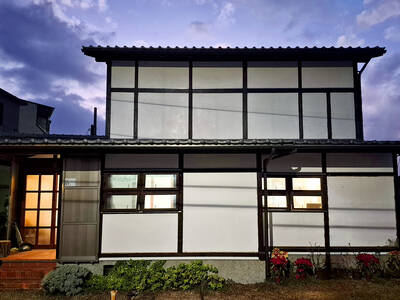
When my friend invited me to take a tour of a wooden house hand-built by a Pingtung County resident, my curiosity was instantly piqued and I readily agreed to join him. If it was built by a single person, it would surely be quite small. If it was made of wood, it would surely be cramped, dingy and mildewy. If it was designed by an amateur, it would surely be irregular in shape, perhaps cobbled together from whatever material was easily available. I was wrong on all counts. As we drove up to the house in Fangliao Township (枋寮鄉), I was surprised
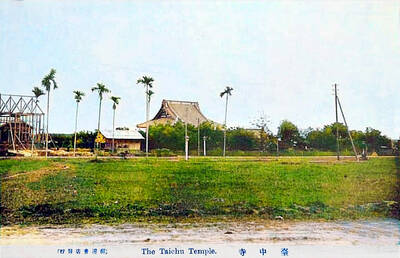
March 16 to March 22 Hidden for decades behind junk-filled metal shacks, trees and overgrowth, a small domed structure bearing a Buddhist swastika resurfaced last June in a Taichung alley. It was soon identified as a remnant of the 122-year-old Gokokuzan Taichuu-ji (Taichung Temple, 護國山台中寺), which was thought to have been demolished in the 1980s. In addition, a stone stele dedicated to monk Hoshu Ono, who served as abbot from 1914 to 1930, was discovered in the detritus. The temple was established in 1903 as the local center for the Soto school


 RSS
RSS