


Dick Francis, who died on Sunday aged 89, was a unique figure — a champion steeplechase jockey who, without any previous apparent literary bent, became an international best-selling writer, the author of 42 crime novels, selling more than 60 million copies in 35 languages. Right from the start, with Dead Cert in 1962, the Dick Francis thriller showed a mastery of lean, witty genre prose reminiscent — sometimes to the point of comic parody — of Raymond Chandler and Dashiell Hammett. It was an American style that many clever people in England had attempted to reproduce without much success, and it was a wonder how a barely educated former jump jockey was able to do the trick with such effortless ease. People said his highly educated wife wrote the books for him. It was a mystery that was never satisfactorily solved.
The most dramatic incident in his racing career was also a mystery. In the Grand National at Aintree in 1956, his mount Devon Loch, Queen Mother Elizabeth’s horse trained by Peter Cazalet, had jumped all
the fences and, well ahead, only 45m from the finish, without another horse near him, suddenly collapsed and was unable to continue.
Some said the horse had attempted to jump an imaginary fence; another theory, put up years later by Bill Braddon, Cazalet’s head lad, was that the girth was too tight and the horse suddenly let loose an enormous fart. Braddon said he had tightened the girth just before the off, “one notch up and another for luck,” without realizing that Cazalet had already done it in the saddling enclosure.
There was no question of Francis, like a crooked jockey out of one of his own books, having pulled the horse. It had been his great dream since he was a lad of eight in 1928 and listened to the Grand National on the radio as Tipperary Tim won at 100-1, to be a steeplechase jockey and win that ultimate prize. Ironically, Devon Loch’s melodramatic collapse in front of a roaring crowd cheering him to the finish has ensured Francis a place in the history of the race he would not have had if he had been merely another winner.
Francis was champion jockey in the 1953 to 1954 season. He rode the queen’s horses for Cazalet, the royal trainer, from 1953 until 1957. Some said he always rode like an amateur, and failed to have a really strong finish. He had indeed started as an amateur, going professional in 1948, but he was a masterful rider and a perfect size for a jump jockey, 1.72m and 63.5kg. Only the great Fred Winter was a better chase jockey.
In 1957 the queen mother sacked him. The Marquess of Abergavenny, racing administrator and friend of the queen mother, summoned Francis to his flat near Hyde Park and told him it was time to stop racing. He suggested that Francis had suffered too many injuries in falls — he had dislocated his shoulder so many times that he had to be permanently strapped for the rest of his life — and should quit while he was ahead. Francis was shattered by this oblique dismissal by the queen mother, for whom he had a rather old-fashioned reverence.
He asked what he was to do for a living. The marquess said something always turned up. Francis had wept when Devon Loch fell and he wept again, walking away through Hyde Park. “I nearly flung myself into the Serpentine, I was so depressed,” he said, years later.
He wrote a racing column for the Sunday Express, but it paid only US$31 a week, not bad for newspapers at the time but far less than he was used to earning. He said his wife, Mary, always read the copy before he delivered it on a Friday, and there was a story at the Express that once when she was ill he was unable to write the column and had to have it ghosted. Other Express men said this was untrue.
Francis was not a particularly good tipster, but he was rather brave in his attacks on the Jockey Club and the toffs of racing. He continued this in his thrillers. But his years at the Sunday Express did not make him love Fleet Street, and journalists were usually low, dishonest characters in his books.
The queen mother, though, was a fan of his books. He always got a special first edition to her, and said he did not put in the usual sex and bad language of the genre because he knew the queen mother would be reading it; she did once complain about the violence.
Born at Coedcanlas Farm in the village of Lawrenny, Pembrokeshire, southwest Wales, Francis came from a line of farming gentry and horsemen. His father was a show rider and manager of hunting stables, his grandfather a farmer and gentleman jockey. Uncles on both sides of his family were Masters of Foxhounds. The family home was a beautiful old farmhouse but it had neither gas nor electricity and was lit by candlelight.
He went to a one-class village school, attending on average only three days a week and riding the rest of the time, until the family moved to Maidenhead in Berkshire, England, where his father was manager of a stable. Dick went to Maidenhead county boys’ school, but his attendance was no better and he left at 15 to work for his father. At one time it was suggested that he should drink gin to keep him from growing so he could become a flat jockey, but his love was steeplechasing. He was also a successful show rider.
When World War II came, he joined the RAF as an aircraftman and served in the Western Desert before going to pilot training in Rhodesia (now Zimbabwe). He never flew in combat, but he was a Spitfire and Hurricane pilot before being transferred to heavy bombers. His lack of schooling gave him trouble with navigation.
In 1947, he married Mary Brenchley. A well-off middle-class girl whose main interest was the theater, she was assistant stage manager at the Hereford Repertory Theatre at the time, and also worked as a publisher’s reader. She could ride, but had no love of horses or racing. The story goes that Dick and Mary went to see a murder mystery at the Oxford Playhouse and came away thinking they could do better. Be that as it may, Dick produced Dead Cert and gave it to Michael Joseph because he had ridden horses for the publisher.
It is said that originally Francis wanted Mary’s name on the book as co-author, but it was thought better business sense to have only Dick’s. In his excellent unauthorized autobiography, Dick Francis: A Racing Life (1999), Graham Lord produces some telling circumstantial evidence that Dick could not have written the books without Mary. It was always acknowledged that she did much of the research for him, but Lord seemed to think it went further than that. The speculation may have arisen because Mary was a well-educated woman with a degree in French and English Literature from Royal Holloway College, London University. What is clear about the thrillers is that whoever wrote them had a wide knowledge of the American tough-guy school of detective fiction. Here a knowledge of French literature would seem to be no help. The fact that when highbrow interviewers spoke of formalism and hermeneutics Dick did not know what they were talking about proves nothing. Hammett and Chandler would probably not have known either.
Dick and Mary had a very close and happy marriage, spending seven months of the year traveling and researching, and five months writing the novels. Once Francis was under way, a book appeared every year in time for Christmas. They were all best-sellers, both in Britain and the US. By the end, in Britain alone each new book would sell 100,000 in hardback and 500,000 in paperback. Francis won several gold and silver dagger awards from the Crime Writers’ Association and was given the Cartier Diamond Dagger for outstanding contribution to the genre. In the US he was made a Mystery Writers of America Grand Master. He was named to the Order of the British Empire in 1984 and made a commander in 2000.
The books were unusual for best-sellers in the genre because Francis did not have a hero like Holmes or Poirot to win the love of the reader. Only Sid Halley, an injured jockey turned detective, makes repeat appearances, in Odds Against (1965), Whip Hand (1979) and Come to Grief (1995). The Francis tales are told in the first person, and the hero/narrator, whether an ill-educated jockey or the son of an earl — Lord Henry Grey in Flying Finish (1966) — were always the same upstanding character, all men with a secret sorrow. When asked about his damaged heroes, Francis, in a rather marvelous throwaway line, said he had “to have something to fill up the pages.”
The plots, too, ran to a formula. Some reviewers protested that racing could not be as crooked as depicted in the Francis novels, but real life (as in the case of the Shergar kidnapping) came in to prove how realistic his stories were.
As well as the thrillers, he wrote his autobiography, The Sport of Queens (1957), and Lester (1986), a biography of Lester Piggott.
Francis became immensely rich. Because of Mary’s poor health — she had suffered from polio — and his many injuries, they fled English winters for Florida and then Grand Cayman in the British West Indies. Although surrounded by the super-rich, they continued a rather suburban lifestyle, and each year returned to the Radcliffe hotel in Paignton, England, for a family holiday. Mary died in 2000. Their two sons said they worked together “like Siamese twins conjoined at the pencil.” As neither Dick nor Mary could type, perhaps there will be manuscripts among Dick Francis’s effects that will show which one was the prime mover.
After her death in 2000, when no new crime novels appeared, it looked as if Mary might have written them. But then, six years later, Francis came out of retirement to produce Under Orders, which had all the old Francis flavor. The next year, 2007, he published Dead Heat, then Silks (2008) and Even Money (2009). Much of the research for the novels was done by Francis’s son Felix, who left his job teaching at Bloxham school in Oxfordshire to work for his father. His other son, Merrick, was a racehorse trainer and then ran a horse transport business that was the background for the 1992 book Driving Force. They both survive him.



Yesterday, the Democratic Progressive Party (DPP) nominated legislator Puma Shen (沈伯洋) as their Taipei mayoral candidate, the Chinese Nationalist Party (KMT) put their stamp of approval on Wei Ping-cheng (魏平政) as their candidate for Changhua County commissioner and former legislator Tsai Pi-ru (蔡壁如) of the Taiwan People’s Party (TPP) has begun the process to also run in Changhua, though she has not yet been formally nominated. All three news items are bizarre. The DPP has struggled with settling on a Taipei nominee. The only candidate who declared interest was Enoch Wu (吳怡農), but the party seemed determined to nominate anyone

In a sudden move last week, opposition lawmakers of the Chinese Nationalist Party (KMT) and Taiwan People’s Party (TPP) passed a NT$780 billion special defense budget as a preemptive measure to stop either Chinese leader Xi Jinping (習近平) or US President Donald Trump from blocking US arms sales to Taiwan at their summit in Beijing, said KMT heavyweight Jaw Shaw-kong (趙少康), speaking to the Taipei Foreign Correspondents Club on Wednesday night in Taipei. The 76-year-old Jaw, a political talk show host who ran as the KMT’s vice presidential candidate in 2024, says that he personally brokered the deal to resolve
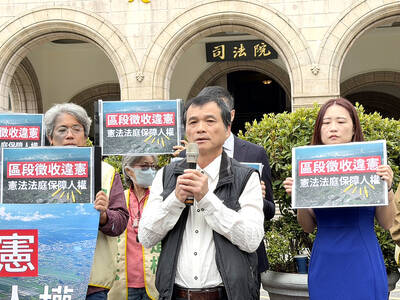
What government project has expropriated the most land in Taiwan? According to local media reports, it is the Taoyuan Aerotropolis, eating 2,500 hectares of land in its first phase, with more to come. Forty thousand people are expected to be displaced by the project. Naturally that enormous land grab is generating powerful pushback. Last week Chen Chien-ho (陳健和), a local resident of Jhuwei Borough (竹圍) in Taoyuan City’s Dayuan District (大園) filed a petition for constitutional review of the project after losing his case at the Taipei Administrative Court. The Administrative Court found in favor of nine other local landowners, but
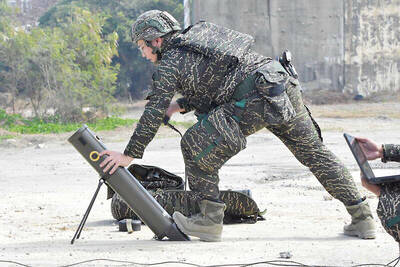
The Chinese Nationalist Party (KMT) and its sock puppet, the Taiwan People’s Party (TPP), passed their version of the government’s proposed supplementary defense spending bill last week, engendering much commentary. While all eyes were on the defense budget, the PRC’s assault on Taiwan was advancing on other fronts. The removal of domestic drone production and other technologies critical to the nation’s asymmetrical defenses from the list of items purchased in the “compromise” bill shows how the KMT-TPP alliance appears to be serving the People’s Republic of China (PRC). Ironically, the cuts will impact industries heavily represented by tech firms in areas run


 RSS
RSS