


It was a big weekend for members of Taiwan’s food and beverage industry who were out in force to check out the latest products and technology at the Taipei Tea, Coffee and Wine Expo (台北茗茶、咖啡暨美酒展) and the Taiwan International Food and Equipment Show (台灣國際優良食品暨設備展) at the Taipei World Trade Center (台北世界貿易中心). One of the highlights of these trade shows was the 2009 Taiwan Barista Championship (2009世界盃咖啡大師台灣選拔賽), the winner of which will go on to participate in the World Barista Championship to be held in London in June next year.
Coffee shops have existed in Taiwan ever since the Japanese occupation era, but the last few years have seen the rapid proliferation of coffee shop chains, ranging from swank US imports such as Starbucks to cheaper local variants such as E-Coffee (壹咖啡), as well as an increase in the number of small boutique establishments that boast outstanding barista talent and often offer beans roasted in-house or by local small-batch roasters.
There were a total of 52 contestants participating in the qualifying rounds of the Taiwan Barista Championship, which took place in September. In an interview during the hectic two-day elimination event, Chou Wen-pei (周溫培), the committee chairman for the competition, pointed out that while Taiwan has many latte art or coffee drink competitions, most of these are company sponsored events primarily designed for promotional purposes. “This competition is the only one recognized internationally,” Chou said, noting that in addition to providing a cash prize, it also qualifies the winner to participate in the World Barista Championship, one of the most prestigious events of its kind in the coffee world.
Hou Kuo-chuan (侯國全), who won the Taiwan competition in 2007, said that overseas the winner of the World Barista Championship is treated as a superstar in the coffee world, commanding huge endorsement and appearance fees. (Chou said that last year’s WBC winner Stephen Morrissey of Ireland commanded an appearance fee of more than 1,000 euros (US$1,500) per hour when he visited Taiwan in November last year.)
Hou himself went on to place 12th in the 2008 World Barista Championship, the highest ranked Asian barista for that year.
At the finals on Sunday, a huge crowd was gathered to watch six competitors battle it out for the coveted place in the international event. Each contestant was required to produce four cups of espresso, four cups of cappuccino and four signature coffee drinks within 15 minutes. During this time, contestants also provided table service to four judges as well as give a detailed explanation of what they were attempting to achieve in terms of the coffee drinking experience. Two additional judges watched every step of the service procedure from the side, and even timed the flow of coffee from the espresso machine to check for consistency between brews. A chief judge monitored the overall proceedings. Prior to service, each contestant had 15 minutes to set up, and afterwards, another 15 minutes to clean up. The efficiency and tidiness of these procedures was also judged. “The idea is to simulate a full session of service from opening to closing,” Chou said, explaining the huge range of items that contribute to the final score.
While brewing a cup of coffee might sound a simple matter, these baristas needed to work with choreographed precision to ensure they got everything done within the tight time limit imposed. There was absolutely no room for error, and even as the clock ticked relentlessly away above the service area, they had to maintain an air of cool assurance. The coffee did not just have to taste good, it had to be part of a complete experience that included service and presentation.
One of the favorites going into the competition was Chuang Hung-chang (莊宏彰), representing the boutique coffee shop L’Apres Midi Cafe (立裴米緹咖啡館), who has participated in the competition every year since it began in 2004 and had already picked up the top prize in the Taipei City Government-sponsored Taipei Cafe Festival (臺北咖啡大賞) earlier this month. A demanding set, which included a highly complex signature drink inspired by the ideas of molecular cuisine, tested him to the limit, and the pressure seemed to bring on a bout of nerves in this otherwise seasoned performer. Chuang took second place, and in an emotional speech when accepting his award, he held up six competitor badges that he had kept from previous competitions, saying that every time he has participated in this event, he has taken a step forward in his knowledge and skills.
Chuang was beaten to the post by first-time competitor Chang Chung-lun (張仲侖), a freelance barista, whose signature drink included the use of local flavors in the form of sour plum powder rimming a glass that had been moistened with grapefruit juice. It is likely that his easygoing manner in front of the judges helped him pull ahead of his more experienced rival.
Taiwan has achieved a very respectable record in the three years it has sent competitors to the World Barista Championship, picking up 17th place in Tokyo in 2007, 12th place in Denmark in 2008 and 19th place in Atlanta earlier this year, all in a field of around 50 competitors. Only one competitor from any one country is allowed to join the competition.
This is a significant development from only a decade ago, when Taiwan’s coffee culture was in its infancy. “Back then, all everyone knew was that you had to roast the beans heavily,” Chou said. “This was simply to disguise the taste of substandard beans.” Now Taiwan has access to some of the best beans in the world, giving its competitors a fighting chance on the international stage. “Most people think that coffee is a simple drink,” Chou said, “but in fact a raw bean contains over 1,000 chemical elements.” It is the barista’s skill to bring out just those elements that he desires in a subtle manipulation of roasting techniques and blending, and the control of pressure and temperature during brewing. Many of Taiwan’s top baristas are as much involved in roasting as they are in simply making coffee.
“It is an art,” Chou said. “Baristas are not people who simply brew coffee. They are like a singer or an actor. They are on stage creating an experience for the consumer.”
In creating this experience, Taiwan’s competitors are held back, in Chou’s eyes, by an inadequate command of English. Keeping up a lively patter that involves the complex vocabulary of both horticulture and gastronomy is no easy matter, especially in a second language. “I have asked our competitors if they would prefer to use a translator [in the international competition], but Taiwanese are proud,” Chou said, with competitors insisting on giving their presentations in English. On the technical front, this pride has produced some of the finest baristas in Asia.
The competition ended with a demonstration by Taiwan’s Li Ya-ting (李雅婷) of Taipei’s Orsir Coffee (歐舍咖啡), who took top honors in the inaugural World Siphonist Championship held in Japan last month, a competition that tests the brewing of coffee using a siphon device rather than an espresso machine.
For Chou, the ultimate beneficiary of this competition is the consumer. “It encourages a higher level of professionalism in the industry, and this benefits everybody,” he said.
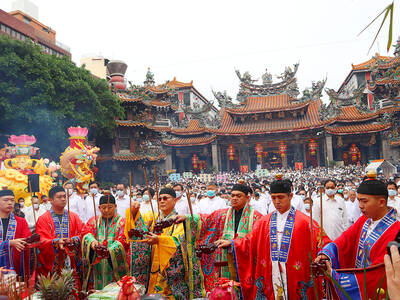
Recently the Chinese Nationalist Party (KMT) and its Mini-Me partner in the legislature, the Taiwan People’s Party (TPP), have been arguing that construction of chip fabs in the US by Taiwan Semiconductor Manufacturing Co (TSMC, 台積電) is little more than stripping Taiwan of its assets. For example, KMT Legislative Caucus First Deputy Secretary-General Lin Pei-hsiang (林沛祥) in January said that “This is not ‘reciprocal cooperation’ ... but a substantial hollowing out of our country.” Similarly, former TPP Chair Ko Wen-je (柯文哲) contended it constitutes “selling Taiwan out to the United States.” The two pro-China parties are proposing a bill that
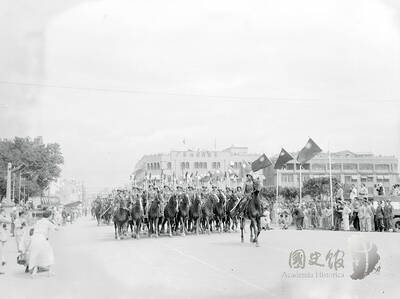
March 9 to March 15 “This land produced no horses,” Qing Dynasty envoy Yu Yung-ho (郁永河) observed when he visited Taiwan in 1697. He didn’t mean that there were no horses at all; it was just difficult to transport them across the sea and raise them in the hot and humid climate. “Although 10,000 soldiers were stationed here, the camps had fewer than 1,000 horses,” Yu added. Starting from the Dutch in the 1600s, each foreign regime brought horses to Taiwan. But they remained rare animals, typically only owned by the government or
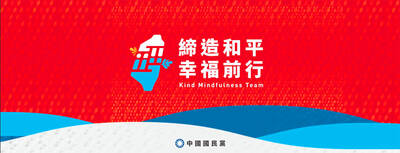
Institutions signalling a fresh beginning and new spirit often adopt new slogans, symbols and marketing materials, and the Chinese Nationalist Party (KMT) is no exception. Cheng Li-wun (鄭麗文), soon after taking office as KMT chair, released a new slogan that plays on the party’s acronym: “Kind Mindfulness Team.” The party recently released a graphic prominently featuring the red, white and blue of the flag with a Chinese slogan “establishing peace, blessings and fortune marching forth” (締造和平,幸福前行). One part of the graphic also features two hands in blue and white grasping olive branches in a stylized shape of Taiwan. Bonus points for
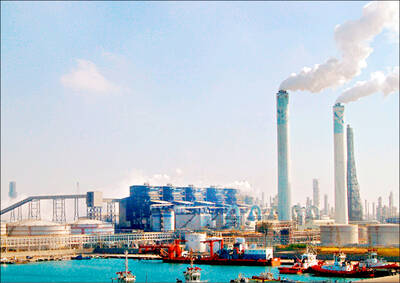
Last month, media outlets including the BBC World Service and Bloomberg reported that China’s greenhouse gas emissions are currently flat or falling, and that the economic giant appears to be on course to comfortably meet Beijing’s stated goal that total emissions will peak no later than 2030. China is by far and away the world’s biggest emitter of greenhouse gases, generating more carbon dioxide than the US and the EU combined. As the BBC pointed out in their Feb. 12 report, “what happens in China literally could change the world’s weather.” Any drop in total emissions is good news, of course. By


 RSS
RSS