


Tengri — Blue Heavens was the official Oscar submission for Best Foreign-Language Picture from Kyrgyzstan, a former Soviet republic. It was probably a little too simple in conception to make the official Oscar lineup, but that does not detract much from its cinematic virtues. What it lacks in sophistication it makes up for in the largeness of its conception and a narrative power derived from folktale motifs that date back to time immemorial.
Set in the mountain pastures of Kyrgyzstan, a grandly beautiful landscape that is terrible in its vastness, this story is ideal material for cinema, which can shift its perspective from the intimately human to the universal in the flicker of an eye. And it is in this dual aspect that we are introduced to Temur, a sailor returning to his landlocked country. He comes by bus, then continues deeper into the mountains by horse and then on foot, the camera exploring the vastness of the land, and Temur’s own unexplained history in the complex topography of his otherwise inexpressive face. He is a man who has been places, to whom bad things have happened, and now he returns to a community in which his father, his only kin, has died some years ago. The desolation of his world, both inner and outer, is absolute.
Temur is welcomed into his father’s community, where he meets Amira, a spirited young woman who enjoys the poetry of her semi-nomadic people and tries to stand up to its often-violent patriarchy. She is drawn to Temur and his adventures in far away places, but also accepts that she belongs to Shamshi, a mujahedin fighting in Afghanistan. He returns soon after the arrival of Temur, having imbibed a harsh Islamic dogma that makes him disdainful of the lax faith of his community and unresponsive to his wife, whom he views as a threat to his Islamic virtue.
And so the story is set up as a conflict over a woman that will ultimately lead to some kind of tragedy. This is a community in which sexual transgressions, real or imagined, are settled through the death of one of the parties involved. Amira, who with her fierce love of life and a willfulness that does not easily accept the constraints that society places on a woman, is a splendidly attractive character. Although the film has clear feminist leanings, they are not intrusive, and Amira never becomes an unbelievably perfect character. The portrayal of Temur is far from heroic, and he is prone, as much as his fellow males, to drown his sorrow in vodka and to walk away from problems posed by women. It is Temur’s psychological vulnerability and Amira’s mixture of childish naivety and passion for love and life that makes Tengri more than a romantic potboiler.
There are a few moments when the story reaches out to the wider world, as with Shamshi’s Islamic dogma, a Russian veteran of the Soviet-Afghan war who hangs out in a ramshackle camp not far from Amira’s semi-nomadic community, and Temur’s own unhappy experience in the West as an illegal immigrant. These stories serve to underline the fact that for people from these barren places at the edge of the world, life beyond the mountains is not seen as some kind of promised land, and that hope, the freedom offered by the blue heaven of title, must be found within.
The extended sequence in which Temur and Amira attempt their escape is deftly handled, and while the climax in which the lovers find redemption shifts the tone from realism to allegory, the film has an integrity that allows it to withstand this jolt.
Although it didn’t make the final Oscar lineup, Tengri has done well at non-mainstream film festivals, and was named Best Film and won Best Director for Marie-Jaoul de Poncheville at the inaugural Women’s International Film & Television Showcase last year.
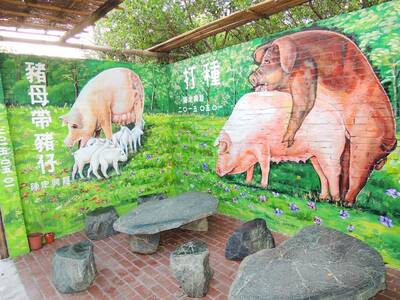
May 6 to May 12 Those who follow the Chinese-language news may have noticed the usage of the term zhuge (豬哥, literally ‘pig brother,’ a male pig raised for breeding purposes) in reports concerning the ongoing #Metoo scandal in the entertainment industry. The term’s modern connotations can range from womanizer or lecher to sexual predator, but it once referred to an important rural trade. Until the 1970s, it was a common sight to see a breeder herding a single “zhuge” down a rustic path with a bamboo whip, often traveling large distances over rugged terrain to service local families. Not only

Ahead of incoming president William Lai’s (賴清德) inauguration on May 20 there appear to be signs that he is signaling to the Chinese Communist Party (CCP) and that the Chinese side is also signaling to the Taiwan side. This raises a lot of questions, including what is the CCP up to, who are they signaling to, what are they signaling, how with the various actors in Taiwan respond and where this could ultimately go. In the last column, published on May 2, we examined the curious case of Democratic Progressive Party (DPP) heavyweight Tseng Wen-tsan (鄭文燦) — currently vice premier
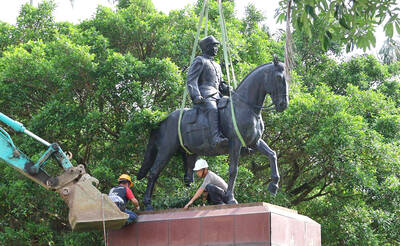
The last time Mrs Hsieh came to Cihu Park in Taoyuan was almost 50 years ago, on a school trip to the grave of Taiwan’s recently deceased dictator. Busloads of children were brought in to pay their respects to Chiang Kai-shek (蔣中正), known as Generalissimo, who had died at 87, after decades ruling Taiwan under brutal martial law. “There were a lot of buses, and there was a long queue,” Hsieh recalled. “It was a school rule. We had to bow, and then we went home.” Chiang’s body is still there, under guard in a mausoleum at the end of a path

Last week the Directorate-General of Budget, Accounting and Statistics (DGBAS) released a set of very strange numbers on Taiwan’s wealth distribution. Duly quoted in the Taipei Times, the report said that “The Gini coefficient for Taiwanese households… was 0.606 at the end of 2021, lower than Australia’s 0.611, the UK’s 0.620, Japan’s 0.678, France’s 0.676 and Germany’s 0.727, the agency said in a report.” The Gini coefficient is a measure of relative inequality, usually of wealth or income, though it can be used to evaluate other forms of inequality. However, for most nations it is a number from .25 to .50


 RSS
RSS