


Under the Dome gravely threatens Stephen King’s status as a mere chart-busting pop cultural phenomenon. It has the scope and flavor of literary Americana, even if King’s particular patch of American turf is located smack in the middle of the Twilight Zone. It dispenses with his usual scatology and trippy fantasy to deliver a spectrum of credible people with real family ties, health crises, self-destructive habits and political passions. Even its broad caricatures prompt real emotion, if only via the damage they can inflict on others. Though the book’s broad conspiratorial strokes become farfetched, its ordinary souls become ever more able to break hearts.
This book has the heft of a brick. It also has a premise that can be summarized in seconds. On a beautiful autumn day in Maine a transparent dome materializes over the town of Chester’s Mill. Once the Dome falls, all vestiges of normal life are suspended. Things run amok. They get scary. The townsfolk become fate’s playthings. And King, who can manipulate this crisis in any way that occurs to him, becomes a kid in a candy store.
The premise provides so many options that King’s decisions about how to tell this story are of special interest. The King book that is most readily brought to mind by Under the Dome isn’t an earlier large-scale apocalyptic fantasy like It or The Stand; it’s On Writing, the instructive autobiographical gem that cast light on how King’s creative mind works. In the spirit of On Writing, Under the Dome takes a lucid, commonsense approach that keeps it tight and energetic from start to finish. Hard as this thing is to hoist, it’s even harder to put down.
Consider the book’s step-by-step way of defining the Dome. King isn’t about to do the easy thing, which would be to give a straightforward description of what it is and how it works. Instead he offers a textbook demonstration of how to make action and explication one and the same. First step: A woodchuck on the ground and a pilot in the air named Chuck are sudden victims of the Dome’s guillotinelike slicing descent.
Second step: The book’s hero to be, a short-order cook and Iraq war veteran named Dale Barbara, looks upward. He sees the front of Chuck’s plane fall off and the back get crushed by the invisible barrier that, we now know, reaches sky high. Big sigh of relief here: Dome calamities, while definitely deadly, will not be (by King’s high standards in this area) described gruesomely at all.
Third step: Barbara, aka Barbie, waves frantically to a stranger for help. The stranger walks right toward him — and smashes into an invisible wall. So the Dome’s extent is making itself known. Then King defines the perimeter by ticking off the various roads that lead to Chester’s Mill. “And shortly before noon on Dome Day,” he writes, now attaching a name to this calamity, “every one of them snapped closed.”
With the same tight efficiency, King goes on to introduce the various businesses (restaurant, newspaper), institutions (hospital) and officials (police and town selectmen) on the Chester’s Mill map. Under the Dome even comes with a map, but the town in the narrative is much too sharply drawn to need one. Special editions of this book also come with playing cards featuring illustrations of the main characters in this story’s huge cast, among them its mega-villain, a used-car salesman and diabolically devious second selectman known as Big Jim Rennie. He has been drawn to look just like Dick Cheney.
The Dome traps the air in Chester’s Mill. But for Big Jim, it creates an exploitable vacuum. His power grab is soon under way, and just in case that isn’t sinister enough, Big Jim’s son, Junior, turns out to have homicidal tendencies. Meanwhile King’s neighborly array of well-sketched locals intertwine in dozens of subplots, to the point where Chester’s Mill really does seem to operate as one cohesive organism. When the local storekeeper and huckster decides that Dome Day’s famine-inducing possibilities can help him unload a lot of old hot dogs, someone at the hospital is told to “expect an influx of gastroenteritis patients this evening.”
All of this — along with the smog that starts to choke off Chester’s Mill and make the Dome as visible as a dirty windshield — is a way of blowing smoke. It gets King through nearly 1,100 fast-moving pages without his having to answer the obvious questions: What is this thing? How did it get here? Why did it get here? What if it doesn’t go away? Under the Dome can’t avoid these thoughts forever. But it can postpone them with an ease that is one more measure of its author’s having placed more value on humanity than on horror.
Under the Dome has a well-stocked emotional arsenal. It also has a great capacity for escapist fun, without which King could never lure readers through such a long trek. As usual he takes every opportunity to dispense winks and shout-outs, and he summons whichever cult-favorite references strike his fancy. A Warren Zevon lyric crops up; so does James McMurtry’s red-hot Talkin’ at the Texaco, which immortalizes a gritty, sidelong small-town spirit and might as well be this book’s theme song.
The local Christian radio station usually plays music that is, in King’s opinion, straight from hell. And one tough female police officer has been hired on the recommendation of a certain Jack Reacher, said to have been the toughest darn cop the Army ever saw. Big currents flow through this book along with the small ones. There are echoes of 9/11, Hurricane Katrina and Iraq that help to shape this small town’s view of the wider world. News crews (notably CNN’s) arrive at the perimeter of the Dome to stake out this colossal human interest story. And what they observe, on a visiting day when loved ones outside of Chester’s Mill are allowed to venture near the Dome’s dangerous surface, conveys genuine tragedy. As King puts it, describing what the TV cameras see:
“They observe the townspeople and the visitors pressing their hands together, with the invisible barrier between; they watch them try to kiss; they examine men and women weeping as they look into each other’s eyes; they note the ones who faint, both inside the Dome and out, and those who fall to their knees and pray facing each other with their folded hands raised; they record the man on the outside who begins hammering his fists against the thing keeping him from his pregnant wife, hammering until his skin splits and his blood beads on thin air; they peer at the old woman trying to trace her fingers, the tips pressed white and smooth against the unseen surface between them, over her sobbing granddaughter’s forehead.” Nowhere in King’s immense body of work have his real and fantasy worlds collided with such head-on force.

In late October of 1873 the government of Japan decided against sending a military expedition to Korea to force that nation to open trade relations. Across the government supporters of the expedition resigned immediately. The spectacle of revolt by disaffected samurai began to loom over Japanese politics. In January of 1874 disaffected samurai attacked a senior minister in Tokyo. A month later, a group of pro-Korea expedition and anti-foreign elements from Saga prefecture in Kyushu revolted, driven in part by high food prices stemming from poor harvests. Their leader, according to Edward Drea’s classic Japan’s Imperial Army, was a samurai

The following three paragraphs are just some of what the local Chinese-language press is reporting on breathlessly and following every twist and turn with the eagerness of a soap opera fan. For many English-language readers, it probably comes across as incomprehensibly opaque, so bear with me briefly dear reader: To the surprise of many, former pop singer and Democratic Progressive Party (DPP) ex-lawmaker Yu Tien (余天) of the Taiwan Normal Country Promotion Association (TNCPA) at the last minute dropped out of the running for committee chair of the DPP’s New Taipei City chapter, paving the way for DPP legislator Su
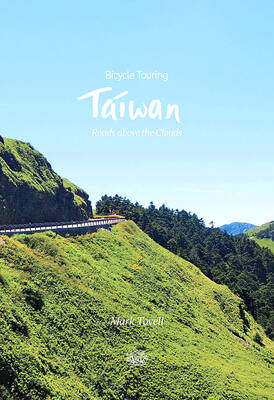
It’s hard to know where to begin with Mark Tovell’s Taiwan: Roads Above the Clouds. Having published a travelogue myself, as well as having contributed to several guidebooks, at first glance Tovell’s book appears to inhabit a middle ground — the kind of hard-to-sell nowheresville publishers detest. Leaf through the pages and you’ll find them suffuse with the purple prose best associated with travel literature: “When the sun is low on a warm, clear morning, and with the heat already rising, we stand at the riverside bike path leading south from Sanxia’s old cobble streets.” Hardly the stuff of your

Located down a sideroad in old Wanhua District (萬華區), Waley Art (水谷藝術) has an established reputation for curating some of the more provocative indie art exhibitions in Taipei. And this month is no exception. Beyond the innocuous facade of a shophouse, the full three stories of the gallery space (including the basement) have been taken over by photographs, installation videos and abstract images courtesy of two creatives who hail from the opposite ends of the earth, Taiwan’s Hsu Yi-ting (許懿婷) and Germany’s Benjamin Janzen. “In 2019, I had an art residency in Europe,” Hsu says. “I met Benjamin in the lobby


 RSS
RSS