


The unseasonable snow that fell on Beijing for 11 hours last Sunday was the earliest and heaviest there has been for years. It was also, China claims, man-made. By the end of last month, farmland in the already dry north of China was suffering badly due to drought. So on the night of Oct. 31 China’s meteorologists fired 186 explosive rockets loaded with chemicals to “seed” clouds and encourage snow to fall. “We won’t miss any opportunity of artificial precipitation since Beijing is suffering from a lingering drought,” Zhang Qiang (張強), head of the Beijing Weather Modification Office, told state media.
The US has tinkered with such cloud seeding to increase water flow from the Sierra Nevada mountains in California since the 1950s, but there remains widespread scientific sniffiness in the West at such attempts at weather control. The chemicals fired into the sky, usually dry ice or silver iodide, are supposed to provide a surface for water vapor to form liquid rain. But there is little evidence that it works — after all, how do investigating scientists know it would not have rained anyway?
Such doubts have not stopped China claiming mastery over the clouds. Officials said the blue skies that brightened Beijing’s parade to celebrate 60 years of communism last month were a result of the 18 cloud-seeding jets and 432 explosive rockets scrambled to empty the sky of rain beforehand. Last year, more than 1,000 rockets were fired to ensure a dry night for the Olympic opening ceremony.
Magic or not, there is growing interest in such attempts to deliberately steer the weather, and on a much larger scale. In the spring, a group of the world’s leading experts on climate change will gather in California to plan how it could be done as a way to tackle global warming, and by whom. The ideas, some of which, similar to cloud-seeding, involve firing massive amounts of chemicals into the atmosphere, can sound far-fetched, but they are racing up the agenda as pessimism grows about the likely course of global warming.
As interest grows, so does concern about whether such techniques, known as geoengineering, could be developed and unleashed by a single nation, or even a wealthy individual without wide international approval. “What will happen when Richard Branson decides he really does want to save the planet?” asks one climate expert. If China thinks it can make cloud seeding work, then what about geoengineering?
“If climate change turns ugly, then many countries will start looking at desperate measures,” says David Victor, an energy policy expert at Stanford University and a senior fellow at the Council on Foreign Relations. “Logic points to a big risk of unilateral geoengineering. Unlike controlling emissions, which requires collective action, most highly capable nations could deploy geoengineering systems on their own.”
Victor is a heavyweight policy analyst, but one of his most impressive academic feats could have been to smuggle the name of the world’s favorite secret agent into the sober pages of the Oxford Review of Economic Policy. “Geoengineering may not require any collective international effort to have an impact on climate,” he wrote in an article published last year. “A lone Greenfinger, self-appointed protector of the planet and working with a small fraction of the [Bill] Gates bank account, could force a lot of geoengineering on his own. Bond films of the future might [enjoy incorporating] the dilemma of unilateral planetary engineering.” Move over, Goldfinger.
Unilateral geoengineering worries experts for two reasons. First, the massive side effects; what it could do to the world’s rainfall, for example. Second, once started, geoengineering would probably have to be continued, as stopping could bring an abrupt change in climate. “One of the many dangers with unilateral geoengineering is that once a country starts, it becomes very hard to stop,” Victor says. “Removing a warming mask, even if it is a flawed mask, would expose the planet to even more rapid and probably dangerous warming.”
In a world where action on global warming has created new markets in carbon worth billions of US dollars, countries are not the only players. Geoengineering would require investment and the private sector is already eyeing up opportunities. Two companies have emerged with a business plan based on dumping iron in the sea and selling carbon offsets based on the extra pollution supposedly soaked up by the resulting algal bloom. And in their new book, Superfreakonomics, Steven Levitt and Stephen Dubner talk approvingly of Nathan Myhrvold, the former chief technology officer of Microsoft, whose company, Intellectual Ventures, is exploring the possibility of pumping large quantities of reflective sulfur dust into the Earth’s stratosphere through a patented 29km-long hose held up by helium balloons.
This is the point where most people will shake their heads, say the whole silly idea will never happen, and skip to the crossword. They could be right, but the global warming story has a tendency to outpace most attempts to predict its path. Just a few years ago, scientists and politicians talked of the need to avoid a 2ºC rise in global temperature, yet experts recently gathered at an Oxford University conference openly talked of a likely 4ºC rise.
A decade ago, an unproven idea called carbon sequestration, that would see carbon emissions from power stations trapped under the ground, was talked up by a small group of advocates, but was dismissed by most people as too expensive and unworkable on a large scale. Renamed carbon capture and storage, the idea is now mainstream energy policy in countries including the UK, despite still being unproven and dismissed by many as too expensive and unworkable on a large scale. Last month, the International Energy Agency said the world should build 100 full-scale carbon-capture power stations by 2020, and 850 by 2030.
If the geoengineering narrative follows a similar arc, then how long until nations or individuals that have the most to lose, or are the first to accept that the required massive emission cuts are impossible, turn to the presently unthinkable option? The US government, under former president George W. Bush, has already lobbied the Intergovernmental Panel on Climate Change to promote geoengineering research as “insurance.” When the Royal Society recently carried out an investigation of the options, senior figures privately expected it to dismiss the whole concept as nonsense. Instead the society, Britain’s premier scientific academy, concluded in September that methods to block out the sun “may provide a potentially useful short-term backup to mitigation in case rapid reductions in global temperature
are needed.”
The society stressed that emissions reductions were the way to go, but recommended international research and development of the “more promising” geoengineering techniques.
“My guess is that we will be taking geoengineering a lot more seriously in the next decade,” says Victor, “but we won’t be in a position to deploy systems for some time. Most nations will decide it is needed only if we have really bad luck as warming unfolds and if we fail miserably in controlling emissions. I put the odds of using such systems in the next 40 years at perhaps one in five.”
Of all the apparent obstacles to geoengineering, cost is not likely to be among them. Compared with the expense of investing in renewable energy and phasing out fossil fuels, the cheapest geoengineering options come with a price tag of just a few billion US dollars, perhaps 1 percent of what it could cost to tackle global warming through emissions cuts.
Alan Robock, an expert on volcanoes and climate at Rutgers University in New Jersey, has looked at how much it might cost to carry out one of the most commonly discussed geoengineering options, to mimic the cooling effect of a volcanic eruption by filling the high atmosphere with sulfur compounds, which reflect sunlight.
The eruption of Mount Pinatubo in the Philippines in 1991 threw so much shiny sulfurous dust into the atmosphere that temperatures across a shaded Earth dropped a year later by about 0.5ºC.
Robock has worked out the likely cost of technology needed to deposit a million tonnes of sulfur in the stratosphere each year, an amount equivalent to a Mount Pinatubo eruption every four to eight years, and which scientists think could be enough to cancel out the global warming caused by a continued rise in carbon emissions.
The cheapest option could be to use giant mid-air refueling aircraft, such as the US air force’s KC-10 Extender, filled with sulfur dioxide or hydrogen sulfide gas. It would be a round-the-clock operation, with nine aircraft each required to fly three sorties a day. In a new paper in the journal Geophysical Research Letters, Robock and his colleagues say it could be done for “several billion” US dollars a year. The results have forced Robock to revise a high-profile list of 20 objections to geoengineering he published last year. “It turns out that being way too expensive is not the case.”
Robock’s new analysis still includes 17 reasons why geoengineering is a bad idea. Throwing sulfur into the atmosphere could slow down the world’s water cycle and do more damage to rainfall patterns than the global warming it aims to prevent. And because techniques that focus on stopping sunlight do nothing to stop carbon dioxide pollution from cars, factories and power stations, they cannot address the looming disaster of ocean acidification. The surface of the world’s ocean is slowly turning to acid as our extra carbon pollution dissolves in seawater. Coral reefs already appear doomed and many shellfish could follow. Altering the atmosphere could also weaken solar power and reverse years of work to close the hole in the ozone layer.
With such a catalogue of potential disasters waiting to unfold, there must be a law against geoengineering? The international rule book is fuzzy on this issue. The only international framework that directly covers many geoengineering techniques, the 1976 Environmental Modification Convention, designed to stop nations at war from meddling with each other’s weather, has never been tested. The 1982 UN Law of the Sea Convention and the 1967 Outer Space Treaty could be used to regulate activities and experiments in those shared spaces, but releases to the atmosphere are legally more problematic because nations have sovereignty over their own airspace.
Rather than laws and treaties, many experts argue that the best way to prevent countries or companies from going it alone is to plunge in and start serious research. “The way to tame the worst forms of unilateral geoengineering is to promote a lot more research, especially [into] the side effects,” Victor says. “One of the biggest dangers is that some governments will try to create a taboo against geoengineering. A taboo would stop a lot of research but it wouldn’t stop determined rogues. That scenario would probably be the worst, because rogues would not abandon their efforts and the rest of us would not have done enough research to know what to expect.”
Mike MacCracken, chief scientist at the Climate Institute in Washington, is organizing the California meeting next spring, which aims to figure out some guidelines. He says large-scale unilateral geoengineering is “not very plausible” and his main concern is fairness to future generations. Once started by anybody, a geoengineering attempt would probably need to be continued by everybody else because it would offer a mask on global warming that could be dangerous to remove.
“It might be that this is how unilateral concerns should be reframed, this generation more or less deciding it will take only slow action on any type on emissions, essentially forcing the next generation to be more likely to have to invoke geoengineering to save much that anyone considers beneficial and unique about the Earth.”

Recently the Chinese Nationalist Party (KMT) and its Mini-Me partner in the legislature, the Taiwan People’s Party (TPP), have been arguing that construction of chip fabs in the US by Taiwan Semiconductor Manufacturing Co (TSMC, 台積電) is little more than stripping Taiwan of its assets. For example, KMT Legislative Caucus First Deputy Secretary-General Lin Pei-hsiang (林沛祥) in January said that “This is not ‘reciprocal cooperation’ ... but a substantial hollowing out of our country.” Similarly, former TPP Chair Ko Wen-je (柯文哲) contended it constitutes “selling Taiwan out to the United States.” The two pro-China parties are proposing a bill that

March 9 to March 15 “This land produced no horses,” Qing Dynasty envoy Yu Yung-ho (郁永河) observed when he visited Taiwan in 1697. He didn’t mean that there were no horses at all; it was just difficult to transport them across the sea and raise them in the hot and humid climate. “Although 10,000 soldiers were stationed here, the camps had fewer than 1,000 horses,” Yu added. Starting from the Dutch in the 1600s, each foreign regime brought horses to Taiwan. But they remained rare animals, typically only owned by the government or

Institutions signalling a fresh beginning and new spirit often adopt new slogans, symbols and marketing materials, and the Chinese Nationalist Party (KMT) is no exception. Cheng Li-wun (鄭麗文), soon after taking office as KMT chair, released a new slogan that plays on the party’s acronym: “Kind Mindfulness Team.” The party recently released a graphic prominently featuring the red, white and blue of the flag with a Chinese slogan “establishing peace, blessings and fortune marching forth” (締造和平,幸福前行). One part of the graphic also features two hands in blue and white grasping olive branches in a stylized shape of Taiwan. Bonus points for
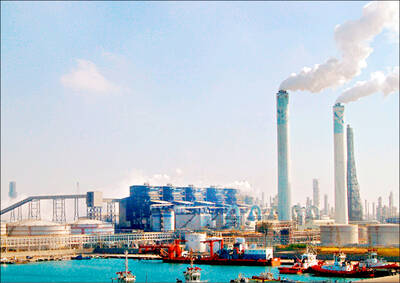
Last month, media outlets including the BBC World Service and Bloomberg reported that China’s greenhouse gas emissions are currently flat or falling, and that the economic giant appears to be on course to comfortably meet Beijing’s stated goal that total emissions will peak no later than 2030. China is by far and away the world’s biggest emitter of greenhouse gases, generating more carbon dioxide than the US and the EU combined. As the BBC pointed out in their Feb. 12 report, “what happens in China literally could change the world’s weather.” Any drop in total emissions is good news, of course. By


 RSS
RSS