


For more than half a century heroin has been carried over the jungle-shrouded hills here, the first leg of a journey that delivers the drugs to cities as far off as Sydney and Tokyo. But anti-narcotics officials are rubbing their eyes at the spectacle they are now witnessing: A flood of heroin and methamphetamine is spilling out of Myanmar as traffickers slash their inventories in a panicked sell-off.
“It’s a clearance sale,” said Pornthep Eamprapai, director of the northern branch of the Thai Office of Narcotics Control, who has nearly three decades of experience tracking illicit drugs from Myanmar. “Some dealers at the border are buying on credit. They don’t even need to pay in cash. This is the first time I’ve seen this.”
The main reason for the surge in trafficking, officials say, is a crackdown by Myanmar’s military government on armed ethnic groups along the borders with Thailand, Laos and China. The ethnic groups, many of which have a long history of illicit drug production, are steeling themselves for battle with the Myanmar junta and rushing to convert their stocks of heroin and methamphetamine into cash to buy weapons, anti-narcotics officials say.
“Various traffickers are liquidating their stockpiles,” said Pamela Brown, an agent for the US Drug Enforcement Administration based in Chiang Mai, Thailand. “They are trying to get large shipments of heroin out, and some have been successful.”
Heroin seizures by the police in northern Thailand have increased more than twentyfold. From October of last year to this August, the authorities seized 1.2 tonnes of heroin, up from 57kg a year earlier, according to the Office of Narcotics Control.
The traffickers are also under increasing pressure in Myanmar, where the ruling junta appears to have become more aggressive in seizing illicit drugs. It sometimes has turned a blind eye to traffickers, but faced with the prospect of battling drug-financed armies, the junta had added incentive to crack down.
The ethnic groups are obscure to most outsiders — the Wa, Kachin and Shan, among them — but their fate is crucial to the future of the world’s heroin supply, experts say. Although they now produce only 5 percent of the total supply, instability could allow them to create much more.
The Myanmar junta and its proxies beat back ethnic Karen rebels along the Thai border in June and attacked and defeated an ethnic Chinese group, the Kokang, in the north in August. The campaigns have the leaders of other ethnic groups wondering if they are next.
The standoff between ethnic groups and the central government in the rugged and isolated northern hills of Myanmar is an anomaly in modern Asia, a throwback to much more unstable times. The Wa and Kachin have large, well-equipped armies and administrations akin to the small kingdoms that existed in Asia before European colonial powers introduced the concept of the nation-state.
GUNS FOR DRUGS
Now, in a desperate bid to protect their fiefdoms, they are casting a wide net for more weapons, according to Colonel Peeranate Katetem, the deputy commander of a Thai anti-narcotics unit based in Chiang Rai, near the Myanmar border.
Three months ago, he said, he received a call from a Wa representative who said he was looking to spend about US$25 million to purchase M-16 assault rifles and “anything capable of exploding.” Peeranate said the group appeared eager to barter heroin for the weapons. He said he declined to help.
The Golden Triangle, as the region where Thailand, Laos and Myanmar come together is known, was once the world’s pre-eminent source of heroin. In recent years, it has been eclipsed by Afghanistan, which produces more than 90 percent of the global supply.
That could change, experts warn, if Myanmar’s dormant civil war reignites.
“The drug trade would flourish,” said Ko-Lin Chin, a criminologist at Rutgers University and author of a book on the Golden Triangle published this year. He believes the planting of opium poppies, now suppressed in many areas, could resume on a wider scale. “They would flood the world with opium.”
Heroin, which is refined from opium, typically travels through Thailand, Laos and Vietnam and ends up in Australia, Japan, Malaysia and Taiwan, anti-narcotics agents say. Heroin is also directly exported to China, where use of the drug increased significantly in the 1990s, creating a huge new market for traffickers. (The heroin sold in the US comes mostly from Colombia, according to US officials.)
Anti-narcotics officials say ethnic groups appear to be stocking large quantities of drugs near the Thai border and sending them across bit by bit. Small-time traffickers, often teenagers, can buy a fingernail-size bag of heroin for about US$1.50 on the Myanmar side of the border, trek a few hours and sell it for up to US$30 on the Thai side, Second Lieutenant Rungrot Lobbamrung said at the military outpost here.
Stopping traffickers is particularly difficult along Myanmar’s mountainous borders. The Thai military has 1,500 troops dedicated to the interdiction of narcotics along the northern stretch of border with Myanmar, but it says it needs better equipment, like night vision goggles.
On the other side of the border, Myanmar has reported enormous drug seizures in recent months, including one in August of more than 726kg, anti-narcotics officials said. Several million methamphetamine pills were also seized in the Myanmar border town of Tachilek.
“There was nothing on that scale last year,” said Leik Boonwaat, the representative of the UN Office on Drugs and Crime based in Laos. “This year has been quite unusual.”
Another development that may be contributing to the increase in heroin coming through the Golden Triangle is what Thai officials say is a new trafficking route in which low-grade heroin produced in Afghanistan is shipped through Pakistan and India to the area controlled by the Wa in northern Myanmar, where it is further refined and re-exported.
This possible link between the world’s two largest heroin producing regions — Afghanistan and Myanmar — could constitute a major shift in the heroin trade, combining the vast scale of Afghan poppy fields with the distribution networks and production expertise of the Wa.
In recent years the Wa have been concerned about their international image, especially in light of an indictment of eight Wa leaders by a US court four years ago that described the Wa army as “a criminal narcotics trafficking organization.” Under pressure from China, the Wa forbade farmers in their territory to cultivate opium.
But such concerns could quickly dissipate in crisis, Chin said.
“If there’s war, nobody cares about a good international reputation,” he said. “Survival will take over.”

In late October of 1873 the government of Japan decided against sending a military expedition to Korea to force that nation to open trade relations. Across the government supporters of the expedition resigned immediately. The spectacle of revolt by disaffected samurai began to loom over Japanese politics. In January of 1874 disaffected samurai attacked a senior minister in Tokyo. A month later, a group of pro-Korea expedition and anti-foreign elements from Saga prefecture in Kyushu revolted, driven in part by high food prices stemming from poor harvests. Their leader, according to Edward Drea’s classic Japan’s Imperial Army, was a samurai

The following three paragraphs are just some of what the local Chinese-language press is reporting on breathlessly and following every twist and turn with the eagerness of a soap opera fan. For many English-language readers, it probably comes across as incomprehensibly opaque, so bear with me briefly dear reader: To the surprise of many, former pop singer and Democratic Progressive Party (DPP) ex-lawmaker Yu Tien (余天) of the Taiwan Normal Country Promotion Association (TNCPA) at the last minute dropped out of the running for committee chair of the DPP’s New Taipei City chapter, paving the way for DPP legislator Su
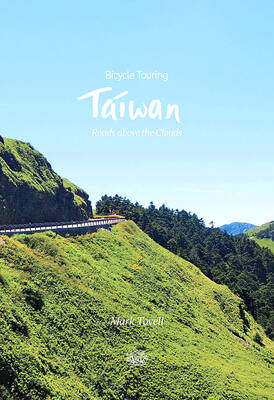
It’s hard to know where to begin with Mark Tovell’s Taiwan: Roads Above the Clouds. Having published a travelogue myself, as well as having contributed to several guidebooks, at first glance Tovell’s book appears to inhabit a middle ground — the kind of hard-to-sell nowheresville publishers detest. Leaf through the pages and you’ll find them suffuse with the purple prose best associated with travel literature: “When the sun is low on a warm, clear morning, and with the heat already rising, we stand at the riverside bike path leading south from Sanxia’s old cobble streets.” Hardly the stuff of your

Located down a sideroad in old Wanhua District (萬華區), Waley Art (水谷藝術) has an established reputation for curating some of the more provocative indie art exhibitions in Taipei. And this month is no exception. Beyond the innocuous facade of a shophouse, the full three stories of the gallery space (including the basement) have been taken over by photographs, installation videos and abstract images courtesy of two creatives who hail from the opposite ends of the earth, Taiwan’s Hsu Yi-ting (許懿婷) and Germany’s Benjamin Janzen. “In 2019, I had an art residency in Europe,” Hsu says. “I met Benjamin in the lobby


 RSS
RSS